


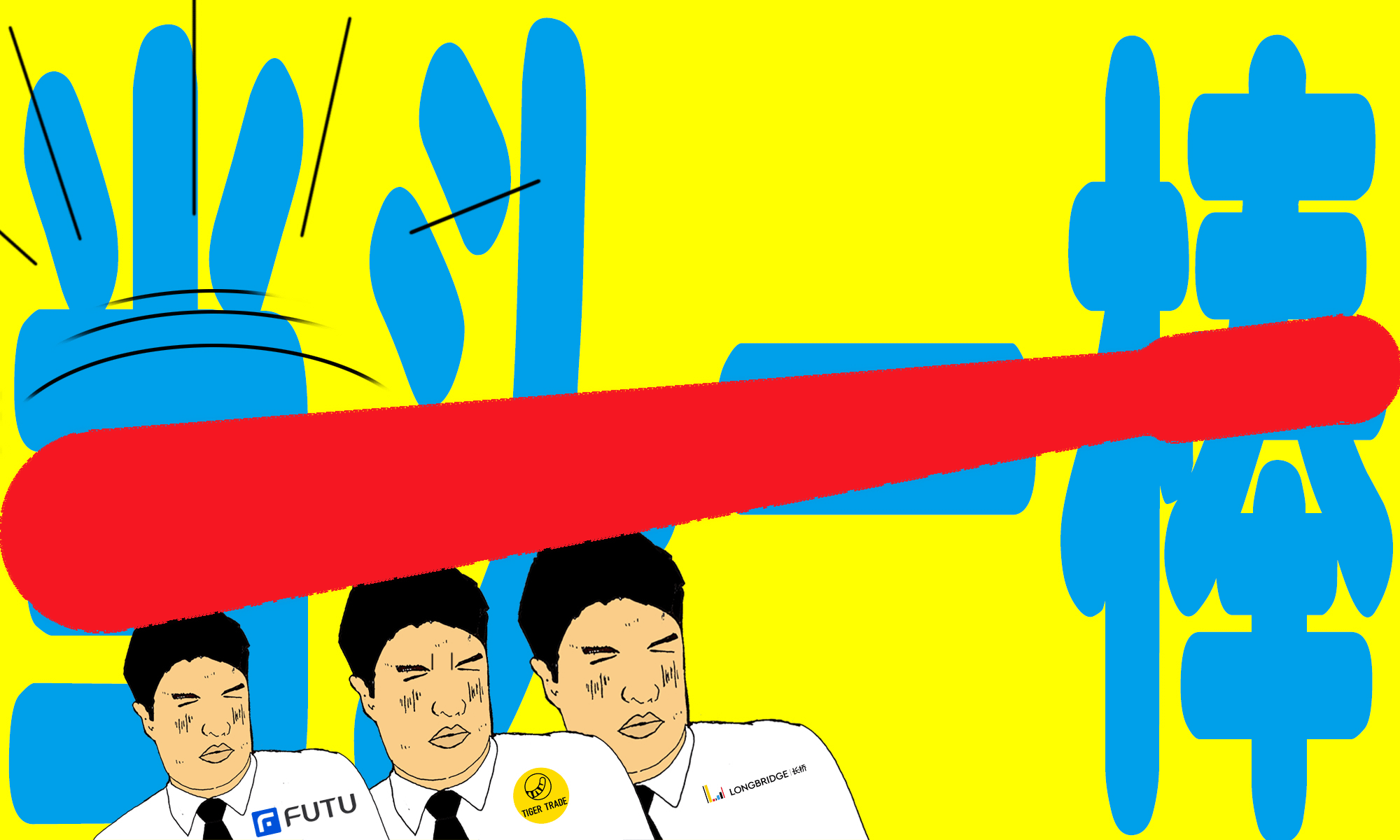
Our phrase of the week is: “a crushing blow” (当头一棒 dāng tóu yí bàng)
Context
On May 22, the China Securities Regulatory Commission launched investigations into three of the country’s largest internet brokerages — Futu (富途), Tiger Trade (老虎) and Longbridge (长桥).
All three were also hit with fines totalling 2.3 billion yuan (around $320 million dollars).
These online brokerages allow mainland Chinese retail investors to trade overseas stocks, including Hong Kong and US-listed shares, directly and easily via an app. This is something that is otherwise tightly restricted inside China, with the likes of Futu operating in what is often described as a “grey area” (灰色地带).
On the same day as the CSRC announcement, Hong Kong introduced the toughest cross-border account-opening rules in its history, making it much harder for mainlanders to open bank accounts in the jurisdiction.
This pressure on brokerages is also concerning the millions of Chinese who have invested their hard-earned cash into them, as one commentator put it:
This regulatory storm also dealt a crushing blow to the mainland retail investors.
这次监管风暴,对内地散户也是当头一棒。
And with that, we have our Sinica Phrase of the Week.
What it means
“A crushing blow” (当头一棒 dāng tóu yí bàng) is a classical Chinese idiom. The individual characters mean: “right at” (当), “head” (头), “one” (一), “club” (棒) — literally, a club brought down straight on the head.
The phrase comes from the Compendium of the Five Lamps (五灯会元), a major collection of Chan — or Zen (禅宗) — Buddhist lineage records compiled around 1252 by the Song-dynasty monk Puji, (释普济).
The work gathers the biographies and sayings of generations of Chan masters, and is one of the defining records of the tradition.
The idiom appears in the section on Linji Yixuan (临济义玄), the Tang-dynasty master who died in 866. He gave his name to the Linji school of Chan Buddhism, which is the lineage that became Rinzai Zen in Japan.
Linji was known for a deliberately jarring teaching style, designed to jolt students out of intellectual hair-splitting and into a sudden awakening.
In the passage, a monk puts a lofty question to him:
A monk asked, “What is the great meaning of the Buddha’s teaching?”
The master raised his fly-whisk; the monk gave a shout; the master shouted back.
As the monk hesitated, the master struck him.
上堂,僧问:”如何是佛法大意?”
师亦竖拂子,僧便喝,师亦喝。僧拟议,师便打。
In Chan practice, a sudden shout or a blow from the master’s whisk, which is known together as “stick and shout” (棒喝 bàng hè), was meant to short-circuit rational thought and shock a student into thinking differently.
This story eventually became the four-character idiom, “a crushing blow” (当头一棒), which everyone in China with a high school education will know about.
Over the centuries the phrase moved out of the monastery and into everyday language. It appears, for instance, in the Qing-dynasty (1644–1912) novel Flowers in the Mirror (镜花缘) by Li Ruzhen (李汝珍):
Although the joke is only told in jest, to those who are ignorant and self-opinionated, it serves as a crushing blow that might just jolt them awake.
这个笑话虽是斗趣,若教愚而好自用的听了,却是当头一棒,真可猛然唤醒。
It recurs through later writers too, including Lu Xun (鲁迅), modern China’s most influential author.
In contemporary Chinese, “a crushing blow” carries two linked senses. It can mean a sudden, unexpected blow that comes out of nowhere. And, keeping to its Buddhist roots, it can also mean a sharp warning that forces someone to wake up to reality.
For the 5 million mainland investors who poured their money into offshore brokerages, China’s crackdown on those companies is both at once: a sudden financial shock, and a hard lesson in how fast the rules can change.
Andrew Methven is the author of RealTime Mandarin, a resource which helps you bridge the gap to real-world fluency in Mandarin, stay informed about China, and communicate with confidence—all through weekly immersion in real news. Subscribe for free here.
