


This article was translated from the original German and was first published on the Limen China Substack.
China in the fall of 2026. In the first nine months of the year, the country invested just over 20 percent less in real estate development than it did in the same period a year earlier. Construction firms and their suppliers have fewer orders as a result.
Local governments are bringing in less revenue from granting land use rights, while still having to service the debts they took on during the boom.
Household consumption expenditures rose 2.7 percent per capita in real terms over the same period.
Who in China can step up spending now that residential construction is likely to contribute substantially less to growth for the foreseeable future? Does the country need a new growth model?
In September, the International Monetary Fund (IMF) published Toward a New Economic Growth Model for China. We follow the authors in asking what is holding Chinese households back from spending and how greater competition could open up new opportunities for investment. The question also leads us to local governments. They pay for many of the public services that households are meant to be able to rely on more in the future. For that to happen, local governments need to regain the financial capacity to act.
Things get interesting when we look at what Chinese economists take from the IMF’s diagnosis and recommendations. They discuss which public investments China still needs, who should pay for them, and how more income can reach households.
For Europe, the debate matters in part because where the money goes will determine where new demand emerges in China. For European policymakers and businesses, the question is which of those markets are actually open to them.

What Will Drive China’s Growth?
On September 30, 2026, the IMF published Toward a New Economic Growth Model for China. In eleven chapters, the authors examine how China can continue to raise living standards as additional investment earns lower returns on average and the population of working age shrinks. The volume appeared in the first year of China’s new Five Year Plan, which seeks to strengthen household consumption. The authors take up a challenge Beijing has set for itself and develop an agenda that ranges from social protection to insolvency law.
The editors, Thomas Helbling, Sonali Jain-Chandra, Siddharth Kothari, and Krishna Srinivasan, bring years of experience working on China at the IMF. The volume draws on regular consultations with the Chinese authorities and on technical collaboration. China’s central bank and Ministry of Finance commented on the manuscript. The recommendations reflect the authors’ judgments. Previous IMF reports have also met with pushback in China.
The report describes China’s economy as resilient since the property market correction began in 2021. Investment in advanced technology and green industries, together with rising exports, has offset part of the decline in residential construction.
“Yet China’s remarkable economic expansion has also been accompanied by rising constraints and vulnerabilities.”
Domestic demand has remained weak in recent years. Falling property prices erode the wealth of many households and weigh on their confidence in the economy. Weak social protection further encourages them to set aside money for harder times.
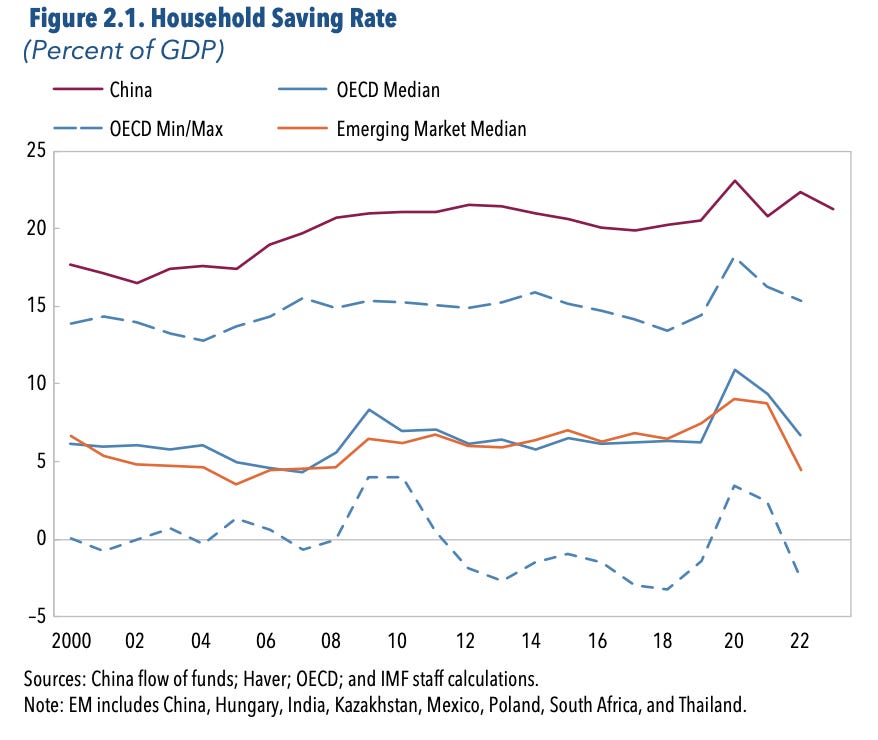
China’s household saving as a share of gross domestic product (GDP) is well above the median for members of the Organisation for Economic Co-operation and Development (OECD). IMF, Figure 2.1, p. 36.
At the same time, local governments took in less from granting land use rights, one of their main sources of revenue. They still had to service debts incurred during the construction boom. With an aging population and slower urbanization, the authors expect the need for new housing to diminish over the long term. The economy thus loses part of the demand that sustained construction and its suppliers for years.
Local governments own revenues fell from an average of 17.9 percent of GDP in 2010–19 to 13.6 percent in 2023–24. Transfers from Beijing stayed nearly unchanged as a share of GDP. Annual net borrowing, inside and outside public budgets, rose from 7.2 to 8 percent of GDP.
The report shows why China needs a new growth model after the property boom. Households need confidence in their economic future to spend more of their income. Local governments need reliable revenue to finance public services. Businesses need new orders beyond the property sector.
The authors propose a new growth model based on stronger household consumption, a larger contribution from services, and higher productivity.
“Ultimately, boosting consumption in China will entail structural transformation […]”
Specifically, the authors recommend higher social benefits and better access to public services where people actually live. People who can count on support when they get sick or grow old need to set aside less of their current income to cover those risks. To help turn the additional demand into more jobs and economic activity, the editors want to make it easier to enter markets such as health care and telecommunications and to remove barriers between provinces.
Greater competition between private firms and those owned by the state and more targeted industrial support that is recorded in the budget would help direct labor and capital where they can generate higher returns.
Public finances also need reform. The authors propose shifting public funds from investments with low returns to social protection and giving local governments more reliable recurring revenue. They also explain how the debts of nonviable financing vehicles could be restructured. When assessing local government performance, they would give more weight to employment, debt sustainability, and the quality of public services alongside growth.
What Keeps China’s Households From Spending?
People who expect to pay a substantial share of an expensive medical bill themselves put money aside. The same is true if their pension will barely cover living expenses. In Chapter 2 of the volume, Yizhi Xu and Fan Zhang examine where this kind of precautionary saving is most pronounced and how public provision affects saving.
They find the clearest relationship in rural areas. There, higher public spending on health care and social protection is associated with lower saving rates. In cities, the relationship is considerably weaker in their analysis. That finding helps Xu and Zhang identify where additional spending should go.
“[…] reduce precautionary saving motives among rural households […]”
The proposal is chiefly relevant to households that pay a large share of their medical expenses out of pocket or have limited pension entitlements. Yongquan Cao and Daniel Garcia-Macia illustrate what such a reform might look like in the chapter on public finances. In their model, doubling benefits under the resident pension system could raise rural household consumption by about 4 percent. They estimate the additional cost in 2050 at 0.6 percent of GDP.
In major cities, another question is who can use existing services. Many people have moved from the countryside to find work in the cities. Their hukou, or household registration, often remains where they came from. We see what this means for families in China. When parents struggle to find a school place for their children where they work, the children often stay with their grandparents and attend school back home. Parents can also face limited access to health care where they work.
Xu and Zhang estimate that the saving rate of city households with urban registration was about seven percentage points lower than that of city households with rural registration. The estimate accounts for pension coverage and other household characteristics, among other factors. The authors recommend easing registration in major cities and making social benefits more accessible where people actually live.
“Social spending targeted to rural households should therefore be a priority, given the fiscal constraints facing local governments.”
The property market correction has added to the uncertainty. Falling home prices erode the wealth of many homeowners. Buyers who purchased a home before it was completed also face the risk that a troubled developer will never deliver it. The chapter refers to a proposal to use central government funds to finish homes that have already been sold and to speed the exit of nonviable developers.
Another proposal in the chapter on public finances focuses on households’ current income. The authors want to lower social insurance contributions and make income taxes more progressive. Refundable tax credits could reach households whose earnings are too low to owe income tax. The authors also want to improve unemployment insurance for migrant workers. To finance pensions over the long run, they examine a scenario in which the retirement age rises to 65 for both men and women by 2040.
“Coverage for migrant workers and informal employees is still inadequate, despite their substantial contributions to economic activity.”
The report identifies two ways to increase consumption. Better protection reduces how much families need to put away for hard times. Higher net income increases what they have available to spend today.
Why China’s Innovators Need More Competition
As Chinese households spend more, a larger share of the additional demand could go to services. The IMF authors see an opportunity for jobs and growth. Natalija Novta, Yizhi Xu, and Robert Zymek show that services now account for more than half of China’s value added. Their share is usually higher in countries with comparable per capita incomes. Sectors such as information technology, financial services, and transportation have already helped raise productivity in China. The authors see room for further growth because barriers to entry make it harder for new providers to attract customers and expand beyond their home province.
“Declining allocative efficiency means that capital and labor are increasingly concentrated in unproductive firms because of a variety of frictions.”
In Chapter 4, Daniel Garcia-Macia and Siddharth Kothari examine how government policy affects the allocation of capital. They add up direct subsidies, tax breaks, subsidized credit, and land made available at prices below market value. The estimated value of this support was about 4 percent of GDP a year from 2013 to 2023. Much of it went to industry. In their model, the associated misallocation of labor and capital reduces the level of overall productivity by about 1.2 percent compared with a scenario without that support.
“Misallocation generated by industrial policies explains a nonnegligible share of overall misallocation in China.”
Looking at individual firms helps explain why higher research spending alone tells us little about productivity across the economy. In Chapter 5, Marshall Mills and his coauthors document that productivity growth has slowed markedly since 2007 even as China spends more on research and files more patents. They summarize how the opportunities for young firms have changed as follows.
“The reallocation of resources from older, less productive firms toward younger, more productive firms has slowed.”
The question, then, is how innovations come into wider use. A young firm might develop a process that uses less material. To deploy that process at scale, it needs financing and access to customers. The IMF researchers find that young firms’ growth advantage has narrowed, while firms owned by the state still enjoy more favorable credit terms on average.
The authors recommend several measures to raise productivity and reduce misallocation in China.
Open Service Markets Across Provinces
The authors of Chapter 3 recommend lowering licensing barriers, easing trade in services, and continuing to reform enterprises owned by the state in these markets. Providers should be able to offer their services in other provinces more easily. Opening markets to foreign providers and giving workers more mobility would further strengthen competition. That would allow more productive providers to expand as demand for their services grows.
Set a Tighter Test for Industrial Support
Garcia-Macia and Kothari recommend reducing the scale of industrial support. They set a narrow test for the support that remains.
“[…] only to address well-defined market failures […]”
One such case arises when research benefits other firms and the firm doing the research can capture only part of that benefit through its own revenues. Where support is justified, the authors prefer funding explicitly allocated in the budget. That makes costs and recipients easier to identify than with subsidized credit or regulatory advantages.
Make It Easier for Young Firms to Grow
Mills and his coauthors propose comparable terms for private firms and those owned by the state when seeking credit, land, and public contracts. More equity capital would give young firms additional financing options. To support innovation, the authors favor publicly funded basic research, grants in the early stages of development, and research tax incentives that firms across industries can use.
A dynamic business sector also requires a way for persistently unprofitable firms to exit in an orderly fashion. That frees up workers and capital for other businesses. Better unemployment insurance and more effective job placement services would ease the impact on workers who lose their jobs in the process.
Who Can Get China’s Local Governments Out of the Debt Trap?
China’s local governments account for about 85 percent of public spending. Before transfers from Beijing, they receive about half of government revenues. This division dates to the 1994 tax reform, which concentrated a larger share of revenue at the central level. As Yongquan Cao and Daniel Garcia-Macia explain in Chapter 7, transfers from Beijing close much of the gap. To meet their obligations and politically mandated growth targets, local governments also turned to proceeds from land use rights and borrowing outside their budgets.
To do so, they established local government financing vehicles (LGFVs) to finance projects such as roads and the development of land for construction. Banks and investors often assumed that the local government would step in if necessary. The authors of Chapter 8 estimate that in 2024, official local government debt and the liabilities of these vehicles together exceeded 80 percent of China’s GDP. The property market correction of recent years has put this financing model under considerable pressure. Proceeds from land use rights have fallen. Many of the vehicles generate too little revenue to service their loans from their own resources. The debt swaps launched since 2024 have reduced interest costs and bought local governments time.
In the view of Yingyuan Chen, Daniel Garcia-Macia, and Henry Hoyle, how additional funds from Beijing are used depends on what happens to the legacy debt.
“Without insolvency-driven debt restructuring, local governments might use additional financial resources from the central government to cover the costs of unsustainable off-budget debt […]”
If more transfers go toward debt service, local governments will still be short of funds for public services. A debt write-down carries risks of its own. As Yingyuan Chen and his coauthors show, smaller banks whose lending is concentrated in a single region are particularly vulnerable. The property market correction is already weighing on the quality of their loan portfolios. Falling profits make it harder for them to absorb further losses.
The authors propose several steps.
Give Local Governments More Reliable Revenue
The authors propose giving local governments a larger share of government revenues and designing transfers from Beijing to better cushion regional revenue shortfalls. Once the housing market stabilizes, a nationwide recurrent property tax could also provide a more reliable source of local revenue.
Base New Borrowing on the Capacity to Repay
Beijing should monitor local government finances using more complete and timely data, including the liabilities of their financing vehicles. The authors recommend clear rules for new borrowing both inside and outside public budgets. Approval should give more weight to how much debt a local government can service from its revenues. The authors would tie any additional assistance to maintain public services during restructuring to verifiable targets for deficits and debt reduction.
Shift Spending From Construction to Social Protection
The authors propose spending less on public investment with low returns and on industrial support. That would free up room in public budgets for pensions, health care, and unemployment insurance.
Prepare Banks for Losses
Before restructuring the financing vehicles, authorities should identify which banks would take losses from a debt write-down and how large those losses could be. Chapter 10 recommends targeted stress tests and supervision that pays closer attention to the risks at individual banks. For crises, the authors propose designating a lead resolution authority and establishing a process by which the central bank can provide temporary liquidity.
Make the Policy Rate the Main Instrument
Chris Redl and his coauthors recommend making price stability the central bank’s explicit primary objective. Credit growth targets and programs that channel credit to particular industries would play a smaller role. The authors point to the implications for how banks assess loans.
“Aggregate credit targets also risk weakening banks’ prudential standards and distorting efficient capital allocation.”
A bank required to hit a credit growth target can come under pressure to make loans even when it doubts they will be repaid. Relying more on the policy rate gives banks greater scope to make that assessment.
What Insolvency Proceedings Can Do
Jose M. Garrido examines how China can restructure viable firms earlier and wind down persistently unprofitable firms in an orderly manner. For local government financing vehicles, these proceedings can establish which assets can remain in use and who bears the losses.
Garrido discusses the draft reform of corporate insolvency law released for consultation in September 2025. A revised draft was considered at a second reading in August 2026. Garrido welcomes clearer rules for new lending during a restructuring and recommends giving the ranking of creditors’ claims greater weight in the courts’ approval of restructuring plans. For proceedings to work with large developers and complex financing vehicles, he sees a need for greater expertise in the courts and more consistent standards for insolvency administrators.
“China Needs Reform, but Not the IMF’s Prescription”
The authors propose relieving China’s local governments of legacy debt and freeing up funds for social protection by cutting spending on investments with low returns. It is worth seeing how Chinese economists assess these proposals. We look at two pieces by Zhang Ming, deputy director of the Institute of World Economics and Politics at the Chinese Academy of Social Sciences.
In China Needs Reform, but Not the IMF’s Prescription, Zhang recognizes the IMF’s strength in economic analysis and shares much of its diagnosis. He sees weak domestic consumption, slower productivity growth, and strained local government finances as problems that China’s economic policymakers need to address.
His objection is to the objective he sees behind the recommendations. Zhang reads them as expecting China to remake its economy in the image of mature Western economies.
“Why must China move towards a standardised model of a mature economy?”
Zhang supports more consumption, stronger social protection, and a larger service sector. He wants China’s stage of development and its industrial policy priorities to guide the transition.
In his October piece, Zhang already proposes making the award of industrial support more competitive and assessing public investment more closely on its merits. He explains how he would reduce legacy debt and overhaul local government financing in a forum contribution published on November 9. He starts with what he sees as the most pressing challenge, weak domestic demand.
On legacy debt, Zhang would begin by examining what the local financing vehicles borrowed for. Where they financed public functions, local governments, the vehicles, and creditors should negotiate lower interest rates and longer maturities. A further debt swap could then be considered for those loans. In his view, liabilities from projects that generate sufficient revenue of their own can be dealt with on market terms.
Zhang would apply debt limits flexibly during periods of weak demand and tighten them again as the economy recovers. If local governments cut spending too quickly, economic output can suffer enough for the debt ratio to rise despite the savings. In his view, more help from Beijing with legacy debt depends on new rules to prevent another wave of borrowing.
Zhang would also redistribute responsibilities and revenues between Beijing and local governments. The central government should finance projects that serve a purely public purpose and generate little revenue by issuing government bonds, preferably without contributions from local governments. State development banks could finance projects that cover part of their own costs. Commercially viable projects can draw on commercial banks, project bonds, or private investors. When assessing local officials, he would look at growth, what they take on new debt for, and the economic and social benefits of the projects.
Zhang uses local governments’ unpaid bills to show how putting their finances in order can strengthen domestic demand. When cities and municipalities resume paying contractors reliably, businesses have more room for wages and investment. That is how relief for public budgets can reach private households as well.
How Can China Get Demand Moving Again?
Zhang Ming has described how Beijing might ease the pressure on local governments and finance public responsibilities in the future. China’s debate over weak domestic demand now centers on where the additional spending should start. Can public contracts generate new income quickly enough? Or do households need more purchasing power before firms have a reason to invest again?
In an article for the China Economic Times, Zhang Bin, deputy director at the same institute as Zhang Ming, takes up the argument of the economist Yu Yongding. The English translation appeared under the title Zhang Bin: China still needs more investment.
“[…] investment is the cause and consumption the effect.”
The government can commission renovations of residential buildings or upgrades of deteriorating utility networks even when firms and households are holding back on spending. The contracts create jobs and income that can lead to additional consumption. In Yu’s reading of the new Five Year Plan, more of the money should come from the central budget. In the November report of the China Finance 40 Forum, Zhang Bin and his coauthors recommend using the additional borrowing capacity already authorized for local governments for projects including underground utility networks, and lowering financing costs.
Cai Fang, a labor economist and former vice president of the Chinese Academy of Social Sciences, focuses on income from work. In China’s consumption problem is an income distribution problem, he calls for improving access to employment, explicitly banning age discrimination in hiring, and reducing income disparities through taxes and public benefits. The English version of his December 2025 speech appeared in January 2026.
Liu Shijin, former deputy head of the Development Research Center of China’s State Council, turns this idea into a proposal for economic stimulus. In Liu Shijin’s Proposals to Turn Excess Saving into Domestic Demand, he argues for directing more than half of stimulus funds toward demand, chiefly through social protection for households with low and middle incomes. Higher basic pensions for urban and rural residents would be financed in part from returns on the state’s corporate shareholdings. In his view, once households spend more and firms make better use of existing capacity, new investment becomes worthwhile again.
For an immediate boost, Zhang Bin and Yu Yongding look to public contracts that create jobs and income. Liu Shijin wants to raise household purchasing power so businesses can make better use of their existing capacity and start investing again.
Taken together, these selected voices show what we see as China’s skepticism toward boosting consumption through higher social benefits and redistribution organized by the state. European welfare states are showing how countries can find themselves in fiscal dead ends as the reach of a publicly administered welfare system grows ever wider. China’s leadership has long been rather skeptical of adopting that approach at home, even as individual voices occasionally call for more generous benefits.
In our view, the decisive difference is where the first impulse should come from. Zhang Bin and Yu Yongding favor public contracts that create jobs and income. Liu Shijin wants to increase household purchasing power so businesses can make better use of existing capacity and start investing again.
For Europe, it matters whether the additional spending first reaches construction firms or private households.
What Europe Stands to Gain From Stronger Chinese Purchasing Power
Europe has an interest in seeing Chinese households able to spend more. If China finds buyers at home for more of what it produces, the pressure to sell additional output abroad may ease.
Access to China’s domestic market therefore belongs on Brussels’s trade policy agenda with Beijing. In services in particular, licensing and local regulations will determine whether European providers can share in growing demand.
European firms have good reason to look at who gains purchasing power. Rising rural pensions reshape different markets from those affected by higher incomes in major cities.
Anyone making investment decisions in China today should have a very concrete idea of who their next customers might be.
Last Chance to Join the China Strategy Lab in Berlin
Which assumptions about China underpin your investment decisions for 2027? At the China Strategy Lab, we will work with you to assess what recent developments mean for your business in China, your position in Germany, Austria, and Switzerland, and competition in third markets. You will identify which decisions you need to prepare for and which assumptions you still need to test.
Together with 365 Sherpas BPI, we invite you to join us at Schlesische Straße 26 in Berlin on December 16, 2026, from 9:00 a.m. to 2:30 p.m. We will work in German in a small group.
