



In a March 30 Sinology I wrote that the Chinese economy is likely at an inflection point, with Beijing’s policy pendulum slowly swinging back towards supporting entrepreneurs and growth and away from a focus on regulatory control. After Trump’s visit the U.S.-China relationship may also be at an inflection point, reducing the political risk for investors and corporates. Trump on Sunday embraced Xi’s new framing of “a constructive relationship of strategic stability.” Does this signal Trump will turn pragmatic on China?
Trump’s Happy Road Trip
Trump got what he wanted out of his China road trip: good visuals and self-proclaimed trade and investment deals.
He came home happy: “An incredible visit . . . very historic . . . an amazing time.”
Trump continues to be a Xi Jinping fanboy: “He’s a man I respect greatly. We’ve become really friendly.” And Trump bestowed one of his top honors on Xi: “I say about him that if you went to Hollywood and looked for a leader of China to play a role in a movie — central casting. You couldn’t find a guy like him.”
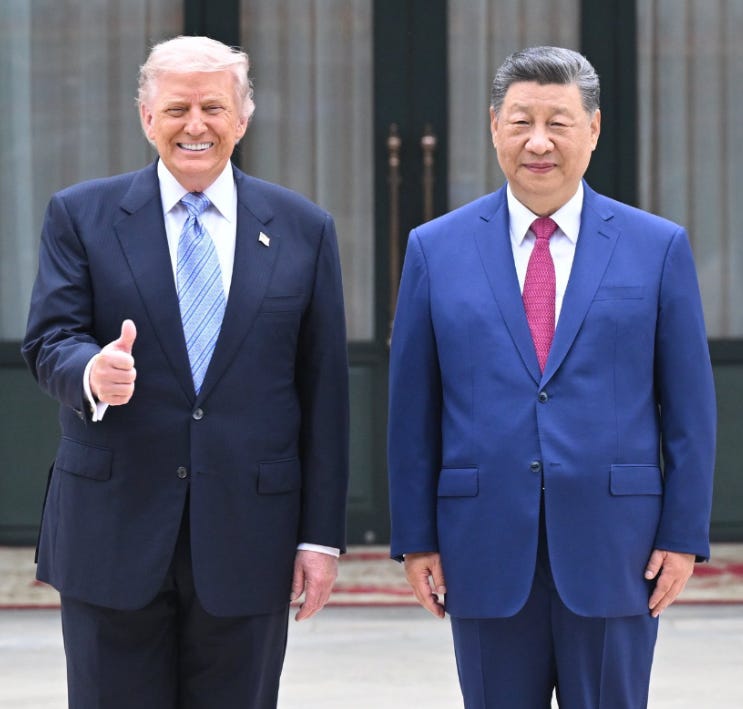
Asked to name his visit’s top achievement, Trump said, “I think the most important thing is relationship. It’s all about relationship.”
Quite a change from a decade ago when Trump said, “We can’t continue to allow China to rape our country, and that’s what they are doing.”
Trump also claimed great substantive successes: “We’ve made some fantastic trade deals, great for both countries. . . he’s [Xi] gonna order 200 jets . . . big ones. That’s a lot of jobs . . . We’re going to start sending Chinese ships to Texas and to Louisiana and to Alaska” to sell American oil.
“It’s a very positive thing to have these two nations getting along,” Trump declared.
What Does Trump Really Want?
It is difficult to know what Trump’s goals for U.S.-China relations really are. During the 16 months he has been in office this time, he has consistently spoken in positive, constructive terms about his personal relationship with Xi. At the same time, however, his administration has taken many steps — tariffs, export controls on tech, limits on outbound investment, blocking imports of Chinese EVs, and sanctions on oil refiners — which have disrupted the bilateral relationship and created a hostile environment for American investors and companies that might want to work with Chinese companies.
So, what comes next? More of the same, with Trump speaking softly about Xi while all the president’s men wield big sticks of anti-China trade and investment measures? Or will it be different following Trump’s happy road trip? Will Trump take a newly pragmatic approach to China?
While I don’t claim any special insights into how Trump thinks, there are a few things we can observe.
First, Trump is clearly focused on Republicans winning the midterm elections in November, to retain control of both the House and Senate. “We’ve got to win the midterms,” Trump said earlier this year, because losing “would lead to very bad things,” especially non-stop hearings, subpoenas and investigations by Democrats.
Second, Trump appears to believe that stronger ties with China will boost Republican chances in November. Maybe this explains why he was so determined to make the trip to Beijing despite his ongoing war in Iran, and why he was unusually self-restrained during his brief visit. (He made very few public comments and social media postings.)
Maybe Trump understands that his tariffs are creating hardships for many of his supporters, from consumers to small businesses, farmers and ranchers, and he sees a path to electoral victory by promising relief via better relations with Beijing.
Trump’s tariffs have not only raised prices for Americans, retaliation by Beijing has also meant that in the first four months of the year, China’s imports from the US fell 11% YoY while Chinese imports from the rest of the world rose 26%.
U.S. agricultural exports were especially hard hit, creating a significant political problem for Republicans. In normal times, one in three rows of soybeans grown by US farmers is exported to China, but those shipments fell sharply after Trump’s “liberation day” tariffs were launched. China has been a key market for U.S. beef, but that trade has largely been shut down.
China joined the WTO at the end of 2001, and in that year U.S. agricultural exports to the PRC were worth just under 2 billion dollars. That ballooned to a peak of 38 billion dollars in 2022 but collapsed to only 8 billion dollars last year.
Farmers and ranchers are an important political constituency for Trump and Republicans, but a recent poll found half of them reporting only fair to poor finances and as a result four in 10 said they were undecided or considering voting for a different party in the midterms.
After his road trip Trump said that China has agreed to resume buying American farm products: “The farmers are gonna be very happy.”
The thesis that Trump will be more pragmatic with China is, I acknowledge, a stretch, given his track record. But why would Trump bring some of America’s most high-profile corporate leaders — Elon, Jensen and Tim Apple — along for his road trip if he doesn’t plan to support them doing business with China?
According to Trump, “China’s going to invest hundreds of billions of dollars with those people that were in that room today. That’s why they came.”
Did Trump bring some of his administration’s top China hawks — Rubio, Hegseth and Stephen Miller —to Beijing to make clear that he doesn’t want them to continue disrupting his relationship with Xi?
What Does Xi Really Want?
If Trump does want to repair the bilateral relationship, will Xi cooperate?
Xi seemed happy with the road trip, saying it was “a historic and landmark visit.”
Xi was keen enough to make Trump happy that he asked the PLA military band to play Trump’s favorite song, YMCA, at the state banquet.
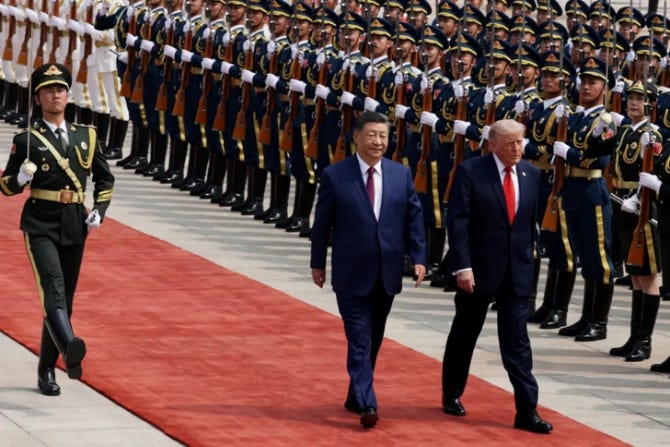
Chinese officials issued carefully worded statements that agreements were reached on tariffs, agricultural exports, sales of airplanes and engines, as well as the establishment of bilateral groups to manage trade and investment. But they provided no details, making clear that Beijing is waiting to see what Trump’s next steps will be before they actually approve those deals.
China’s commerce department said that “both sides are still discussing the details of the outcomes” of the talks.
Foreign Minister Wang Yi said, “The working teams of the two sides are still negotiating the relevant details and will lock in the outcomes as soon as possible and work together to implement them.”
It is safe to assume that if the Trump administration resumes trying to slow China’s economic growth with export controls on tech, Beijing will not reopen its markets to the goods that Washington would like to sell, like soybeans, beef and Boeings.
Taiwan, Iran and Cyber Seem Manageable
Trump suggested that he has found a way to manage some of the more contentious issues in the bilateral relationship.
On Taiwan, Trump said Xi “doesn’t want to see a war.” This is consistent with a March statement by the US intelligence community that it “assesses that Chinese leaders do not currently plan to execute an invasion of Taiwan in 2027, nor do they have a fixed timeline for achieving unification.”
As I expected, there were no indications that Xi pressed Trump to change US policy on Taiwan. Foreign Minister Wang Yi said that “during the meeting, we felt that the US understands China’s position” on Taiwan.
On Iran, Trump said he wasn’t “asking for any favors” from China, and he didn’t publicly criticize Beijing for continuing to buy Iranian oil.
Asked if he spoke with Xi about cyber attacks in the U.S., Trump said, “I did. And he talked about attacks we did in China. You know, what they do, we do too. We spy like hell on them too. I told him, ‘We do a lot of stuff to you that you don’t know about.’”
None of these issues are likely to be obstacles to better bilateral relations, if that is where Trump wants to go.
Pressure Drop
Between now and November, Trump will be under pressure to deliver on what a White House fact sheet published Sunday calls “a sweeping package of commitments [by China] that will drive high-paying American jobs and open new markets for US goods.”
Remember that Beijing has yet to publicly confirm any of the specific trade commitments announced by Washington. As was the case after the last Trump-Xi meeting, when Beijing never openly acknowledged any deals claimed by Trump, the Chinese are keeping their options open to press the president to deliver on what they want, especially a reduction in tech export controls.
Xi has accepted Trump’s invitation to visit the U.S. in September — another opportunity for great visuals ahead of the midterms — which is another pressure point. If Trump allows his hawks to continue tightening export controls and sanctions, Xi would likely cancel his trip.
Oddly, two other contentious issues in the bilateral economic relationship appear to have been sidestepped during the Beijing summit. But they cannot be ignored in the coming months.
According to U.S. Trade Representative Jamieson Greer, the two leaders did not discuss export controls on semiconductors. [Although Reuters last week reported that the Trump administration “has cleared about 10 Chinese firms to buy Nvidia’s second-most powerful AI chip, the H200.”]
And while Trump was in Beijing, neither side mentioned last year’s hottest trade topic, rare earth elements and other critical minerals. In Sunday’s fact sheet, the White House simply claimed that “China will address U.S. concerns regarding supply chain shortages related to rare earths and other critical minerals.” Trump must recognize that this remains a key point of leverage for Xi, adding to pressure for the U.S. to relax its efforts to slow China’s technological development.
Odds Of A Political Inflection Point
While I do not think investors and corporates should count on Trump fully reining in his hawks and putting the bilateral relationship on a constructive path (to the benefit of American consumers and companies), I do think investors and firms should be prepared for this possibility.
Trump may well decide that this will help Republicans keep control of the House in November, leading him to be pragmatic on China.
It is significant that Sunday’s White House fact sheet opens with Trump accepting Xi’s new framing of U.S.-China relations as one based on “a constructive relationship of strategic stability.” Does this nod to the slogan that Xi introduced last week set the stage for policy changes in Washington?
If it does, an inflection point in the bilateral political relationship that coincides with a gradual recovery of China’s domestic economy would be a welcome opportunity. Stability in U.S.-China relations would also accelerate the return of the Chinese consumer that I wrote about in the January 8 Sinology.
