


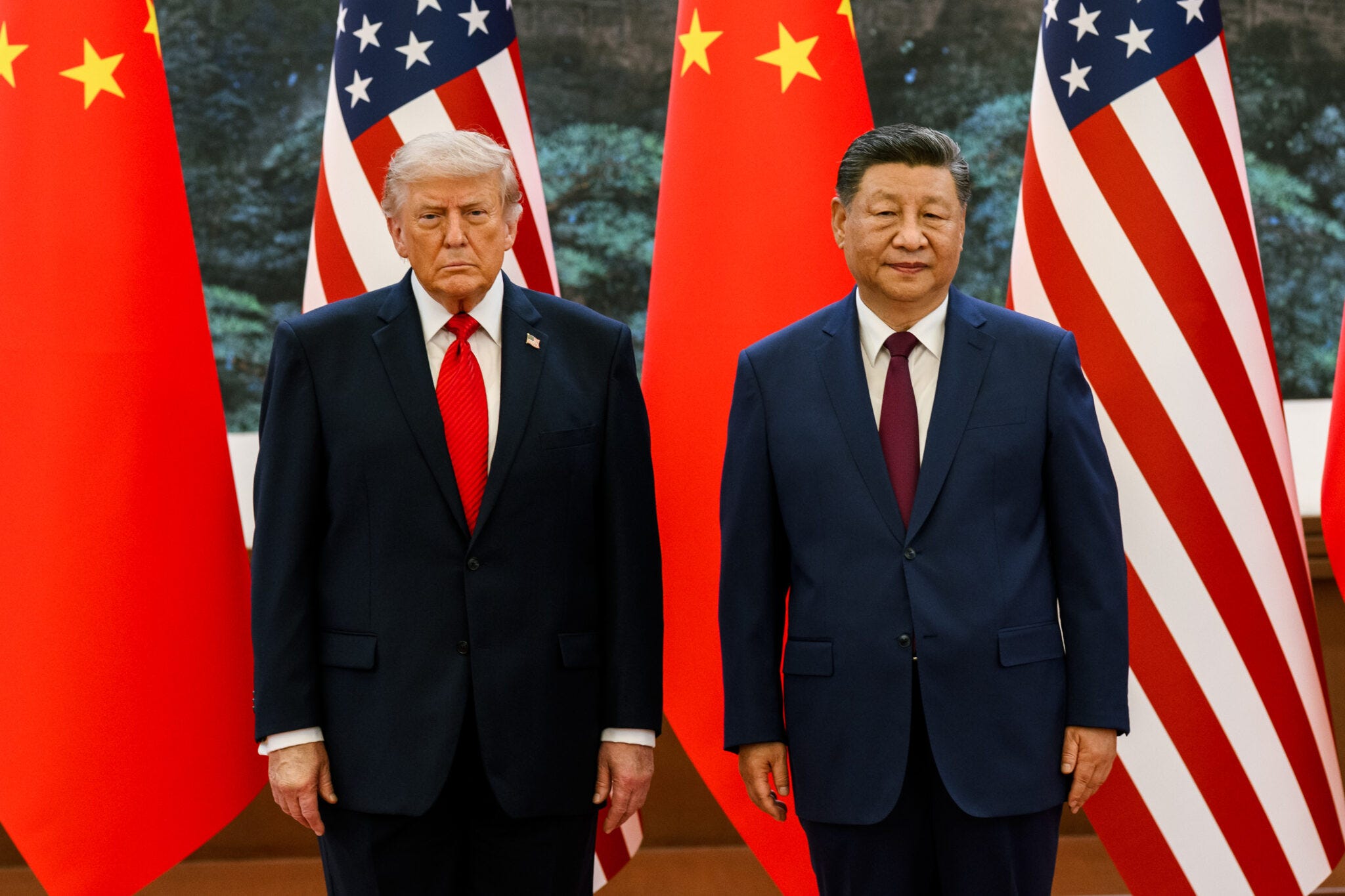
Following the Trump-Xi summit, the Institute for America, China, and the Future of Global Affairs (ACF) shared this assessments from ACF affiliates and China experts across Johns Hopkins School of Advanced International Studies (SAIS) of what this summit means — and what it leaves open. Republished here on the Sinica Podcast Substack with permission.
On May 14–15, 2026, President Trump visited Beijing, marking the first presidential visit to China in almost a decade. The summit came at a pivotal moment for the world’s most consequential bilateral relationship. The Trump administration began the relationship in 2025 with escalations over tariffs, technology, and rare earths, until a fragile truce was reached in South Korea in October.
The summit, which was delayed almost a month by the U.S. war with Iran, was highly anticipated by analysts, sparking great speculation on what a “deal” could look like between the two leaders.
The essays collected here offer assessments from ACF affiliates and China experts across SAIS of what this summit means — and what it leaves open.
Carla Freeman, Senior Lecturer, International Affairs; Director, Foreign Policy Institute, JHU SAIS
The US-China relationship is high-risk enough that any summit matters, but this one carried particular urgency, with multiple clocks running simultaneously. The Iran war is disrupting global energy flows with economic impacts for both countries. Trump faces November midterms amid rising inflation, needing visible wins while constrained in his ability to impose new tariffs. Xi almost certainly wants to protect signs of new momentum in China’s economy as the 15th Five-Year Plan begins. And both sides recognize intensifying strategic threats, from unprecedented AI security risks to spiking tensions over Taiwan.
Amid these pressures, there were signs of openness to a new footing for the relationship from both leaders — if in characteristically different registers. Trump declared the relationship would be “better than ever.” Xi offered a framework: a “constructive China-U.S. relationship of strategic stability” to provide “strategic guidance for the next three years and beyond.” Many CEOs in Trump’s entourage seemed glad they made the trip, though it is unclear how many deals were actually struck.
One underreported and related detail deserves attention. Although the significance of Hegseth’s presence has been debated in reporting, less attention has been given to the fact that Rubio attended, despite being sanctioned by China. Beijing changed the Chinese transliteration of Rubio’s name when he joined Trump’s cabinet—thus welcoming “Marco Lu” without formally lifting the ban. This removes a constraint on a more multidimensional diplomacy that until now has been led almost entirely by Treasury and other economic officials.
Nevertheless, the deep structural tensions — technology, military competition, values, and Taiwan — remain intact. Xi raised the conflict risks over Taiwan early and publicly. The US readout on the visit did not mention Taiwan. What Xi and Trump and he said about Taiwan privately is a question worth asking.
David M. Lampton, Professor Emeritus, former Hyman Professor and Director of SAIS-China and China Studies, JHU SAIS
Given that this meeting was postponed by an unanticipated war turned into a quagmire; given that the careful planning that usually precedes such a summit did not occur in a distracted Washington; and, given that the U.S. president arrived in Beijing domestically weakened by an eroding domestic circumstance, things could have turned out a lot worse in the just-concluded Trump-Xi meeting. Avoiding the worse, however welcome, is a low bar.
President Xi laid out the goal of working toward “A constructive China-US relationship of strategic stability”, also bluntly warning Washington to “Never mess it up” and cautioning that if the Taiwan issue was “not handled properly” the two sides “will have clashes and even conflicts, putting the entire relationship in great jeopardy.” President Trump’s willingness to discuss with Beijing weapons sales to Taiwan, and his observation that the island is close to China and far from the US, will unsettle Taipei and its friends in America. Otherwise, Trump was tight-lipped on Taiwan, leaving unclear the fate of a next arms sales package to Taipei.
The Chinese have agreed to as yet unspecified agricultural and aircraft purchases, echoing a prior unfulfilled trade agreement going back to the end of the first Trump term. Trump looks set to loosen some export controls on chips. Trump said Xi would be helpful on Iran/Hormuz, something about which the Chinese president was tight-lipped.
The two leaders agreed to meet again in September of this year. Given the unresolved issues, we will see. This summit achieved just enough to keep the process going, for now. How the U.S. and China can develop a durable framework for coexistence remains the great unresolved problem.
Jack Shanahan, Senior Fellow, SAIS ACF; contributing author, ACF Insights
On the technology front, there were few real surprises. The reported agreement allowing roughly ten Chinese technology firms to purchase Nvidia H200 chips leaves far more questions than answers. First, we still have not seen concrete evidence that any sales or deliveries have actually occurred. More importantly, it remains unclear how extensively the Chinese central government will intervene in the process — by determining which firms ultimately receive access to the chips, in what quantities, and on what timeline. I would be deeply surprised if Beijing does not intercede in a substantial way, particularly given its longstanding concerns about strategic dependence on U.S. technology and its ongoing efforts to accelerate indigenous semiconductor development.
Regarding AI more broadly, the summit reinforced how rapidly AI has moved from a secondary issue in the bilateral relationship to a central strategic concern. Public reporting strongly suggests that Anthropic’s recent preview of Mythos’ capabilities heightened interest within the White House and helped elevate AI on the summit agenda. So far, the only meaningful public comments on the topic have come from Treasury Secretary Scott Bessent, who indicated that future bilateral discussions on AI safety and guardrails may focus initially on preventing the most advanced AI models from falling into the hands of nefarious non-state actors. If such talks do materialize, the crucial questions will be when they begin, who leads them, who is included, whether they remain confined to official Track I diplomacy or expand into Track 1.5 and Track II dialogues, and whether the agenda eventually broadens beyond narrow AI safety concerns. Given the current state of the relationship, even limited government-to-government AI discussions will represent a constructive and welcome step.
Andrew Mertha, George and Sadie Hyman Professor of China Studies; Director, China Studies Program; Inaugural Director, SAIS China Research Center at JHU SAIS
The old chestnut that the Chinese traditionally trade substance for symbolism seems to have been reversed, with President Trump feasting on symbolism while seeming unconcerned about countering Beijing’s initial gambits. Perhaps the most important concession so far has been the absence of Taiwan in the first US readout of the Trump-Xi meeting, even as it leads the Chinese one. Even more worrisome is Trump’s apparent violation of the Six Assurances by discussing arms sales to Taiwan directly with Xi. More broadly, in contrast to a US aversion to committing to Chinese frameworks, Trump has seemingly done exactly that: stumbling into Xi’s concept of a “constructive China-US relationship of strategic stability” (中美建设性战备稳定关系), perhaps not fully realizing the full implications of doing so. Whether this is a less optimal outcome for the US than its current ad hoc approach to China remains to be seen, but it certainly signals a change in the bilateral relationship that privileges China on multiple dimensions, moving forward.
Ling Chen, William L. Clayton Chair and Associate Professor, JHU SAIS
The Trump-Xi summit is a stepping stone for the two leaders to engage in short-term, transactional exchanges, such as agriculture exports, chip controls, trade and investment committees, and technology regulation. These are where we are likely to see the most visible results. China plays this card well because it knows Trump’s preference for short-term deals. But China also fundamentally seeks to achieve long-term “constructive strategic stability,” which lays a more favorable foundation for its domestic and international development as its economy slows. This long-term perspective is what the U.S. currently lacks, but is what China prioritizes. In other words, if short-term, incremental deals cannot ultimately change the U.S. positioning of China as its adversary, then the value of these deals would be greatly discounted. However, given geopolitical tensions, deglobalization, and the rise of national security concerns, the summit is unlikely to profoundly alter the equilibrium underlying their relationship and the way that the U.S. and China perceive each other. What it does, for now, is to prevent a catastrophic clash of the two.
Dan Taylor, Senior Fellow, SAIS ACF; contributing author, ACF Insights
From what we can tell so far, the summit outcomes did not alter the underlying equilibrium of the relationship. What happened seems to have been a continuation of the discussions in Busan last year aimed at reducing tensions and finding areas of agreement. Both sides seemed mostly interested in stability in the relationship in a way that makes it increasingly predictable, especially as both look forward to Xi visiting Washington in the Fall.
There don’t appear to have been any “grand bargains” that shifted the two sides into a much closer partnership but there also were no major new points of friction that were exposed. There may be an early test for the relationship soon, however. Xi made a point to emphasize the importance of the Taiwan issue, President Trump seemed to agree on the need to avoid conflict in that area. The question now is whether the discussions between the Presidents over Taiwan arms sales will cause a change to U.S. plans for a potential large arms sale announcement that has been expected since the beginning of the year.
Ho-fung Hung, Henry M. and Elizabeth P. Wiesenfeld Professor in Political Economy, JHU Sociology Department and JHU SAIS; contributing author, ACF Insights
The US readout emphasizes that Xi is against Iran having nuclear weapons and against Iran charging tolls in the Strait of Hormuz. It amounts to China aligning itself with the US’s current goal regarding Iran. Only time will tell how serious this pledge is. Beijing can say these things and allow various Chinese entities to continue aiding Iran’s war efforts financially and logistically in many clandestine ways. After all, Beijing’s policy toward the Middle East will continue to be driven by China’s self-interest in guaranteeing a stable energy supply while enjoying the freedom of action given the US impasse in the Middle East, just as during the Second Iraq War. It would be mistaken to hope that China can contribute significantly to brokering a peace settlement over the Iran war. In 2023, China brokered a normalization agreement between Iran and Saudi Arabia. In light of how things go now, it matters little in retrospect. Washington needs to guard against the temptation of delivering anything concrete regarding Beijing’s demands over Taiwan, which Xi explicitly emphasized as “the most important issue in China-US relations,” in exchange for Beijing’s empty pledge over the Middle East.
Jason Hsu, Senior Fellow, SAIS ACF; contributing author, ACF Insights
What Xi Jinping appeared to seek was not immediate unification, but strategic clarity from Donald Trump on the limits of U.S. support for Taiwan. At the same time, Trump seemed determined to preserve ambiguity and negotiating flexibility rather than make ideological commitments. What deserves more attention is not simply what was said publicly, but the emerging structure underneath the diplomacy: Taiwan is increasingly being folded into a broader “stabilization framework” between Washington and Beijing. That subtly changes the conversation from defending Taiwan on principle to managing Taiwan as a geopolitical risk variable.
I do not think the summit fundamentally alters the equilibrium yet, but it does reveal a shift in how both sides define the relationship. Beijing now sees Taiwan as central to overall bilateral stability, while Washington increasingly views Taiwan through the lens of strategic leverage, economic resilience, and deterrence management. The deeper question nobody is asking yet is this: if Taiwan becomes too strategically indispensable to both powers, does that increase deterrence — or make Taiwan an even bigger bargaining chip during future crises?
John Yasuda, Assistant Professor, JHU Department of Political Science
That the summit produced no significant breakthroughs is unsurprising. Both sides have been too far apart for too long on too many issues for any substantive deal to emerge without one side signaling weakness. Perhaps, given diminished expectations, the mere fact that an off-script tirade by President Trump or one of his coterie did not upend the proceedings is a win in and of itself for US-China relations.
Despite the lack of real progress, this summit was pivotal. Xi appeared to be entirely in command – reiterating China’s red lines on Taiwan, withholding trade concessions, and, most importantly, espousing a new foreign policy concept. His body language – directing where President Trump should walk and sit, the unhurried stroll through Zhongnanhai, and his more reserved composure – gave-off an image of a wise king dealing with a supplicant rather than two equals meeting as peers.
The entire summit seemed to signal that if the United States is willing to return to a more transactional basis for its dealings with China, Beijing is content to let tensions ease. Indeed, the one thing Xi needs is a less confrontational America while he tends to serious challenges at home. Whether Washington fully grasps the asymmetry of the arrangement remains the open question.
Samm Sacks, Senior Fellow, New America; Research Scholar in Law and Senior Fellow, Yale Law School’s Paul Tsai China Center; contributing author, ACF Insights
For many months now, Beijing has understood that President Trump is the most likely President in the near term that would be open to realigning the US-China relationship towards one of accepting coexistence over the existential paradigm that had grown in Washington. The messaging from this summit confirmed their view. The question now is whether Trump can deliver on his intention of creating a new paradigm, or whether hawks in his administration and in Congress will work to scuttle the promise in this new form of engagement. Early signs are ominous. While President Xi plans to send President Trump rose seeds for the White House’s Rose garden (after Trump admired the roses in Zhongnanhai, the secretive governing compound rarely seen by outsiders), American staffers on the trip marked their departure by tossing their burner phones, pins, and credentials into the garbage bin at the foot of the Air Force One stairs before departing. If there is a better symbol of the lack of trust in the relationship, I don’t know what it is.
Graham Webster, Research Scholar, Program on Geopolitics, Technology, and Governance, Editor-in-Chief, DigiChina Project, Center for International Security and Cooperation at Stanford University; contributing author, ACF Insights
One of the most important factors in assessing this meeting is the expectation that Trump and Xi will meet as many as three more times in 2026. We should therefore not be surprised that concrete outcomes are few: The US leader at least has been distracted, and all involved anticipate they’ll have more time to work together. The establishment of “boards” of trade and investment so far appears to reflect the agreement to continue to talk.
That said, here are two things I will be watching as a technology-focused analyst of US-China relations. First, I will be watching to see whether exports of Nvidia H200 chips to China actually occur. US Trade Representative Jamieson Greer reportedly said “We did not talk about chip export controls at the meeting,” and multiple US comments suggested the ball was in Beijing’s court. (The stakes of these sales are highly contentious.) Second, will a government-to-government meeting on “AI safety” take place, and if so with what participants and agenda items? Treasury Secretary Scott Bessent told CNBC the US would discuss “AI guardrails” with China. “We’re going to set up a protocol in terms of, how do we go forward with best practices for AI to make sure non-state actors don’t get a hold of these models,” Bessent said. Will limits to the open release of LLM weights be on the agenda?
Mieke Eoyang, Visiting Professor, Carnegie Mellon Institute for Strategy & Technology; contributing author, ACF Insights
The Trump-Xi summit did not seem to make any notable progress on cyber and technology risk, even though tensions and cyber risks between the two countries have been increasing. The two leaders shared a Festivus of grievance airing over each others’ cyber attacks. President Trump made no pretense of claiming that the US is purely a victim here, stating that he told President Xi, “We do a lot of stuff that you don’t know about.” In light of this mutual acknowledgement of each others’ offensive cyber activity, expect to see ever increasing attempts by the PRC to infiltrate US critical infrastructure. Certainly the cyber tensions are not slowing down any time soon.
Kyle Jaros, Associate Professor, University of Notre Dame Keough School of Global Affairs; contributing author, ACF Insights
This summit has underscored both sides’ interest in maintaining near-term stability in the US-China relationship even as both Beijing and Washington, DC hedge for a highly uncertain future in 2027 and beyond. Xi Jinping and Donald Trump both appreciate the importance of pageantry, and did what they could to present the image of a successful summit. However, it seems that little of substance was achieved–or, given deep mistrust and strategic uncertainty, could have been achieved. Donald Trump may consider Xi Jinping a friend, but it is unlikely that the feeling is mutual.
D.G. Kim, Assistant Professor, University of Nebraska–Lincoln Department of Political Science; contributing author, ACF Insights
The 2026 Trump–Xi summit may help revisit some of the questions that emerge during periods of shifting great-power relations—periods increasingly marked by struggles among mutually exclusive interests, identities, and ways of life. First, Trump’s rhetorical inversion of Xi’s declining-versus-rising power (“Thucydides Trap”) narrative may reveal fundamental gaps in the two sides’ worldviews, particularly in how they perceive themselves and their relationships. What, then, do high-stakes negotiations look like when great powers operate from starkly different explanatory frameworks of international politics? Second, and relatedly, what enables an intense security dilemma to wind down and evolve into a security community, especially when one party views itself as a rising power threatened by an anxious dominant power? Does the current moment call for theorizing alternatives to the conventional binary of “accommodation” and “coercion” strategies—between policies aimed at ameliorating the other side’s false beliefs and those focused on punishing actions based on such beliefs? What would constitute an effective “conversionist” strategy capable of transforming self–other relationships and identities into positive ones? Finally, another related question concerns whether unforeseen risks of backlash inhere precisely in such moments of transformation. What happens to those whose identities radically shift during these global processes? What lessons can we draw from the 1930s and the 1990s, lest new tares of resentment be sown?
Paul Triolo, Partner, Albright Stonebridge Group
The summit in Beijing comes at a particularly important time in the US China bilateral relationship, following more than a year of tit-for-tat escalation. The primary goal of the Beijing summit is to reassert the pledge from Busan on both sides not to take measures that the other would consider an escalation, particularly around export controls for semiconductors on the US side and rare earths and magnets and critical minerals on the Chinese side. At the same time, both sides appear to be looking for more positive measures to add further ballast to what many have seen as a fragile if stable relationship in the wake of Busan. While commentators have focused on the importance of external geopolitical factors such as the Iran conflict at the summit, these are really just transient events in a much broader and more important evolution of the bilateral relationship between the world’s two most important countries.
One issue that clearly deserves more attention is the development of a real government-to-government dialogue between the US and China on frontier AI model governance. It is more than serendipitous that the postponement of the summit due to the Iran conflict meant that the release of Anthropic’s Mythos model has focused policymakers in both Washington and Beijing on the dangers of advanced artificial intelligence. While many commentators in the US believe the US should continue to attempt to slow China’s development of AI via export controls and other measures, the Mythos Moment actually points in another direction: the need for much closer collaboration around putting guardrails over the release of models that are capable of enabling bioweapons, cybersecurity risks, and loss of control. A two-day meeting will not change the major underlying structural issues that will continue to dog the relationship, nor will it have a major impact on strengthening the current period truce and détente, unless some of the more positive proposed measures take hold in the months after the summit.
One question the summit raises that nobody is asking yet: what really would happen if there was a peaceful unification of China and Taiwan under the eye of the Trump administration. Nobody is thinking seriously enough about how such a complex set of issues should be dealt with in the age of AI. Much more serious and long-term thinking, fully informed by the technology and supply chain realities of the region, is required, but still sorely lacking. Without a resolution of the Taiwan issue that is acceptable to all sides and maintains the unique character of Taiwan, normalization of US China relations will remain a chimera. The stakes here are already sky high and going higher.