


This is a guest post by Angus Stewart. who writes strange stories and essays that have found home in publications including the Asian Review of Books, Big Other, Cha, and Typebar. He hails from Dundee, lives in Stockport, and ran the Translated Chinese Fiction Podcast for five years. Find some of his work here and follow him on Instagram at @goose_ologist or on X or BlueSky here at @anguslikeswords.
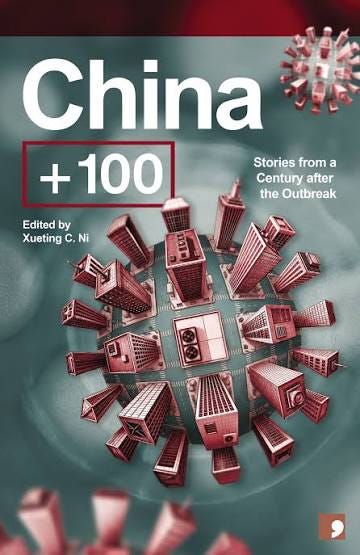
China + 100 arrives as the newest entry in Comma Press’ Futures’ Past series, which it names as part of its Science ‘Fiction from Beyond the West initiative’. Each book in the series centres a non-Western country or territory, isolates an event from its past, and then presents an array of sci-fi stories set 100 years after that event. For this book, the event is the outbreak of COVID-19. Incidentally or not, China marks a major step east for the series, following Afghanistan and selections from the Middle East.
The stories within China + 100 were rallied by Xueting C Ni. She’s a Chinese-to-English literary translator, author of nonfiction books on Chinese culture, and here serves as editor, as well as translator of three of the tales. She has brought in work not only from ten writers in the People’s Republic of China, but also seven translators from a variety of literary and cultural backgrounds.
Take for example Dust Rose — penned by Yimei Tangguo (‘Poison Candy’ — offline name Zhuo Qin) and translated by Taiwan’s Etvolare (offline name Mel Lee). Both emerged to print publication from the world of webfiction and web translation, respectively — the former famed for addictive tales of terrible cruelty, and the latter a sweet and wholesome digital persona presenting mountains of translated internet wuxia, xianxia and more to her readers. Without the connections a curatorial figure like Ni can bring, a print collection from an esteemed house like Comma Press would struggle to pull in ‘usernamed’ contributors to sit among more ‘traditional’ writers and translators — for example the Chinese sci-fi doyen He Xi or Jack Hargraves, an up-and-coming translator of, by and large, literary fiction.
In her role, Ni also serves as a navigator of censorship — a word she uses once in her introduction, but in reference to McCarthyism in the USA. Regarding ‘sensitivities’ in the PRC, she describes her careful efforts to solicit meaningful stories on such a fraught topic:
Pressuring people [to write for China + 100], or raising the issue publicly would have created the sorts of incidents I know people wanted to avoid, and respecting the decisions of the writing community, and prioritising their safety was paramount, even to the extent of being overcautious.
While (indirectly) discussing the state-sponsored minefield of depicting Chinese futures, Ni makes an affirming claim: that China needs to take part in COVID-19 discourse to ‘speak for itself’ and ‘undo the damage caused by polemicised press and political point-scoring’, but that ‘in China’s current cultural environment’ it falls on international publishers and speculative fiction writers to make this happen.
She is hitting on certain truths here – consider the turmoil the realist writer Fang Fang faced when posting her Wuhan Diary to Weibo, and later publishing it overseas. The otherworlds of speculative fiction are a comparative shelter.
In China + 100 there is no mention of the Wuhan municipal government’s moves to suppress initial news of the virus. The city itself is named twice. But certain nameless, science-fictionalised municipal authorities are up to some shockingly sinister business: cleansing the homeless, erasing history, and manipulating language — see in particular Dust Rose and Dan Shi’s Fire. Seasoned readers of Chinese fiction may recognise this de-locating strategy across genres, from Jia Pingwa’s venal Xijing to Chen Qiufan’s cyberpunk vice city of Silicon Isle. Nonspecific local governments can be fair game for accusations proximate to real, material concerns.
Chen Qiufan’s own Glaze closes China + 100. It’s a shocker to rival the cruelty of Dust Rose, delivering body horror verging into gore, enacted in the lofty world of performance art. Consider the bleak consequences if transformation of the body by technology becomes heritable, but not reversible. While Glaze makes no direct connection with the pandemic nor plunges the uncanny depths Chen traverses at his best, he crescendos to an ending reminiscent of the anti-human oblivion of The End of Evangelion, driving his works’ intertwining themes of transhuman disintegration and intra-elite maneuvering down an austere and terrifying road. In that sense the spirit of COVID-19 is there.
Most of the other stories skew more wholesome. At certain points, the upbeat tone tends toward national showcasing: weaving (or grafting) in the traditions, geographies, and potentials of the authors’ homeland. At times this showcasing correlates with a tendency to shy away from difficult social questions and any pessimistic notes that might, beyond the story’s end, leave the reader with troubling thoughts.
The lightest story in the collection, Ling Chen’s Miracle Grass, opens with a new COVID outbreak onboard a spaceship, at a time when Earth has ‘entered barbeque mode’ and overheated humans are relocating to Mars and the moon. So far so grim, but our hero Duowei’s quest for a cure for the new COVID strain, drawn with little debate from traditional Chinese medicine, proves frictionless:
So many organisations had opened their doors, in order for him to find this cure. Without them, he could never have travelled 5000 miles in a single day, rushing from the northwest to the middle of China, and now out to the southwest corner.
Duowei’s mission is a cozy, one-nation affair. It opens in Xinjiang, presented as just another secular Chinese territory. Along the way, Ling Chen namedrops Chinese flora, Chinese agricultural products, Chinese cuisine, Chinese infrastructure, and Chinese regions.
Perusing the side of the can, he read out: ‘Honeysuckle from Pinghu in Shandong, Self-heal from Anlong in Guizhou, liquorice from Yanchi in Ningxia, lotus leaf from Jiangxi... all original ingredients that have been shipped up here, so the quality’s first rate.’
The recurrence of agriculture, food, medicine, and national characteristics does serve a broader theme, distilled in a passing reference to an old Chinese saying: ‘food and medicine are one and the same’ (药食同源). Miracle Grass manages only snatches of meaningful dialogue between its biocultural theme and its quickly-forgotten ‘barbeque mode’ climate. Readers keen to extrapolate may feel prompted to ponder 22nd-century China’s curation of historic, fragile biospheres — but to do so one must squint past the gleaming grin of the literary patriot. Ling Chen opens Miracle Grass by describing climate change degrading humanity’s grasp on the planet, but as she progresses, she leaves intact our delusional conception of nature’s aspects as properties of national culture. Her final act funnels in earnest discussion of tourist board strategies for the Jiabang rice terraces of Guizhou Province, and thus at story’s end we exit through the gift shop.
Miracle Grass is not the only story that focuses on Guizhou, geography, and life-forms other than ‘animal’ or ‘viral’. Anna Wu’s Archaic Dust hinges on the cave systems of said province — the deep hiding place from which a strange fungal contagion emerges to infest the planet’s surface. An international team visiting the cave includes one Japanese scientist, granted a sympathetic portrayal contrary to national biases. But by the story’s end we learn that the Japanese state weaponised the fungus, fusing it with a coronavirus to form a hybrid that would spare human respiratory systems but cripple the world’s quantum computing infrastructure. ‘Japan’, writ large, ‘vaccinated’ its own machines in secret then set the plague loose in China. Archaic Dust is so flush with inventive flourishes that one might find the twist — that Japan, China’s pop culture stock villain, is the villain — conspicuously pat. Indeed, Wu seems to be playing with two elements of the real-world ‘story’ of COVID-19’s origins.
It is a narrative of two theories, passingly familiar to many. First there is the theory informed by scientific investigation: that the virus evolved among horseshoe bats in the cave systems of southwest China (specifically Yunnan Province, which Guizhou borders) or neighbouring Southeast Asian countries. The second theory, informed by speculation, is that the virus accidentally leaked from the Wuhan Institute of Virology. The latter blends easily into aggressive conspiracy theories, including those of a ‘plandemic’, perhaps by the hands of the Chinese state, and thus, it’s a handmaiden to paranoid Sinophobia.
Rather quietly, Archaic Dust seems to draw upon and subvert both origin narratives. Wu’s danger in the caves becomes something far stranger than COVID-19 —something unable to escape its cradle without being sought, discovered, and instrumentalised. Something which then goes on to permeate not only our bodies but also our machines. Like COVID-19, it is an economy-killer. Meanwhile, the sinister state accused by the ‘plandemic theory’ becomes a Japan that behaves how the most paranoid, fevered reactionary mind imagines a communist state would behave, given the opportunity. So while Archaic Dust does not run the risk of presenting a ‘dissident’ position, it is bold in its engagement with both the real COVID-19 and the fevered narratives — many concerning China — that it triggered.
Archaic Dust comes first in the anthology. Third last comes another fungal tale, The Concrete Farm. Author Lu Hang is best known for young adult fiction, which may account for this story’s gentle tone and young-ish main character, Siyu, an undergraduate. But ‘gentle’ does not necessarily mean ‘light’. The Concrete Farm takes a classic PRC ‘xiaoqu’ as its setting — that is, a (lightly) gated community compound of residences; often apartment towers. This xiaoqu lies in dwindling, far-flung suburbs. Its elderly residents face isolation as, in the face of ‘finite resources’, China’s working population increasingly migrates to online VR offices, decoupling employment ever-further from offline geography.
Siyu’s grandfather, after years of stubbornly clinging on to his apartment in a decaying xiaoqu tower, has passed away, leaving her to sort his affairs and sell or rent the property. In the story, as in real China, there is a waiting game one may play — if the state marks a residential area for demolition and new development, residents can secure hefty compensation. Thus, well before introducing interstellar fungi, The Concrete Farm concerns itself with family and grief alongside hard material realities present and predictive — some universal, some specific to China’s human geography. Siyu fails to sell the property, so instead follows a tip to use it to livestream mushroom cultivation – something of an ode to her grandfather, who was an academic authority in the field. But one specimen, harvested from an asteroid, balloons, triggering a crisis that a swift response from emergency services and experts manages to resolve.
The site of the disaster is transformed from redundant housing into a new ‘vertical horticultural station’, and the troublesome mushroom is configured ‘as a demolition method for removing older buildings, as a way of making their levelling cost effective.’ It is a rather cosy ending. Yet readers who retain memory of the preceding pages will recall worrisome trends: the erosion and forgetting of both flesh-and-blood communities and ‘community’ in the broad sense, and the normalisation of digital hustle culture forming symbiosis with economic inequality in a society that, in the 20th century, aspired to become classless. Ask yourself whether Siyu’s friend Lin Feng is describing sporepunk dystopia or a free market success story when he gushes:
‘My supervisor live-streamed himself picking these mushrooms in a spacesuit on some asteroid. The sponsorship and advertising revenue covered the scholarship money for a bunch of underprivileged kids.’
Lu Hang’s characters are universally well-intentioned, but they navigate their future world carrying burdens the young and elderly of today would recognise. As Siyu learns, eccentric individualistic schemes present one road to security, but with risk of exhaustion and misfire. And for the elderly, precarity is a matter of fate. Death, disease, and fiction can help underscore capitalism’s contingencies — provided we read between the lines, and behind the happy endings.
Regarding the prevalence of fungus in China + 100, Ni notes in her introduction that the emergent motif:
‘may be purely coincidental, but it demonstrates how these life forms, being so different to mammals like us, have captured our intellectual fascination and storytelling imagination’
She then moves on. And fair enough. It is hard to push analysis further, but we may note that the strangeness of fungi in all their forms lends itself naturally — pardon the pun — to speculative fiction. In horror, (bio-)sci-fi, and neo-folk fairytales, here is one frontier where science has long to go before it can eliminate ‘the strange’. We can note here that Ni’s last translated Chinese anthology was Sinophagia – a collection of horror stories sharing three authors with China + 100. Perhaps her new anthology asks: to what extent was COVID-19 a horror story?
Its stories — in their variety and in their dark corners — suggest that the pandemic was not just a healthcare crisis but something far more complex, which we are refusing to face. To what extent are we scarred, inspired, or immobilised by the hyperobject we survived? Are we upgraded? Is our soul intact? Will art and culture help us to grapple with our memories, or replace them? And when the next planetary crisis arrives — what then?
