


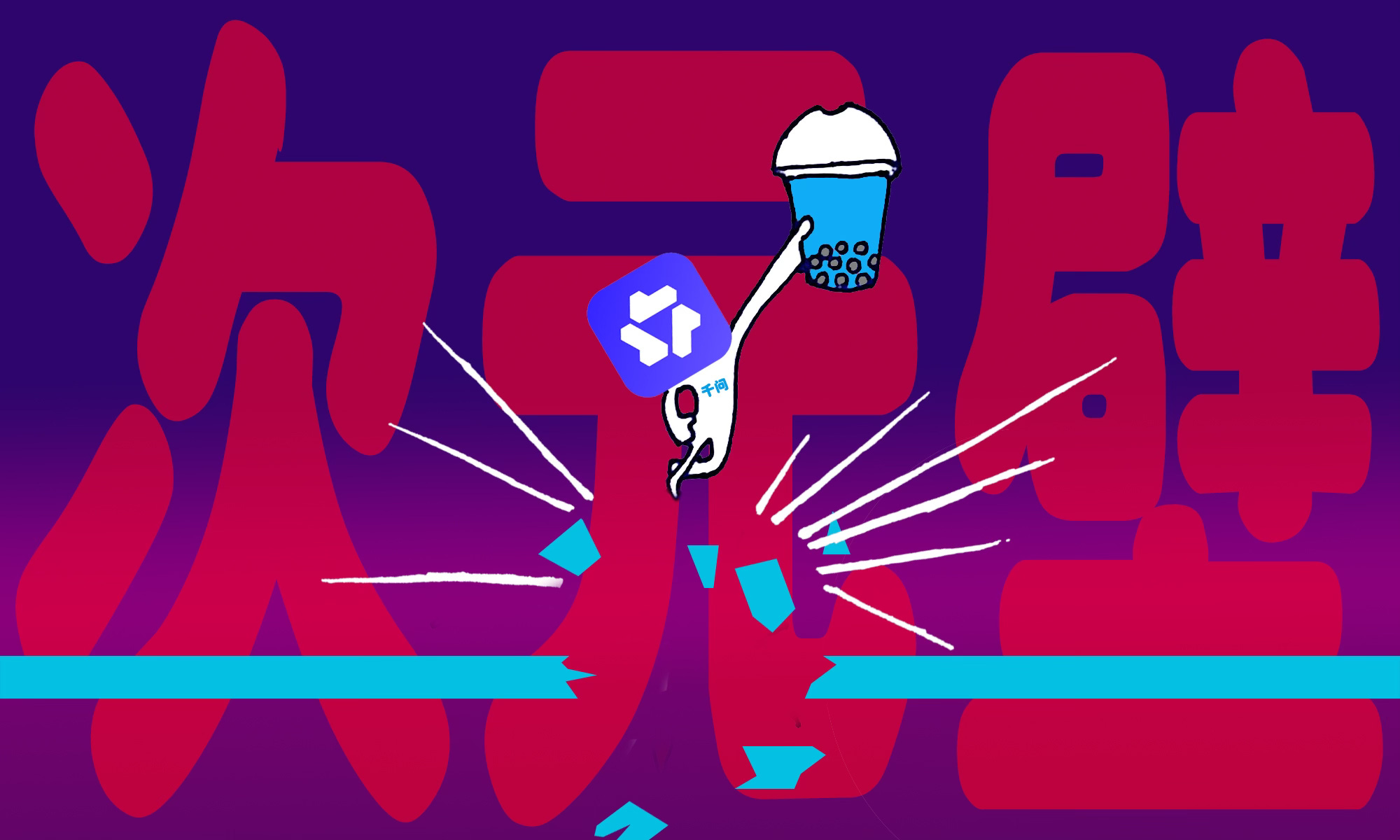
Our phrase of the week is: “dimensional wall” (次元壁 cì yuán bì)
Context
Alibaba’s AI agent, Qwen (千问), has been making headlines with the launch of its “Spring Festival 3 Billion Giveaway” (春节30亿大免单) campaign, offering unlimited free bubble tea vouchers.
This allowed users to order a drink through a simple prompt to Qwen, which would then claim the voucher and process it through its Alipay integration without having to jump between multiple apps.
The campaign covered over 300,000 bubble tea stores nationwide. Within hours of launch, Qwen crashed due to overwhelming traffic, and a massive 10 million orders were completed in just 9 hours.
Two weeks earlier, on January 15th, Alibaba announced that Qwen now had integrations with major platforms across its ecosystem including Taobao Flash Buy (淘宝闪购), Fliggy (飞猪), Damai (大麦), Freshippo (盒马), Tmall Supermarket (天猫超市), and Alipay (支付宝).
This means consumers can now buy things with a single prompt to Alibaba’s AI agent. It’s the beginning of a shift in how AI is used in daily life, captured in this popular internet slang phrase:
Beyond the chatbot: Qwen breaks the AI “dimensional wall.“
The core challenge facing the AI industry today is not technology itself, but how to translate virtual intelligence into real-world application.
从聊天到办事:千问拆掉AI的”次元壁”。当前AI产业面临的核心挑战,并非技术本自身,而是如何将智能转化为真实场景中的执行力。
And with that, we have our Sinica Phrase of the Week.
What it means
“Dimensional wall” (次元壁 cì yuán bì) is internet slang describing the barrier between the virtual world and the real world.
The phrase originally emerged from Japanese ACGN culture (Anime, Comics, Games, Novels) to describe the gap between anime and manga fans, and mainstream society.
In anime, “2D” or “nijigen” (二次元) refers to the fantasy worlds created in two-dimensional media like anime and manga. And “3D” (三次元) refers to real life, the physical world we live in.
The “wall” (壁) between them separates anime and real life.
In the 2010s, as video games like Honor of Kings (王者荣耀) achieved massive commercial success in China, the “dimensional wall” (次元壁) took on new meaning. It came to represent the boundary between niche geek culture — gaming, anime, manga — and mainstream society.
But that niche exploded. By 2016, China had 250 million nijigen fans. By 2023, that number hit 500 million, with the market growing from $2.6 billion to $30.5 billion. So what was once fringe became mainstream.
In China, anime conventions began “breaking the dimensional wall,” bringing virtual characters into physical spaces. Shopping malls deployed anime aesthetics to drive foot fall. And the “goods economy” (谷子经济) — one of 2025’s top buzzwords which we translate as “anime merch economy” — emerged around anime merchandise.
Today, the phrase “dimensional wall” (次元壁) has evolved again. It now describes any barrier between virtual and real, such as AI entering daily life.
So when Qwen moves from chatting to ordering your bubble tea — that’s breaking down the “dimensional wall” between the virtual and real worlds.
Andrew Methven is the author of RealTime Mandarin, a resource which helps you bridge the gap to real-world fluency in Mandarin, stay informed about China, and communicate with confidence—all through weekly immersion in real news. Subscribe for free here.

Interesting… many similar mind/world distinctions such as fantasy v reality and interior-subjective v exterior-objective.
The strange thing however is that this mind/nature wall is a fabrication of Western thought and less an issue in Chinese/East Asian thought where experience is just experience. This “wall” is a symptom of how Western thinking has been adopted.
Fortunately, embodied mind cognitive science is slowly dispensing with the wall-split and coming closer to the traditional Chinese conception where the distinction is less of a problem.