


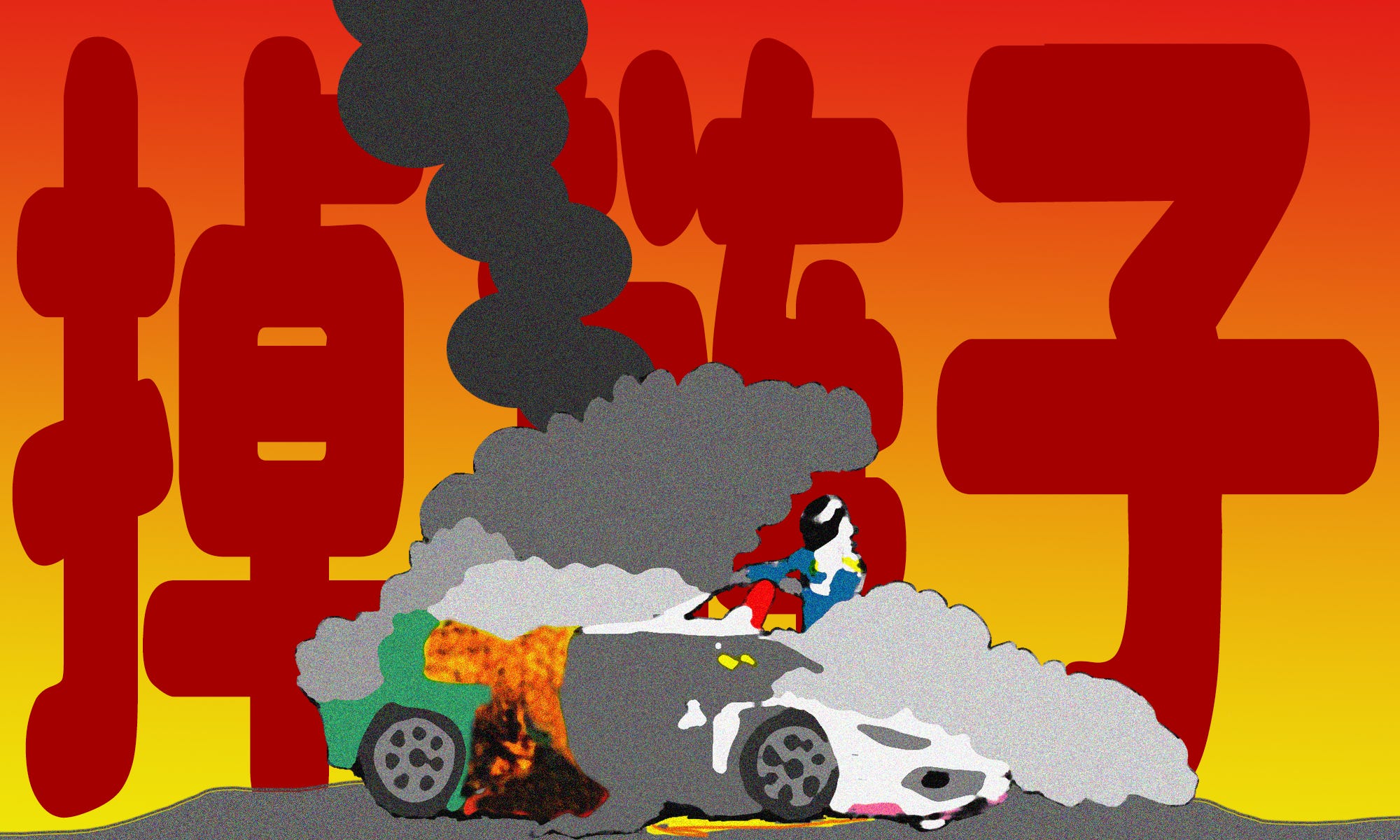
Our phrase of the week is: “drop the chain” (掉链子 diào liàn zi)
Context
On September 5, on the seventh lap of the Shanghai round of the China GT championship, cars 37 and 33 tangled and ran off the circuit. One of them struck car 91, which went up in flames. Trapped inside was British driver Ollie Millroy.
Ollie’s rival, Loek Hartog, a 23-year-old Dutchman driving car 79, was close behind. He stopped and tried to tear the door off. When that failed he took a fire extinguisher from a marshal who had just arrived. He managed to calm the flames just enough to climb into the burning car, and dragged Millroy out.
The British driver came out with five broken ribs, a broken collarbone, a broken hand and finger, and a bruised lung.
That evening Millroy’s team, FIST Team AAI, condemned the organisers for gross negligence, said they were pulling out of future races, and demanded a full investigation.
Other drivers said the marshals panicked, put down their extinguishers and fled. The ambulance took fifteen minutes to arrive, because its driver was asleep and could not be woken.
Footage from the scene showed another marshal unable to get his extinguisher open. That level of incompetence is captured in one colloquial phrase:
“The drivers were out there racing. So why did the organiser drop the chain when it came to the rescue?”
车手在比赛中,救援为什么掉了链子?
And with that, we have our Sinica Phrase of the Week.
What it means
“Drop the chain” is a colloquial expression which translates directly as “to drop” (掉 diào), “chain” (链子 liàn zi).
It began as northeastern dialect, associated particularly with Shenyang (沈阳). Originally it refers to the chain falling off a bicycle while pedalling. A scenario in which nothing is broken, but the bike doesn’t work.
From there it became a metaphor for failing at the moment it really counts. It’s not incompetence in general, but the thing that gives way at a critical point, and takes everything else with it.
Which is why the phrase is usually paired with the word “critical”, as in the standard form “dropping the chain at the critical moment” (关键时刻掉链子). For example:
“Don’t leave it to him. He drops the chain every time it matters.”
这活不能交给他,他关键时候总掉链子。
Describing a person, someone who “drops the chain” is unreliable, or is fine until the pressure is on.
The phrase spread from the northeast through news media and the internet, and it is now ordinary household Mandarin rather than a regional expression. It’s common in sports commentary, workplace complaints and, as this week shows, criticism of institutions.
A close relation is “buckling at the hips” (拉胯), another northeastern term which became internet slang and means underperforming, falling short, or failing to deliver. Cantonese has its own version of the same idea in “to lose a wheel” (甩辘).
The standard English rendering, and the one China Daily’s English service uses, is “drop the ball”. That is right for the sense of it. But we prefer to keep the bicycle metaphor of “drop the chain”.
Because that is exactly what the argument in China is about this week. Nothing about China GT’s setup was missing. The marshals, the extinguishers and the ambulance were all in place. But when a driver was stuck in a burning car, the man who got him out was another driver, not a marshal. The organisers dropped the chain.
Andrew Methven is the author of RealTime Mandarin, a resource which helps you bridge the gap to real-world fluency in Mandarin, stay informed about China, and communicate with confidence—all through weekly immersion in real news. Subscribe for free here.
