


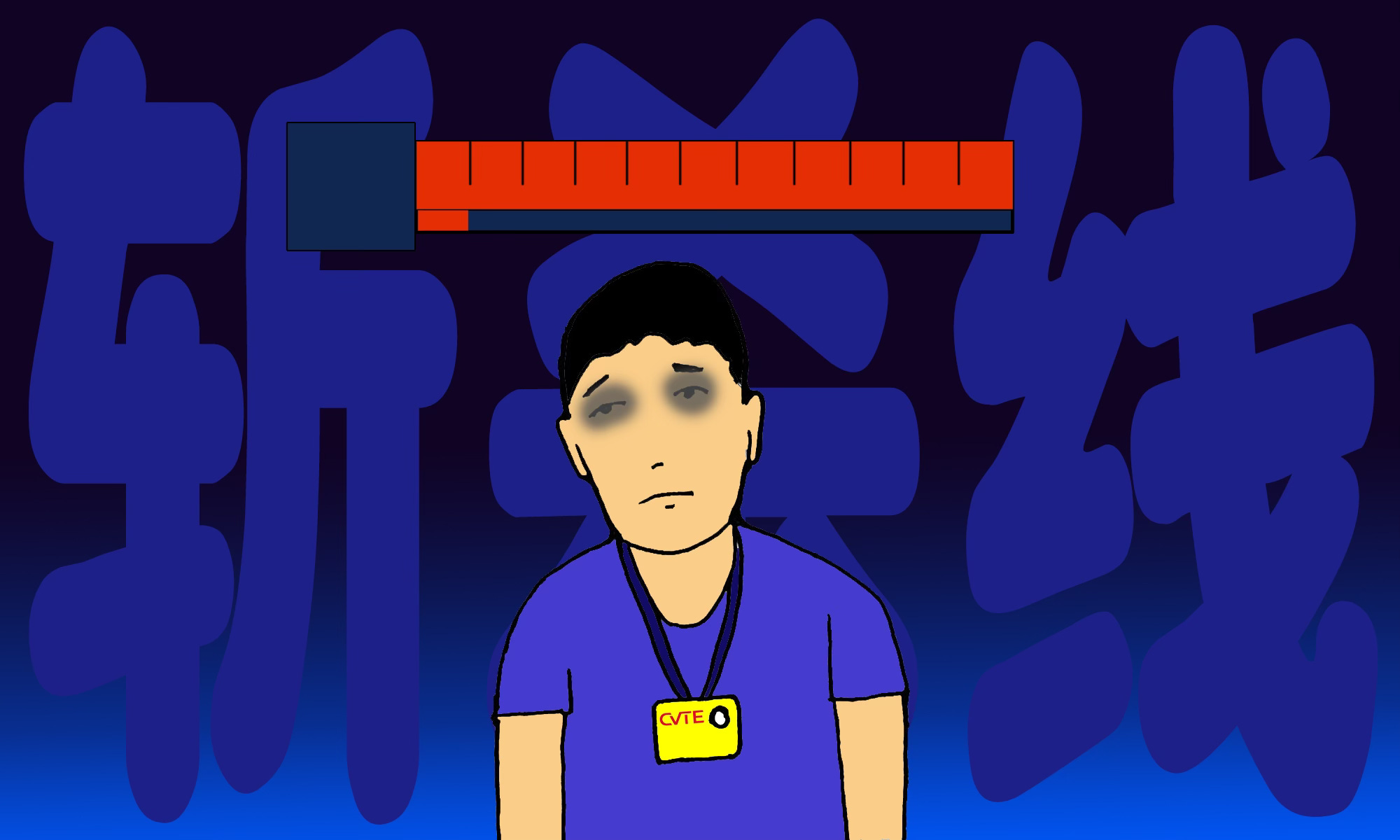
Our phrase of the week is: “execution range” (斩杀线 zhǎn shā xiàn)
Context
The story of the sudden death of a 32-year-old software programmer in Guangzhou has been trending on social media feeds over the last two weeks.
His name was Gao Guanghui (高广辉). He worked for a major tech company, CTVE (视源股份) a major tech company listed on the Shenzhen Stock Exchange.
Gao actually died on November 29 last year but the story has only recently gained media attention.
The night before he died, Gao had worked overtime until 10pm. The following morning, which was a Saturday, he woke up early telling his sleeping wife he needed to finish some urgent work.
His wife got up shortly after to find him collapsed in his chair. She called an ambulance and tried to help him downstairs. On his way down, Gao collapsed again in the lift. Before losing consciousness, he asked his wife to bring his laptop so he could carry on working.
He was pronounced dead at 1pm that day. His wife is seeking official recognition that Gao’s death was due to overwork at CVTE.
The case sparked widespread discussion online about China’s brutal work culture. One commentator in a now-censored article used a recently coined slang phrase to describe the grim nature of work culture:
A while back, everyone was discussing the “American execution range.”
The idea that once you lose your jobs, can’t afford medical care and go bankrupt consequently, you then get “physically eliminated” by the system in the US. Many people reposted it with a sense of schadenfreude: “Thank goodness it’s not us.”
But now if you look at this 32-year-old programmer, you’ll discover an even more brutal truth:
You don’t need to end up on the streets to be eliminated.
前阵子,大家都在讨论“美国斩杀线”。说美国人一旦失业、看不起病、破产,就会被系统“物理清除”。 很多人转发的时候,带着一种隐秘的庆幸:“还好不是我们。”可现在你再回头看这个 32 岁的程序员。你会发现一个更残酷的事实:你不需要流落街头。
And with that, we have our Sinica Phrase of the Week.
What it means
“Execution range” (斩杀线 zhǎn shā xiàn) is a three-character phrase which started out as a gaming term.
Originally from video games like World of Warcraft (魔兽世界), “execution range” refers to the critical threshold where an enemy’s health drops low enough to be finished off instantly with a single attack. It’s the moment a player can be executed with no escape.
The term evolved across different games. In League of Legends (英雄联盟), the champion Pyke has an ultimate ability where the execution range can stack infinitely—meaning he can eventually execute enemies at full health. In card games like Shadowverse (影之诗), players calculate “kill windows” to determine when their combo can finish an opponent.
The phrase became a mainstream expression in late 2025.
It first went viral from a video on video streaming platform Bilibili, in which the creator (牢A) uses it to describe American society. The state propaganda machine picked up on its popularity, and it became an official way to comment negatively on middle-class Americans who lose their jobs, can’t afford medical care, go bankrupt, and fall within a financial “execution range.”
Cross that threshold, and there’s no coming back — a financial and social tipping point that could ruin middle-class families.
Early translations of the phrase by Chinese state media label it as “kill line”. But we disagree with that translation. It’s lazy and makes no sense. As illustrated by a Chinese journalist's question about America’s “kill line” to U.S. Treasury Secretary, Scott Bessent, at the World Economic Forum in Davos recently. He didn’t understand the question. And, according to Mr Bessent, nor did she.
In the American context, the “ALICE line” (asset limited, income constrained, employed) comes closest to what “execution range” has been repurposed to mean.
But we’ve decided to stick with the gaming terminology!
Now, in this latest evolution, the phrase has taken on a mocking tone of Chinese society. Because while official channels have seized the opportunity to highlight China’s advantages over the US, the public debate has inevitably drawn parallels with the economic woes faced by Chinese people.
China too has its own “execution range”: its brutal work culture.
Andrew Methven is the author of RealTime Mandarin, a resource which helps you bridge the gap to real-world fluency in Mandarin, stay informed about China, and communicate with confidence—all through weekly immersion in real news. Subscribe for free here.
