


China now accounts for more than 45 percent of the world’s production capacity for basic chemicals and plastic resins. The expansion of this industry in China has put profitability under pressure across the global sector.
This article was translated from the original German and was first published on the Limen China Substack.
For Europe, developments in this particular industry raise a much more fundamental question.
What industrial base does an economy need to preserve and increase prosperity and remain competitive in the next phase of technological development?
As the “industry of industries,” the chemicals industry supplies materials to other industries and creates the conditions for their development. The chemicals industry underpins numerous industries and constitutes a form of industrial infrastructure. China’s massive capacity expansion in recent years also shows how the country is continuing to use industrial policy to lay the foundations for future economic development.

Drawing on a recent Rhodium study, we therefore examine the state of this foundational industry and what to expect next from China’s chemicals sector.
We then turn to a new study by FERI and Sinolytics to explore what this industrial infrastructure, understood as a foundational industry, could enable China to achieve in emerging technologies.
Finally, we consider a new article by Henry Huiyao Wang and the offer it presents from China to Europe to use reciprocal investment to create prosperity in their own economies and shape a multipolar world order.
Why does this matter?
Because, given the difficult economic conditions, policymakers and businesses in Europe and Germany urgently need to consider the foundations on which they intend to build future economic development and where they will make the investments it requires.
China’s chemicals sector provides a case study that merits close attention.
China is renewing an integrated industrial system
In its report “Global Impacts of China’s Chemicals Buildout,” published in early November 2026, Rhodium describes the rapid development of China’s chemicals industry in recent years.
The author also describes the widely discussed mechanism of involution in the Chinese economy. The rapid expansion of supply has led to shrinking margins and a significant increase in the number of companies making losses in China’s chemicals industry as well. Ever greater supply is failing to find enough buyers in the domestic market. For foreign producers, declining Chinese imports have so far been the main source of pressure. At the same time, Chinese suppliers are gaining market share in third markets, particularly in emerging economies.
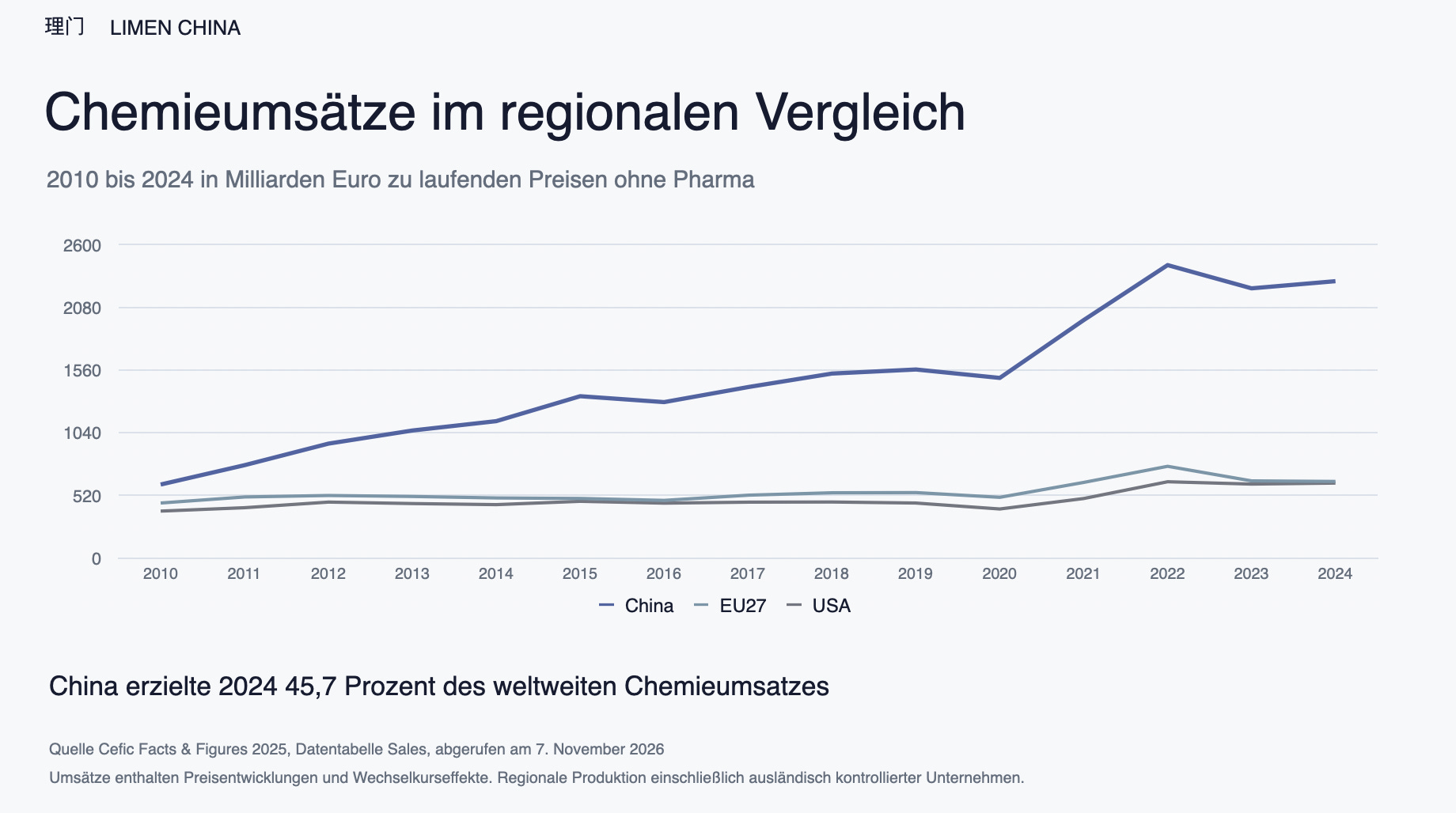
Regional chemicals sales from 2010 to 2024 in billions of euros at current prices, excluding pharmaceuticals. China accounted for 45.7 percent of worldwide chemicals sales in 2024. The original graphic retains German labels.
Source Cefic Facts & Figures 2025, Sales data table, accessed November 7, 2026. Sales reflect price changes and exchange rate effects. Regional production includes companies under foreign control.
According to Rhodium, the political response to capacity expansion that increasingly exceeds demand focuses on modernizing existing facilities and forging closer links between refineries, chemicals production, and higher value applications. The study sees little prospect of capacity reductions in the short term. It expects the industry’s renewal to have the potential to improve Chinese producers’ cost position further. The sector’s strategic importance, it argues, increases policymakers’ willingness to accept low returns on capital for longer.
“Supply growth became increasingly untethered from demand, pushing down prices, piling up inventories, and shrinking profits.
…
Beijing has acknowledged the supply-demand imbalance, but Chinese policymakers are reluctant to face the economic, social, and supply chain repercussions of large-scale closures.”
Chinese policy documents make the intended changes clearer. The “Work Plan for Stabilizing Growth in the Petrochemical and Chemical Industries for 2025 and 2026” links the management of new capacity to more sophisticated products and the modernization of existing facilities. Electronic chemicals and advanced plastics are among the areas targeted for development. Industrial AI is intended to improve production. Demand is also to grow through new applications in new energy, the low altitude economy, and humanoid robots.
Industrial policy planning for the sector’s further development also takes place at the provincial level. The eastern Chinese province of Zhejiang, for example, aims to develop Ningbo’s petrochemical cluster into a cluster of global standing while limiting the expansion of refining and basic materials capacity. Chemical and pharmaceutical projects are to be concentrated in chemical parks. The plan thus documents an intention to organize proximity, specialization, and the renewal of existing capacity together.
China is thereby making clear that it regards the chemicals sector as industrial infrastructure. The capabilities of this industry shape the development opportunities available to other, quite different technologies and companies.
For industrial users of chemical products, material quality, availability, and processing costs matter. If they can qualify new materials or adapt a process more quickly with a supplier, the conditions for their own development change. In this context, a chemical plant and the industry as a whole have strategic economic value that can support other industries, technologies, and companies.
In a sector so far upstream, the economic benefits are distributed across many customers. Cheaper materials can lower costs and facilitate investment. International trade can extend these benefits to companies outside China, while also displacing established suppliers in those markets.
Additional benefits tied to a particular location can arise when proximity between producers and users accelerates joint development.
An economy-wide assessment would need to weigh these effects against the capital required and the alternative uses to which that capital could be put.
Rhodium, in any event, sees China’s development as a strategic policy challenge for the regions competing economically with it.
“Global producers … face increasing pressure as Chinese companies push into segments they have long dominated.
…
The complex structure of the industry will make protection difficult with conventional trade tools.
…
Policy solutions will also have to balance each country’s reshoring goals against the complex interests of multinational chemical producers who operate and trade across many jurisdictions with competing priorities, including in China.”
New technologies grow out of existing industry
While Rhodium examines chemicals as a foundational industry, a new study by FERI and Sinolytics describes the next stage of China’s industrial development as the creation of its own technology pathways for the future. The study is titled “China’s Third Wave of Global Disruption in AI, Robotics, and Emerging Technologies.”
Semiconductors, AI, and robotics are among China’s priorities. Existing industrial capacity provides applications, supplier relationships, and technical experience. New technologies with applications across sectors are, in turn, intended to increase productivity in established industries. The authors see these developments as overlapping waves that reinforce one another.
“China’s industrial policy through 2030 pursues five interconnected objectives. The first is to eliminate remaining technological dependencies. The second is to upgrade the existing industrial base through technologies such as AI and robotics that have applications across sectors. The third is to scale new growth industries rapidly. The fourth is to define technological pathways early in emerging fields. The fifth is to spread Chinese technologies and industrial ecosystems internationally.”
Quotation translated from German.
This relationship is also explicitly described within China. Xu Jianwei and Hu Wenjin of the Academy of Macroeconomic Research at the National Development and Reform Commission outlined it in an article published in early August 2026. “传统产业为未来产业发展提供条件支撑.” In our translation, “Traditional industries create the conditions for the development of future industries.” Their article explains how existing facilities, skilled workers, and technical capabilities are intended to support new stages of industrialization.
The “Implementation Plan for Innovation and Development in the Fine Chemicals Industry for 2024 to 2027” had already specified part of this task in 2024. Among other measures, it envisages pilot platforms for producing photoresist resins and purifying high purity chemicals. Producers of basic materials and fine chemicals are to work more closely together in chemical parks. The policy objective thus links the industrial base to the materials needed for sophisticated production processes.
The FERI study explicitly mentions the chemicals sector as an example of this development.
“This vertical integration enables economies of scale, rapid innovation cycles, and aggressive pricing strategies. A … shift in position can be seen in many other sectors, including machinery and chemicals.
…
The industries particularly affected include automotive, machinery, chemicals, and renewable energy technologies.
Germany is especially exposed because China’s industrial catch-up is increasingly reaching the core sectors of Germany’s industrial export model.”
Quotation translated from German.
A feedback relationship emerges that matters for a European economic policy strategy. New technologies need an environment in which they can be developed, tested, and improved under real operating conditions. Industrial users contribute process knowledge and requirements for reliability. When collaboration succeeds, improvements accrue both to the technology supplier and to the plant operator.
The chemicals case thus reveals a possible direction of development. The industrial base can become the starting point for further technological capabilities, while those capabilities renew the base itself.
This requires technical advances to translate into repeatable and economically viable applications. FERI explicitly identifies bottlenecks, uncertain business models, weak demand, and fiscal constraints as obstacles. The intended reinforcement represents a strategic possibility whose realization will advance to different degrees in different technologies.
The use of technological strength is subject to political conditions
For European companies, this creates an economic incentive to connect with Chinese development partners and production networks. Access to advanced materials or improved production processes can help companies develop their own offerings. The value of that access also depends on which capabilities a company builds itself and is allowed to use over the long term.
A company can, however, also find itself caught between geopolitical interests. FERI captures the geopolitical difficulty of this access in the diagram on page 5.
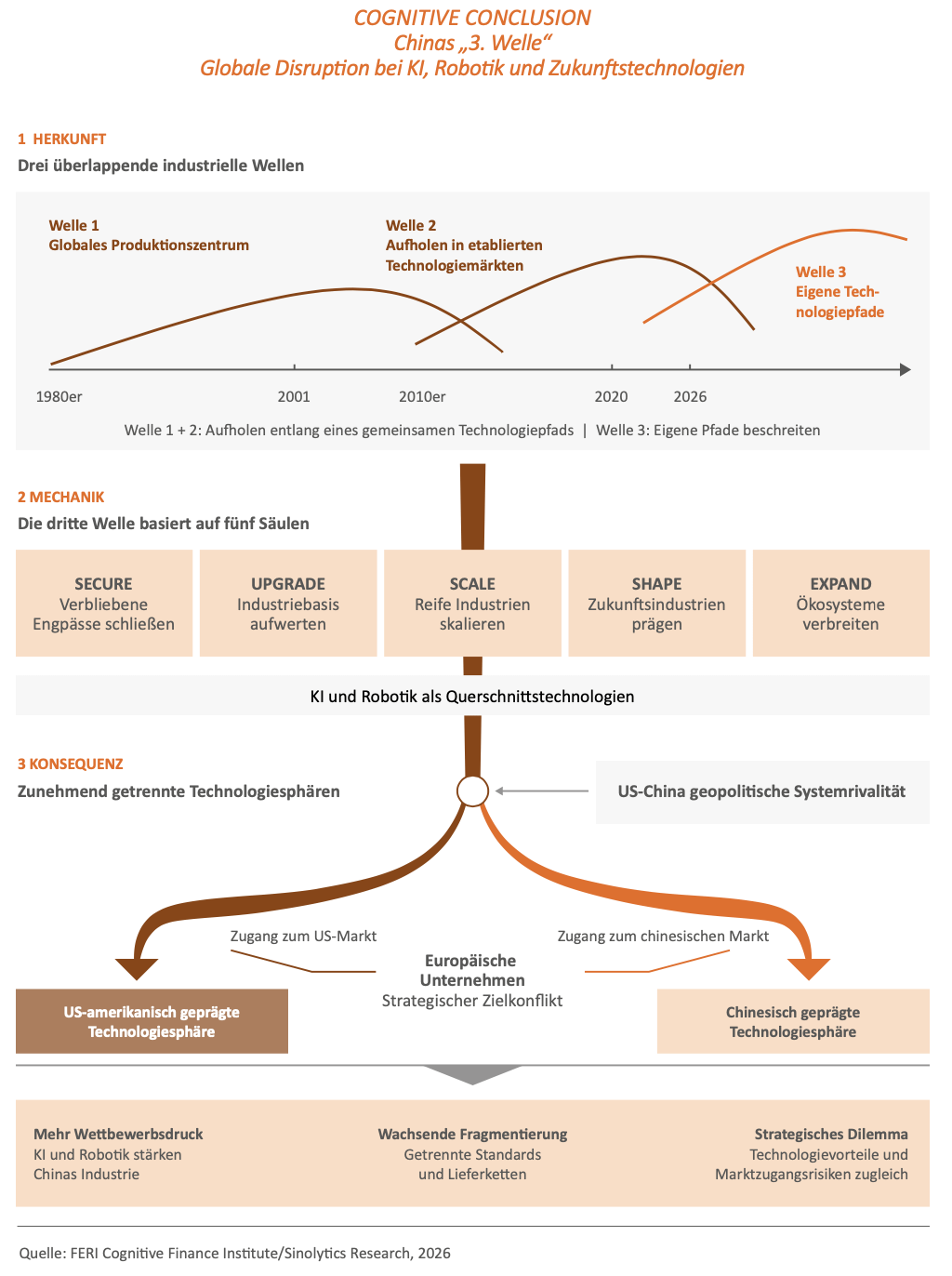
China’s third wave. Original FERI diagram, with German labels retained. Source FERI Cognitive Finance Institute and Sinolytics Research, 2026.
Reading the diagram in English. Three overlapping industrial waves move from a global production center to catching up in established technology markets and then to independent technology pathways. The five pillars are closing remaining bottlenecks, upgrading the industrial base, scaling mature industries, shaping future industries, and spreading ecosystems. AI and robotics serve as technologies with applications across sectors.
The consequence is increasingly separate technology spheres shaped by U.S. and Chinese rivalry. European companies face a strategic dilemma between access to the U.S. market and the Chinese market. AI and robotics strengthen Chinese industry, separate standards and supply chains increase fragmentation, and technological advantages come with market access risks.
European companies risk being caught between the increasingly separate technology spheres of China and the United States. The study describes a strategic dilemma shaped primarily by mutual restrictions on market access and by different technology pathways in the respective markets.
U.S. restrictions on connected vehicles provide a tangible example. They cover certain software, hardware, and manufacturers with a sufficient connection to China or Russia. The prohibitions therefore also depend on the origin or control of technology. They apply to certain software from model year 2027, while restrictions on certain hardware apply from model year 2030. The technology a company integrates into its product can consequently affect its access to the U.S. market.
Strategic options for dealing with these restrictions may include choosing one trade and technology sphere or establishing regional production across several major industrial regions. Depending on the industry, companies can align development, software, supply chains, and production more closely with individual markets. In doing so, they must examine which links to origin and which control arrangements remain relevant to market access even when production is regionalized.
The extent of technological separation also depends on political decisions. Feng Zhongping, a scholar of Europe at the Chinese Academy of Social Sciences, advocates joint research and dialogue on data rules and the regulation of artificial intelligence. His contribution outlines a political possibility for preserving technological connections.
“China and Europe have potential for both competition and cooperation in fields such as digital technology, artificial intelligence, big data, and the Internet of Things. … China and Europe should enhance dialogue and exchange in areas such as digital infrastructure, data security and privacy protection, and AI ethics; explore models and pathways for cooperation; and encourage enterprises and research institutions on both sides to undertake joint research and development, jointly promoting scientific and technological innovation and injecting new vitality into economic and social development.”
In our view, this gives greater definition to the strategic dilemma described by FERI. Companies must take existing restrictions into account while examining which connections can be developed further through reliable agreements.
For corporate leadership, this changes the assessment of an investment. Expected technical and economic benefits must be considered alongside the question of where the resulting solution may be used and sold in the future. Separate technical systems can require additional resources. A shared solution can create dependencies that may take considerable time to unwind later. These conditions need to be reflected from the outset in the structure of a partnership and in the choice of its technical interfaces.
In our view, the chemicals buildout and technology push therefore reveal a common relationship. The way industrial capabilities are organized influences where new value can be created. The rules governing their international use then influence who can participate in that value creation.
For Europe, renewing the foundations of production and securing access to technology thus become connected tasks, much as China is currently demonstrating in the chemicals industry.
Europe must define the economic foundations of its renewal
A more developed European strategy should begin by defining the capabilities required for Europe’s economic development and renewal. We addressed this at length in last week’s article.
These capabilities include product knowledge, skilled workers, and facilities where new processes can reach industrial maturity. What matters is which interdependencies among these capabilities would make a loss particularly consequential, and under what conditions their renewal is economically viable.
In chemicals, the closure of a plant may therefore call for an examination of its industrial connections. Which customers need its material flows? Which alternatives can be qualified, and within what time frame? What development work would be affected? For an integrated European production system, the assessment should also include the costs that its customers could save through more modern processes and the contribution they would be willing to make themselves. The assessment must be traceable to specific products and sites.
The European Commission addresses parts of this task in its current chemicals initiative. The modernization of critical steam crackers and ammonia plants is linked to flexible energy and feedstock supply, logistics, and infrastructure. A declaration setting out actions and political commitments is planned by the end of 2026. A concrete test is therefore approaching. The proposed measures must lead to decisions that actually induce companies to invest.
For policymakers, this creates a need for industrial policy coordination. A modern plant requires reliable conditions for its operation and future development. Energy supply, grids, and permitting must fit investment planning. Public support should be tied to a demonstrable additional benefit, such as technical infrastructure that can be shared or the qualification of new suppliers. Review dates and conditions for adjusting support should be included from the outset. The costs of this policy must remain visible. Little of this is apparent in current policy action in Europe and Germany.
An industrial base could be organized entirely within Europe or through international partners. The required capability must remain reliably available over the long term under the relevant conditions. Where domestic production appears necessary, it needs an economic prospect supported by viable demand. Where international cooperation can secure access, it must be technically robust and sufficiently protected by contract.
Wang’s industrial compact needs binding contributions
Henry Huiyao Wang, founder and president of the Beijing research center Center for China and Globalization, develops a political proposal for such cooperation. In his essay “A New Compact for China and Europe” published this week in Horizons, he advocates an industrial compact linking Chinese investment to the development of European capabilities. He identifies local supplier development, worker training, joint research, and the sharing of production know-how while respecting intellectual property rights.
“We must … build a new industrial compact: one that aligns Chinese industrial capacity with Europe’s need for investment, innovation, and employment, and that enables China and Europe to stand together in support of a world of free, fair, and open trade.
…
This would represent the next stage of globalization: not simply Chinese companies ‘in China, for the world,’ but ‘in the world, for the world.’ It would spread productive capacity more widely, answer concerns about concentrated supply chains, and make development a shared undertaking rather than an arena for geopolitical competition.
…
An industrial compact cannot by itself remove all political differences. But it would serve as a springboard, and a trust-building exercise, for deeper commitments and further work on shared interests.”
Wang links Chinese investment in Europe to more reliable access to the Chinese market for European companies. A newly negotiated investment agreement would address equal treatment, subsidy transparency, and enforceable dispute resolution, among other issues. His essay sets out a negotiating agenda whose implementation would require agreements among political actors and investment decisions by companies.
In our assessment, this proposal could translate the findings of the chemicals case into a European agenda. Those seeking to participate in China’s industrial development must connect access to knowledge with the development of their own capabilities. For an investment in Europe, an agreement should therefore specify which development tasks would be undertaken at the site and which suppliers would be qualified for more sophisticated products. Available usage rights and the ability to adapt processes independently would determine the economic value of the cooperation.
Such a compact also requires Europe to make its own contribution. Industrial users that test new materials or improve production processes create economic value for their partners. Purchase commitments and joint development budgets can make this contribution binding. The compact would need to be measured against verifiable investments and the results of cooperation that remain usable over the long term.
Companies must include their future options in the calculation
Corporate leaders should examine these relationships in their next strategy review across their three forms of economic exposure to China.
In their direct China business, they need to consider which local capabilities and development relationships will become necessary for their own competitiveness. In their European home market, they need to identify the foundations of production on which their business model depends. In third markets, technical performance, technology pathways, and the interests of local partners need to align.
The question also arises in the role of industrial customer. A company that opens its plant to the development of a new technology contributes employees, operating knowledge, and economic risk. It must assess that contribution and agree on the access it will receive to the results. The gains from learning together can thereby become a distinct component of a partnership.
For European policies aimed at prosperity, what matters is which productive opportunities arise within Europe itself.
China’s chemicals buildout thus provides a concrete reason to reassess the conditions for industrial development in Europe, both in public policy and in corporate strategy.
The transition to the next phase of technological development makes the task of securing long-term access to these capabilities more pressing.
Europe’s response must prove itself through investments that renew the foundations of production and open further development opportunities for companies.
Invitation to the China Strategy Lab
What do these developments mean for your company’s China agenda? On December 16, 2026, we are joining 365 Sherpas BPI to host the China Strategy Lab in Berlin. From 9 a.m. to 2:30 p.m., we will examine what economic and political changes mean for your China business, your position in the German, Austrian, and Swiss home markets, and competition in third markets.
The workshop will be conducted in German. Its goal is a prioritized agenda for the changes your strategy will require in 2027.
Information and registration at china@365sherpasbpi.com

China seems to have a better system for allocating resources.