


This essay was originally published in German and translated by the author. This is a guest post from René Ruschmeier, co-founder, senior strategist and lead author of 理门 Limen China, a businsess intelligence consultancy focused on contemporary China..”
Henry Huiyao Wang on Chinese investment in Europe, the dispute over competitive conditions, and Europe’s room for maneuver between China and the United States.
What role could China play in Europe’s industrial renewal? Henry Huiyao Wang proposes using corporate partnerships built over decades to bring new investment to Germany. In his view, Chinese capital and technological capabilities could strengthen European industrial sites. He also considers Europe’s political approach to China economically damaging. The conversation reveals the expectations and assumptions behind those ideas.
Wang is the founder and president of the Center for China and Globalization in Beijing and a former counselor to China’s State Council. He worked at China’s foreign trade ministry and held senior fellowships at Harvard Kennedy School and the Brookings Institution. The CCG organizes dialogues with international economists, business leaders, and former government officials. His career combines experience within China’s government system with an extensive international network.
I spoke with him on the sidelines of the China Outbound Investment Forum in Beijing on October 17, 2026, about relations with Germany and Europe. Wang advocates Chinese investment in Europe, a revival of the investment agreement with the EU, and a dialogue among the three major economies of China, the United States, and the European Union. I also questioned him about subsidies, exchange rates, and weak Chinese domestic demand.
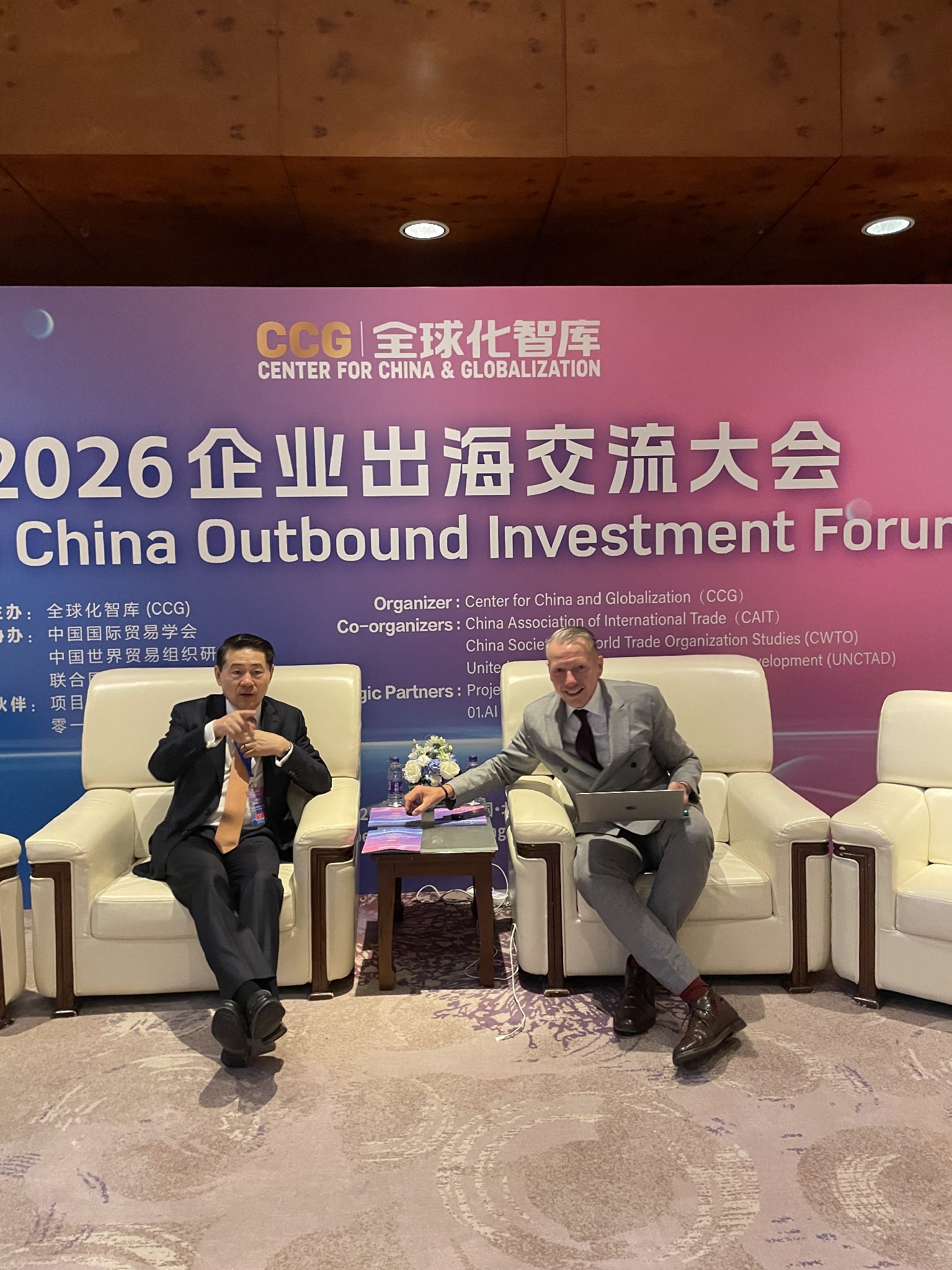
Following this week’s publications in China.Table and The Pioneer, we have deliberately chosen to publish the full conversation so readers can form their own view of Wang’s reasoning.
We briefly provide context on the most important factual issues and clarify significant inaccuracies. Other figures and causal claims in the interview reflect Wang’s personal views and assessments.
The conversation took place in English. Both the German translation and the English version have been edited for readability.
René Ruschmeier
Mr. Wang, thank you for this opportunity. Germany and China have a trading relationship going back decades. How do you assess the relationship today, and which changes in recent years will matter most for its future?
Henry Huiyao Wang
I think China and Germany are two of the most important trading nations in the world. Germany is the largest trading nation in Europe, and China is the largest in Asia and in the world. What really matters is that China has worked with Germany and the European Union for so long.
Around 5,000 to 6,000 German companies operate in China. A month ago, I attended a reception for German Unity Day. The new German ambassador said that more than 5,000 German companies operate in China and generate substantial revenues. Among European countries, Germany probably has the strongest economic presence, the deepest knowledge of China, and the most extensive cooperation with the country.
These longstanding relations have produced many successful joint ventures. Think of BMW, Mercedes Benz, Volkswagen, BASF, Merck, or Bosch. So many German companies depend on China for their international competitiveness. A large part of trade between Germany and China consists of semifinished products, many of them made by German companies in China. These products go to Germany, where they are turned into finished goods and sold around the world. In this way, Germany achieves a trade surplus with the rest of the world.
Politicians in Germany may make their own statements about this. German companies themselves know that without China, they would not be very competitive in the world. That is an important fact that too few people mention.
René Ruschmeier
People in Germany are increasingly concerned about jobs and the competitiveness of Germany and Europe as China advances rapidly in technology and industry. What would you want a German audience to understand about this development, and how would you respond to those concerns?
Henry Huiyao Wang
There are several ways to respond. I would suggest applying the joint venture model in reverse. When China opened up in the 1980s and 1990s, Volkswagen sold the Santana in China for twenty years. Volkswagen was the most popular car brand in China at the time.
I think this model could now be applied to Germany. Many German companies have extensive experience in China and work with Chinese partners. Volkswagen, BMW, and Mercedes Benz, as well as General Motors from the United States and Toyota from Japan, have just extended their agreements with their Chinese partners for another twenty or thirty years. Why should these joint ventures not invest in Germany?
Volkswagen recently closed some factories. Why could Volkswagen Shanghai and Volkswagen China, together with their Chinese automotive partners, not come to Germany and use those factories for new technologies and electric vehicles? I think the factories closed because the technological transition was too slow. Demand for vehicles with combustion engines is weakening, while electric vehicles are gaining importance.
The Chinese partners in those joint ventures could invest in Germany together with Volkswagen Shanghai and Volkswagen China, bringing the latest Chinese technologies and Chinese capital. Japan did something similar in the 1980s and 1990s. Japanese cars were being sold everywhere, and many people were worried. Twenty or thirty years later, those worries had disappeared. The companies produced locally, hired local workers, generated local revenues, and contributed to local social benefits. Both sides benefit. I think that is the way forward.
To make this possible, we need to improve the political environment and move away from sanctions, ideologically driven decisions, and negative narratives about Chinese companies such as TikTok, Huawei, and ZTE. If Germany welcomes Chinese investment, it could benefit the most.
Chinese companies are already investing heavily in countries that are friendly toward them. Spain is one example. The Spanish prime minister has visited China four times in four years, and the Spanish king has also visited during that period. Investment also goes to Hungary, Serbia, and Slovakia. Those countries have friendly relations with China.
Germany should change its negative attitude toward China and enable substantial Chinese investment. That could address the problems local politicians worry about, particularly unemployment and lost revenues.
René Ruschmeier
You mentioned the political environment. A week ago, European Trade Commissioner Maroš Šefčovič was in Beijing. The European Council has also discussed these questions over the past two days. How do you assess the visit and its results? Where do you see the strongest prospects for progress in these political discussions?
Henry Huiyao Wang
I welcome it very much. The visit is important and shows that both sides are keeping cool heads and acting rationally. A pragmatic approach makes it easier to resolve the problems and calm the situation.
China has reduced its exports of hybrid vehicles, been more accommodating on supplies of rare earths and other critical minerals, and agreed to price limits for some product categories. China is meeting European needs and demands and has made compromises. Europe is also being less aggressive than China had expected.
If Europe were really to force a trade war with China, would China be afraid? I do not think so. China is not afraid of the trade war with the United States and is sustaining that conflict. Trump has already been back in office for two years. China would likewise not be afraid of a trade war with European countries.
There is also the extent to which Germany and other middle powers depend on China. Such a conflict would be difficult for them. If more than 5,000 German companies are operating here, there must be 50,000 European companies in China, from France, Italy, Spain, Belgium, and elsewhere.
China exports about 500 billion worth of goods to the European Union. Of that, 250 billion consists of semifinished products. If tariffs were imposed on those products, the European Union’s trade with the rest of the world would go into deficit. It is currently in surplus. You need to look at the whole picture, including the composition of China’s exports.
Around 30 percent of China’s exports are made by multinational companies. For electric vehicles exported from China to Europe, their share is 25 percent. That includes Tesla, BMW, Mercedes, and other manufacturers. Those connections also need to be considered.
René Ruschmeier
Let us stay with the risk of a trade war and the German perspective. A few weeks ago, German Chancellor Friedrich Merz and French President Emmanuel Macron proposed a stronger European instrument to respond to Chinese trade practices. Some German media have called it a kill switch for trade relations between China and Europe. What practical steps could both sides take to prevent an escalation that would benefit none of the countries or economies involved?
Henry Huiyao Wang
There are many things they could do. I consider the German and French leaders’ push for such measures highly political and unwise. I understand the domestic pressures they face. President Macron has probably already become a lame duck and needs to sound tough. Chancellor Merz has a very shaky coalition and wants to show that he is still in charge. They are essentially addressing their domestic audiences and fighting for their political survival. That is bad for business.
They could learn from President Trump and have the courage to come to China and talk to China. European leaders should demonstrate their commitment to dialogue through regular visits. The American and Chinese leaders could meet four times in six months, with visits in May and September, a meeting at the APEC summit in November, and another at the G20 summit in December. These high level contacts are important. Where do we see comparable visits by European leaders to China? We do not see them. This is a way to keep the situation under control and find a way to work with China.
One practical common goal could be peace in Europe. When I was invited to the Valdai Club meeting in Moscow, I asked President Putin what role China could play in peace mediation, peacemaking, and peacekeeping. I proposed a trilateral meeting between President Trump, President Xi, and President Putin on the sidelines of the APEC summit. Putin called it a very good idea. He said that China had always promoted peace, had a philosophy of peace, and now had the economic and military strength to make such a contribution.
European leaders could join that process. We could then have another meeting within the United Nations framework to establish a peace framework. After that, peacekeeping forces could be sent, including troops from European countries as well as China, India, Brazil, South Africa, and others. At the G20 summit, together with European leaders, we might be able to witness the final step toward peace. That would be a major contribution by China.
European politicians should stop constantly blaming China for supporting Russia. China conducts normal trade. The United States is now also making deals with Russia, for example on diesel. I do not see much criticism of that from European leaders. Europe should apply consistent standards, adopt a new approach to China, and work with China to resolve these issues.
Editorial context on investment, trade, and Russia
European leaders have visited China, including Macron on December 3 to 5, 2025, and Merz on February 25 and 26, 2026.
The joint statement by the EU and China of October 9, 2026, on the European trade commissioner’s visit records an understanding on hybrid vehicle trade, further procedures on price undertakings for battery electric vehicles, and facilitation of export licenses for rare earths and permanent magnets. Implementation of the agreements is still pending.
The EU has also targeted companies in China and Hong Kong for supporting Russia’s military industry or circumventing export restrictions. Describing all these relationships as normal trade leaves those measures out of account.
René Ruschmeier
You would like to see more visits by European leaders to China. There is certainly a great deal of discussion about China in Europe. Let us go through three issues that repeatedly arise in the competitiveness debate. The first is the renminbi exchange rate and the allegation that it is undervalued. How do you assess that, and what is your response to European governments?
Henry Huiyao Wang
I see this as a gradual process. Over the past ten or twenty years, the renminbi has appreciated by around 30 percent. A dollar used to buy eight, at times almost nine renminbi. Now it buys fewer than seven. I have also read about an appreciation of five percent over the past two or three years.
More could certainly be done. We need goodwill and a suitable way forward. At our conference, for example, the former commerce minister proposed reviving the comprehensive investment agreement between Europe and China. We should create a good negotiating atmosphere. On that basis, we could address the renminbi, so called overcapacity, and subsidies.
René Ruschmeier
Subsidies and overcapacity are the other two issues. Do you acknowledge that these three problems exist and that Chinese policymakers should be willing to address them?
Henry Huiyao Wang
China has already taken one concrete step immediately after an agreement with the European trade representative. Just last week, it announced a reduction in the tax rebate for exported electric vehicles. Manufacturers used to receive a certain percentage of their taxes back when they exported. The more they exported, the larger the refund and the stronger their competitive position.
The government has now announced that it will cut this rebate by five percent. I think the total rebate is about ten percent. The reduction is due to take effect in a few months. If you consider this tax rebate a subsidy, that is already a step toward reducing it.
René Ruschmeier
Looking back over the debate of the past six or twelve months, many people in Europe mainly remember the Chinese commerce ministry rejecting these criticisms. It denies that the renminbi is undervalued and criticizes, for example, the OECD’s MAGIC database on government support. This creates the impression in Europe that China acknowledges none of the three problems. What stronger arguments could establish a shared basis for discussion?
Henry Huiyao Wang
I was at the World Trade Organization last month and took part in several panel discussions with American representatives and ambassadors from Europe and the United States. Basically, every country subsidizes its economy. Think of American industrial programs and the CHIPS Act. The European Union has similar instruments, and China also uses such measures. We can discuss that. As I said, after meeting with the European Union, China has already voluntarily cut its tax subsidy by five percent.
For the renminbi, the longer term trend has been appreciation. Over ten or twenty years, it has already appreciated by around 30 percent. That need not be the end of the process. Further appreciation is possible, but it requires an overall package of measures, a good negotiating atmosphere, and an agreement among those involved. Unilateral action is problematic. The Plaza Accord shows what strong appreciation can cause. After the sharp appreciation of the yen, Japan slipped into a recession for thirty years. In a country of 1.4 billion people and the world’s second largest economy, such measures need to be considered very carefully.
China really does not recognize the overcapacity accusation. Perhaps 70 to 80 percent of German cars are sold outside Germany, and nobody talks about overcapacity. Japan sells 80 percent of its cars worldwide, and that accusation is not made there either. Nor does anyone talk about overcapacity when 70 percent of aircraft are sold outside Europe. China produces twenty million electric vehicles and sells four to five million abroad. That is then described as overcapacity. We need comparable international standards for making such judgments.
Chinese companies are willing to invest in Germany, France, Italy, and Spain. We need a better political environment for that. Regularly attacking, sanctioning, and accusing China makes it harder to ask China to buy more. I think China’s capacity to absorb additional imports is already reaching certain limits. Domestic consumption would also need to be strengthened.
China’s capacity for overseas investment is still far from fully utilized. At our conference, you can see many Chinese companies interested in investing abroad. That offers a way toward a solution.
Editorial context on competitive conditions and agreements
The announced change to the export rebate for the listed new energy vehicles is four percentage points, from 13 to 9 percent, effective April 1, 2027.
Longstanding nominal appreciation of the renminbi provides only a limited answer to questions about its current real valuation. The IMF points to real depreciation caused by lower Chinese inflation. The OECD finds substantial differences in government support within its company sample. High export ratios alone do not settle the overcapacity question.
For the agreements discussed here and later, negotiations on the investment agreement with China were concluded in principle in December 2020. The agreement is not in force. Negotiations on the free trade agreement with India concluded in January 2026. Entry into force is a further procedural step that is still pending.
René Ruschmeier
Another argument in Europe is that China’s domestic economic problems increase the pressure to export. Two issues stand out. Household demand is weak, and some economists describe a development shaped like the letter K, with different parts of the economy moving apart. China is investing heavily in advanced technology. How do you also assess the situation of people in the gig economy and the broader workforce? What should China do about these developments?
Henry Huiyao Wang
I agree that the property market has slowed. Every economy has periods of expansion and periods of stagnation. China’s property economy is probably in such a stagnant phase.
China has considerable potential to stimulate domestic consumption. I have made a proposal to the government. China has 300 million migrant workers. In the past, all apartments for urban residents were privatized, creating a middle class of 400 million people. The 300 million migrant workers already living in cities have not yet been able to acquire private ownership of their rural homestead land in the way their urban counterparts could.
I would encourage the government to privatize that rural homestead land as well. Migrant workers could sell it and use the proceeds to buy an existing apartment in a city. They could then become permanent urban residents. This could add another 100 to 200 million people to the middle class. That policy does not yet exist. It might come in the future.
The property sector, which used to be a major growth driver, has now weakened substantially. China is shifting toward what I call synergies. It has five million 5G base stations, ten times as many as Europe and the United States. It has 60 million charging points for electric vehicles. Seventy percent of the world’s high speed rail network is in China, as are seven of the ten largest container ports. There are also 1.23 billion smartphone users.
This dense connectivity creates synergies and increases productivity and efficiency. There is also work taking place around the clock. Hard work is deeply rooted in Chinese culture. China is not a welfare society. My European friends have been spoiled by their welfare systems. August is a holiday. You send a message and do not receive a reply for a week or two.
In China, many places can be reached within a few hours by high speed train. WeChat and digital connectivity allow continuous communication and avoid wasting time. Together with robots, artificial intelligence, and other technologies, this creates very high productivity. The resulting gains can offset the slowdown in property. Productivity has increased substantially. That also explains the strong demand for new Chinese technology products.
René Ruschmeier
Should China further develop its welfare state and provide more support to poorer households to increase demand?
Henry Huiyao Wang
China is constantly working on that. It has already built the world’s largest education system. Education is compulsory and free for students from kindergarten through ninth grade. Some 1.3 billion people have some form of health insurance, in both cities and rural areas. Some of that coverage is very basic, but it exists. Another 1.2 billion people have access to some form of social security.
China has already built the largest social security system, along with large healthcare and education systems. Benefits have not yet reached European levels, and they are continuing to expand.
The number of days off has also increased. There is Golden Week and ten days off. Around Chinese New Year, there are almost another ten days, and in May there are five. That gives people more opportunities to travel, shop, and do things. Domestic consumption is rising.
China also encourages its citizens to travel abroad and spend money there. But there is the visa issue. China now allows citizens of almost all European countries to enter without a visa. I see very little equivalent opening by European countries. Chinese citizens can travel to Serbia without a visa. They do not have that freedom for other European destinations, even though they want to go to places such as Spain. Countries in the Middle East, such as Qatar and the United Arab Emirates, allow them to enter without a visa, as do Thailand and Malaysia. Why do European countries not open up as well?
Germany and the European Union should allow Chinese citizens to enter without a visa. They could at least begin with residents of Beijing, Shanghai, and other particularly wealthy cities. Hong Kong could be included. A first step would be to open entry to residents of the ten leading and wealthiest provincial capitals and major cities.
René Ruschmeier
The great majority of Chinese people cannot afford a vacation abroad. That is also part of the issue.
Henry Huiyao Wang
That is not true. Even before the pandemic, calculations put the number of Chinese people traveling abroad at 150 million. Perhaps half traveled to destinations such as Hong Kong, Macao, and Taiwan. Another 60 to 70 million people traveled to other parts of the world. That is a substantial number. The European Union should allow residents of cities such as Beijing, Shanghai, and Guangzhou to enter without a visa.
Editorial context on the domestic economy and social protection
Rural homestead land in China is generally collectively owned, while urban land belongs to the state. Apartment ownership and land ownership need to be considered separately.
The official 2025 total of 301 million migrant workers includes people working locally. Around 131 million were living in cities at year end.
The energy administration reported around 24.2 million charging points at the end of August 2026.
The infrastructure figures cited do not establish an economywide offset to the property crisis through higher productivity. The IMF still identifies weak private demand and recommends stronger social protection.
General compulsory education starts with primary school and covers nine school years. Kindergarten is outside that requirement.
René Ruschmeier
I have read your book about the development of international relations, China and the Next Global Order. In it, and in your public contributions, you frequently advocate a G3 approach involving China, the United States, and Europe. What do you expect from such a dialogue? What responsibilities should Europe take on, and what benefits would the format offer the three economies?
Henry Huiyao Wang
By the G3, I mean the world’s three largest economies. The European Union remains one of them. We are already seeing a strategic equilibrium emerge between China and the United States. Both have the capacity for mutually assured destruction. In a sense, that forces them toward mutually assured construction. They have to reach agreements, coexist peacefully, and move from strategic rivalry to strategic stability. President Trump has made that shift.
This gives the European Union a great opportunity to gain the most from its relationships with both sides. It needs the United States for some of its security, and China can make a major contribution to its economic development. Europe can move away from the idea of a conflict between China and the West and act with strategic independence. Depending on the issue, it can align with the United States or China and make its decisions on the merits of the matter.
China and Europe have common interests on many issues. These include multilateralism, the United Nations, artificial intelligence, climate change, global debt, and international development. We belong to the World Health Organization and support the Paris climate agreement. On this common basis, China and Europe should work together to sustain the international order.
The European Union can act as a mediator and coordinator. I have even proposed a G3 summit. European leaders could maintain good relations with both the United States and China. China and Europe have some of the longest historical traditions and a rich heritage that we cherish. Europe’s political systems and values are closer to those of the United States, whose history goes back only 250 years. Both relationships bring advantages and difficulties.
Europe can benefit from its relations with both sides as a mediator and promoter of peace. Such a structure could create more stability and greatly enhance the European Union’s role. Since Europe is relatively weak in defense, it could shape its relations with China and the United States to serve its own interests. I therefore think the G3 approach offers a good path toward greater strategic autonomy and an independent approach to both powers.
René Ruschmeier
Many of our readers lead European companies. If a German company is considering its next investment in China, where do you see the most credible opportunities for profitable growth over the next three to five years?
Henry Huiyao Wang
German companies are very good at adding value. Europeans still have great strengths in trade in services. German companies can help develop China’s services sector internationally.
Another field is education. Germany has good institutions for crafts and vocational training. Their experience would also be valuable to China.
There is also manufacturing. Germany has advanced technology and great expertise in precision manufacturing. These strengths should be combined with China’s new technologies, for example in products addressing climate change and in electric vehicles. Companies could then work together in ASEAN countries, Latin America, Central Asia, and Africa. Both sides can build on fifty years of cooperation between their industries through joint ventures.
Germans also work hard. They are precise, punctual, and diligent. I see many similarities with China in that respect. Both countries have a good industrial base. Why should the roughly 5,000 German companies currently in China not become 10,000? Another 5,000 German companies could use China’s large market and supply chains to strengthen their competitiveness around the world.
German companies should look at the economic connections as a whole. If you have a trade deficit with China while achieving a surplus with the rest of the world, you should also recognize that success. There are many opportunities to work together.
I see great hope for the future in the connection between German industry and China. China is becoming a fitness room. An industrial training center. If you want to be competitive in the world, you first have to be competitive in China. Competition there helps you eliminate redundant structures, inefficiency, and waste. Companies become leaner and more competitive. If you can win the market in China, you can win the market in the world.
René Ruschmeier
Finally, looking three to five years ahead, how do you expect the economic positions of Germany, the European Union, and China to develop, and what will that mean for their relations?
Henry Huiyao Wang
The next four or five years will be critical. Relations between Germany and Russia will take a long time to recover because of the war in Ukraine, possibly five to ten years. Germany also faces high energy costs. It should use the opportunities for affordable green energy offered by Chinese technologies, including electric vehicles, solar panels, and wind turbines. Competitive Chinese products for the energy transition could strengthen German industry’s competitiveness.
Germany could also take a leading role within the European Union and show that the joint venture model between German and Chinese partners still works. That could provide an example for other European countries.
Germany and France in particular should move away from a bloc approach between the West and China, become more strategically independent, and adopt a neutral position between the United States and China. This could mean fewer sanctions and less harsh political rhetoric, creating a more welcoming environment for Chinese companies. It would include more frequent visits at the highest political level in both directions. That creates a better atmosphere for cooperation.
We also need a stronger institutional framework. The European Union has a free trade agreement with India. Why should it not have one with China? There is also the comprehensive investment agreement between Europe and China. Why not resume it and improve it? Our former commerce minister proposed at today’s conference that we revive it with new additions.
If we can reach an understanding with the relevant ministers and representatives of the European Union, we should resume the investment agreement. We signed it eight years ago. It therefore already provides a good foundation. We should greatly reduce the negative factors and expand cooperation.
Substantial Chinese investment in Europe would solve many of the problems politicians face. It could create jobs and generate revenues. At the same time, more German companies could invest in China and earn profits that support German industry.
Volkswagen and Mercedes owe part of their economic success to their large profits in China. Those profits allow them to support production in their home market. With the rise of electric vehicles, Germany is falling behind technologically. Volkswagen and other companies can no longer generate the same large surpluses to finance their operations in Germany. In my view, that explains Volkswagen’s closures.
We need a sustained improvement in the approach between China and Europe, more trust, and good relations. This requires strong political leadership that moves beyond populism, makes difficult decisions, and improves conditions for business. If business is successful, employment improves, voters are happier, and government becomes more stable.
René Ruschmeier
Thank you, Mr. Wang. Is there anything else you would like our readers to know?
Henry Huiyao Wang
I think I have made my main points.
