


At the 2026 Tencent Cloud AI Industry Applications Conference in Beijing on Friday, June 5, Dowson Tong (汤道生), Senior Executive Vice President of Tencent and CEO of the Cloud and Smart Industries Group, hosted a fireside talk with Yao Shunyu (姚顺雨), Tencent’s 28-year-old Chief AI Scientist. Yao was formerly a scientific researcher at OpenAI, and his decision to join Tencent in December 2025 was widely discussed in China's AI circles. Yao now also serves as head of Tencent’s Hunyuan large language model (LLM) and AI Infra.
The transcript of their interview below was translated from Chinese by Google’s Gemini.
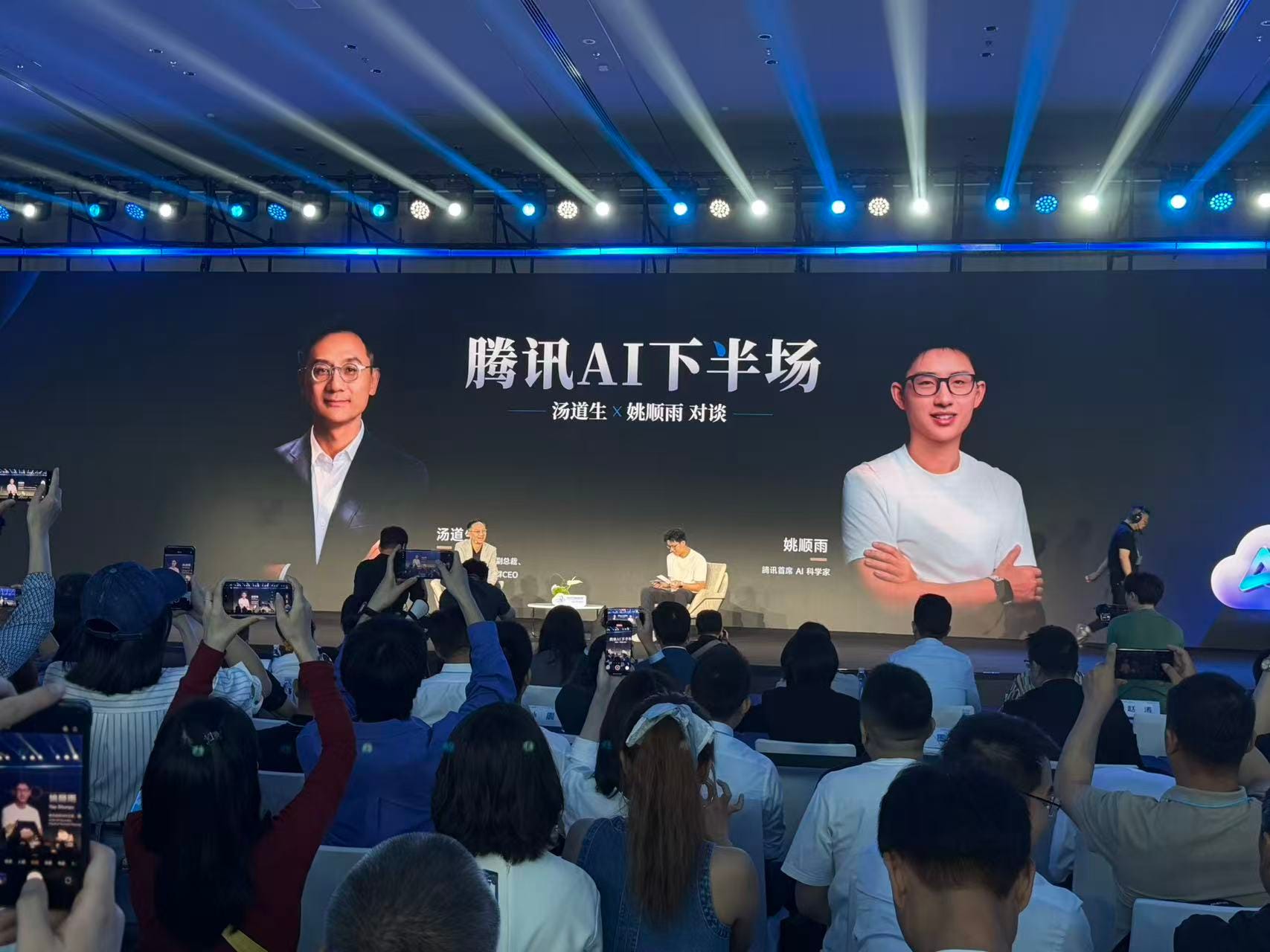
Dowson Tong: Today, I have specially invited Tencent’s Chief AI Scientist, Shunyu Yao, to chat with everyone about Tencent’s thinking and progress regarding large models and AI products. Let me briefly introduce Shunyu. In academia, Shunyu proposed the ReAct framework, and at OpenAI, he was involved in cutting-edge Agent products like Operator and Deep Research. Since joining Tencent, he has spearheaded the architecture of the Hunyuan large model. He not only understands frontier technology but is also deeply rooted in the front lines of business, so I believe he will bring unique insights. Let’s welcome Shunyu.
Host: Please welcome Tencent’s Chief AI Scientist and Head of Tencent Hunyuan Large Language Model and AI Infra, Mr. Shunyu Yao.
Dowson Tong: A very warm welcome, Shunyu.
Shunyu Yao: Hello everyone. I usually spend my time in Haidian District and rarely come to Chaoyang District, so I’m very glad to be here.
Dowson Tong: Our conversation today might take a relatively new format. If anything unexpected happens, I suppose we can consider it a surprise for everyone. Shunyu, before you joined Tencent, I remember asking you a few questions—specifically, why did you choose Tencent for the “second half” of the AI race? And what do you think is most important in this second half?
Shunyu Yao: First, let me explain what I mean by the “second half.” Lately, I feel this term has been a bit overused. This concept actually came from a blog post I wrote last year. What does it mean? I feel that before last year, AI had already been developing for decades, but the focus was heavily on how to solve problems—on finding good methodologies. Recently, it has become very obvious that while our methodologies have become highly mature, finding the right problems to solve has become much harder.
For example, in the past, we invented methods like AlphaGo to play Go, but that method was only suitable for Go or similar board games. You would build a specific model for translation, but it could only do translation and nothing else. However, with pre-training and post-training, we found that we now have a universal hammer that can strike any nail. It is a general methodology capable of solving all kinds of problems. Paradoxically, the harder part now is figuring out which good problems to solve.
A big reason I joined Tencent is that there are so many great problems and so many products here. I believe this aspect will become increasingly vital moving forward. On one hand, good products solve the first question: where exactly do we apply pre-training and post-training to generate real value? On the other hand, the environment is critical. Without a good environment, an Agent cannot perform various actions. For instance, if there is no food delivery tool available, it cannot order food; many things simply become impossible.
I believe the most critical factor is context. Whether for enterprises or individuals—as I mentioned last time at AGI-Next—context is becoming increasingly crucial. Because models are getting better at turning a highly complex input into an output, your competitive moat often boils down to whether you possess the raw, original input. Do you know what a user is actually doing? Do you have access to an enterprise’s diverse streams of information? I think Tencent holds a massive advantage here.
However, that is actually only the second biggest reason. The most important reason is the culture. I remember my first chat with you, as well as with other leaders in the Administration Office (General Office). My first impression was that everyone was incredibly honest—very straightforward about what was going well and what wasn’t, without trying to cover things up. That candor left a deep impression on me.
Secondly, Tencent as a whole is a company that runs on trust rather than just metrics. I believe this is crucial for doing AI. Our culture has a very low-ego, highly solid side to it, and these traits are vital for building a long-term AI organization, including our commitment to long-termism.
So, what matters most in the second half of AI? Personally, I think it’s about establishing a long-term, AGI-based organization in China. Today’s AI primarily consists of three parts:
Foundation: How we make the most basic elements of pre-training and post-training incredibly solid.
Product: How we take this technology and truly generate value for people and society.
Frontier: How we explore new research paradigms and hunt for new opportunities.
I believe the most critical task is to build a highly balanced, triangle-like organization. For the foundation side, the most important things are having ample resources and the right way of doing things, which aligns with the culture I just mentioned. For products, having a strong product sense and the right product people is paramount. Lastly, regarding the frontier, we aren’t doing enough frontier exploration in China today, so I hope to inject more of that spirit into our organization.
Dowson Tong: The sincerity and pragmatic atmosphere you felt during our chats is feedback I also frequently get from clients. I think our way of doing things and our product philosophy are quite realistic. After all, the AI track is a marathon. Sometimes awareness is very important—we have to own up to what we do well and what we don’t. But ultimately, this is a multi-dimensional competition. We see a lot of progress in models now, and our products are taking on more and more forms to meet different needs in various scenarios. I think the future remains highly promising.
You just mentioned models and products. You could say products provide an environment that feeds context to the model. I wanted to ask: a phrase we use quite a lot in our meetings is Co-Design—how to tightly integrate products with models. This is especially true today with such a rich array of products, from chatbots like Yuanbao, which we work closely on, to AI search, and enterprise deployments like intelligent customer service and smart marketing. Additionally, products like CodeBuddy and WorkBuddy have become incredibly hot lately and rely heavily on models. How do you view this approach of Co-Design?
Shunyu Yao: There are three main points. First, the prerequisite for Co-Design is that the model itself must be solid; a lot of foundational work has to be done right. I view pre-training as a relatively product-agnostic process. When done solidly, it provides a powerful foundation. Its greatest characteristic is that it’s a generalizable learning process, meaning its advancements can continuously elevate the value of various downstream tasks.
For post-training, I believe the most critical thing is establishing the correct Evaluation (Eval). In China, there is an unfortunate tendency where people love to game leaderboards (刷榜). But I believe it is far more important to be realistic and construct truer Evals based on actual products and real-world applications.
Second, we must realize that “practical value” outweighs leaderboard-climbing value. We have done a massive amount of work on this, engaging in deep Co-Design with various products. A crucial element of Co-Design is building mutual trust. We worked incredibly hard to achieve this mutual trust—figuring out how to utilize product data effectively, handle data flywheels (回流), and set up proper Evals. There are many details here that I won’t get bogged down in.
Third, I want to say that the most fundamental difference between the LLM era and past AI is generalizability. Before LLMs, if you were building a translation product, you just needed to curate excellent translation data. If you were making a Go program, you just needed great Go data. Today, however, even if you want to build a pure Coding Agent, you’ll find that you need far more than just coding data. You need excellent conversation skills, strong search capabilities, robust instruction-following, and deep reasoning. It requires a highly complex data taxonomy, and you need a real taste for it.
The corollary to this is that systematic product ecosystems hold a major advantage. For example, our Co-Design with Yuanbao endowed our model with strong chat and search capabilities, which can then be transferred to other products like ima and WorkBuddy. So, while these products provide different types of data, the data can cross-generalize. It forms a network-like ecosystem, and the value of this is becoming increasingly important.
Dowson Tong: Right. External leaderboards are a type of Eval, so what is the difference between our internal Evals and those external leaderboards?
Shunyu Yao: First of all, benchmarks still have value; they aren’t entirely useless. It’s just that these leaderboards are highly prone to overfitting. Relying on real-world data helps model R&D in a few ways:
Discovering baseline flaws: One of the main reasons we release a Preview model is to gather real-world feedback to fix baseline issues that leaderboards miss. This leads to massive improvements in the official version.
Deeper understanding of the actual prompt distribution: For example, benchmark questions are usually highly precise with long, concrete descriptions, and typically consist of a single question. In real scenarios, however, user queries are often vague—just a sentence or two—and involve continuous follow-up questions. These scenarios inspire us on how to train models better.
Finding inspiration to push new domains: We can spark ideas from these products to advance benchmarks or domains that don’t even exist yet. For instance, we’ve done a lot of work on in-context learning recently, and feedback from Yuanbao has given us tremendous inspiration and help. So, the way products and models empower each other is becoming an increasingly vital topic in AI.
Dowson Tong: I remember when we were developing Yuanbao in the early days, we ran into issues with multi-turn instruction following. The way users iterate on prompts in a live product is quite different from a benchmark. The capabilities required in a real product genuinely seem to differ significantly from benchmarks.
Shunyu Yao: You’ve asked me so many questions, let me ask you one.
Dowson Tong: Go ahead.
Shunyu Yao: I remember our very first chat where you shared a lot about your past experiences—from the eras of Qzone and QQ Show (which was my favorite product back in primary school) to QQ Music, Tencent Cloud, and now Yuanbao. It’s fascinating chatting with you because you’ve built all kinds of products: to-C, to-B, products from the ancient internet era, and now AI-era products. I’m curious, what is your first principle for product development? Which experiences and values remain constant, and what has changed?
Dowson Tong: I think ultimately, product development always boils down to what the user actually needs, how to solve their pain points, and how to create value for the user or client. In different eras, and even across different industries, a product must deliver real value for users to buy into it and keep using it. That’s why whether it was the PC internet era when we built Qzone, the mobile era with various content products, or the industrial internet era with Cloud, we always had to spend a lot of time and energy listening to customers and trying to solve their problems. The underlying logic hasn’t changed all that much.
However, building products in the PC and mobile eras is indeed quite different from building them in the AI era today.
First, from a paradigm standpoint, prior to the AI era, we mostly thought about satisfying user needs through fixed features. As a product or service provider, you mapped out a specific capability and let users select options from a menu—it was like a “pre-prepared dish” where they could only order what was already there.
But in the AI era, the open-ended nature of services introduces very different requirements and challenges. With simple interaction methods like natural language or voice, you as the product developer don’t actually know what the user will ask. Therefore, you must fully leverage the model’s capabilities to understand user intent. Then, through things like the large model’s logical reasoning, it can call upon tools. The product’s job is to supply the model with various usable tools to handle these open-ended requests. This is very different from how we used to build products.
This also applies to the Evals you mentioned earlier. In the past, product development followed clear, concrete descriptions of detailed features, with structured processes for design, R&D, and testing. That waterfall workflow was quite defined. With AI products, I’ve found the biggest change is that our entire workflow has to be redesigned. Especially this year, as the vast majority of code is generated by AI, our engineers might spend more time on system and architectural design, leaving the actual coding to AI while stepping in periodically to guide and correct it.
Testing also has to shift left—becoming much more front-loaded. We have to think ahead about our Evals, environments, requirements for open-ended answers, and even alignment to match the style our users need. I feel that building products in this era requires a much more comprehensive set of capabilities.
Shunyu Yao: It’s gotten harder.
Dowson Tong: Much harder. Let me ask you about Hunyuan 3. Everyone is saying that Hy3 Preview is your debut show at Tencent. Can you introduce what specific changes have been made in Hunyuan 3?
Shunyu Yao: Honestly, I don’t think there are any secrets. To some extent, building large models today is a somewhat trivial matter in terms of the formula: you need to get the infrastructure right, and you need to get the data right. The algorithm part is actually relatively simple. I’d highlight a few key points:
First, we completely rebuilt the infrastructure, both for pre-training and reinforcement learning. Second, we made massive changes to our data and Evals—focusing on how to define truer problems, enrich data taxonomy, and elevate data quality. This is an endless pursuit.
Third, a lot of critical decisions—including how to recruit, how to set the cadence for model releases, and navigating the daily trade-offs—don’t have a clear-cut formula. I think it is highly taste-driven.
Because of this, I’m actually curious to ask you a question. Since you just brought up Co-Design, what are your thoughts on it? What tasks do you think should be handled by the model, and what should be handled by the product?
Dowson Tong: I think Co-Design has been continuously shifting over the past two years across different stages. To some extent, this evolution moves in tandem with the upgrading of model capabilities. Of course, as the industry, market, and user needs evolve, it requires better alignment from both the model and product sides.
One thing that struck me deeply is the challenge of alignment. When we sit down together for product alignment meetings, we face many different decisions. The product side might want to solve a problem in a specific direction, and we have to figure out how the model can meet that need. But it always goes back to the fact that models require data. How should that data be annotated? To what level of granularity? What constitutes good versus bad annotation? Because some behaviors need to be rewarded, while others need to be penalized.
Then there is the Eval and assessment. If the product team identifies something as a good user experience, but the Eval system doesn’t recognize it, the product built out of that mismatch will be inconsistent. So, my sense of Co-Design is that it requires different roles within a project team to participate in product design from the start. Once product goals and directions are set, multiple roles must achieve solid alignment on open-ended questions. Without this alignment, you’ll find the product’s behavior becomes unpredictable or even random, because the model’s training process gets muddled. This is a profound realization I’ve had over the past two years working on Co-Design between product and model teams. What do you think?
Shunyu Yao: I feel that, as I just said, the hardest part is establishing trust. Empathy is incredibly important because, at the end of the day, the goals of model developers and product developers have areas where they align, but also many areas where they don’t. Model people want the model to be as powerful as possible, while product people want user needs to be satisfied as much as possible. So there is a natural misalignment, and having the ability to change perspectives is vital.
You asked how we did Co-Design step-by-step with Yuanbao. A significant detail was that back then, we dispatched our strongest core talent from the post-training team to help Yuanbao optimize their post-training. At that time, our own pre-training wasn’t fully ready yet, but we knew that maintaining a product like Yuanbao and protecting its DAU would be incredibly critical for our subsequent model development and innovative collaboration.
At the time, many algorithm engineers didn’t understand this choice, and I had to work very hard to explain it to them. Looking back, those efforts were about making the right trade-offs. That move made the product team realize that the model engineers were truly looking out for the product. I think this played a monumental role in our later cooperation, including the successful launch of Hy3 Preview on Yuanbao. Of course, there are plenty of technical aspects to discuss, but the hardest part is always building trust and practicing empathy.
Dowson Tong: Yes, I completely agree. Let’s switch gears. You are the creator of the ReAct framework, and your PhD research centered around language agents. Have your perspectives from a few years ago materialized today? What are some examples?
Shunyu Yao: I felt quite sentimental the other day when I re-read my doctoral thesis. It felt like returning to an ancient era. The title of my thesis was “Language Agents: From Next-Token Prediction to Digital Automation,” written back in 2019.
Dowson Tong: Seven years ago.
Shunyu Yao: At that time, we literally only had GPT-2. Back then, it could only do next-token prediction, and the text it generated wasn’t very coherent and had a lot of rough edges. It was hard for people to imagine that it would one day become a world-changing force. Back then, if you had a bit of imagination in your research—for example, if you prompted it with “The capital of China is,” and through next-token prediction it answered “Beijing”—people were already thrilled that it somehow possessed knowledge.
My imagination was a bit wilder back then. I felt that GPT was something beautiful—that spitting out the next token was an elegant, minimalist, and universal concept. I believed its potential wasn’t just about outputting text, but about automating everything in this world. I actually didn’t think big enough back then; I called it “digital automation,” but looking at it now, it could be “digital and physical automation.”
My work during my PhD was mainly split into two parts. The first was how to establish an Agent methodology—how to turn a next-token prediction machine into an Agent, an automated machine. The most important piece of that work was probably ReAct. I remember a night in July 2022 when I first connected the PaLM 2 API with a hand-coded Wikipedia API. When it successfully answered a question based on that webpage through multi-turn interaction for the very first time, it felt like a dim light bulb suddenly flashing bright. As far as I knew, it was the first time humanity had connected an LLM to the internet for multi-turn interaction. My feeling then was that this would change things in 5 or 10 years—but it happened even faster than I imagined.
I remember when we first proposed SWE-bench, I thought: okay, if this can be achieved, it will clearly bring immense value—maybe tens or hundreds of billions at the time. But now we are looking at trillions. My initial thinking was still too small.
The other part of my work was defining digital automation tasks. For example, WebShop was the first internet-based Web Agent task, and InterCode and SWE-bench were among the earliest Coding Agent tasks. Looking at it today, the two most important pillars of Agent technology are indeed Web Agents and Coding Agents. The other day I was chatting in a group and looked at the conclusion of my PhD thesis where I listed my future work directions for 2024: first was training models for Agents, second was safe and robust deployment, third was scientific discovery, and fourth was helping humans. It made me quite emotional to realize how fortunate I am to be working on exactly those future directions right now.
Dowson Tong: Incredible. You are seeing the entire industry advance along every single one of those directions.
Shunyu Yao: Maybe I still didn’t think big enough. I thought my vision was wild back then, but it turns out reality is even bigger.
Dowson Tong: Technological advancement often outpaces our expectations. Today, everyone says that Agents consume massive amounts of tokens. For Hunyuan’s next-generation model R&D, what is your focus, and what areas do you think are most important?
Shunyu Yao: Without a doubt, Agents and Coding Agents are things we must do, much like pre-training was; they represent foundational capabilities. Personally, I believe Coding Agents are fundamental for several reasons. One key reason is that coding is somewhat Turing-complete. When a model has the ability to control its own file system and run within a container, it becomes a complete system.
Today, Agents are unquestionably the core focus for every model vendor. I think our approach will differ in a few ways:
First, even though coding is the most critical task today, we will still emphasize a comprehensive ecosystem. I firmly believe that to do coding well, you need data far beyond just coding—you need chat, reasoning, and all sorts of diverse inputs, because the core value of a large model is generalizability.
Second, the role of products is visibly becoming more important. Figuring out how to utilize live online data flywheels is a challenge every model vendor is grappling with. This is where our accumulated Co-Design experience becomes incredibly valuable.
Third, we still need more imagination. Whether in technical evolution, product iteration, or even the shift to the next paradigm, we need to dedicate resources to exploratory work, even if it comes with uncertainty.
Dowson Tong: From the product side, because we hear more and more voices expressing “token anxiety” due to the exponential growth of token costs, I hear many clients and even colleagues keeping a close eye on credit or token consumption. How can we make our models more token-efficient when solving a problem or completing a task? I’ve seen tasks where a model tries different paths; it might know certain directions won’t work out, but it still tries them, hits a dead end, and then tries the next one. What can be optimized here to make overall token usage more efficient?
Shunyu Yao: I think when people discuss cost-effectiveness in China, they often focus strictly on model architecture, but it’s actually a highly complex system. The most important factor is performance. Many people tell me that they ultimately find using a model like GPT-4-Opus cheaper than using a lesser model, because it gets the job done right much faster, saving human effort. Performance is paramount; if your performance is excellent, cost-effectiveness follows.
Particularly this year, robustness on simple tasks will become even more vital. Getting a relatively simple task right on the first try is a more critical piece of cost-effectiveness than just tweaking model architecture.
The second part is the cost itself. China is leading the world in this aspect—we have done a tremendous amount of work optimizing our costs. The core challenge in cost optimization is figuring out how to use a smaller model to execute higher-value tasks efficiently. On top of that, there is architectural innovation, long-context management, and scaffolding work to be done. If we can build a relatively small model that rivals large model performance and exhibits extreme robustness across the majority of tasks, even a 1% or 2% improvement in long-horizon tasks could be incredibly valuable in China today.
I’m curious to ask you: when did you realize that Agents represented a fundamentally new product opportunity, what is your current understanding of them, and where do you think the bottleneck lies for creating a truly seamless Agent?
Dowson Tong: The Agents we build take on different product forms depending on the scenario. In Agent design, a large part of it is about maximizing the model’s inherent capabilities. Of course, as models iterate and grow more powerful, the scaffolding work required by the Agent decreases. I’ve noticed several of our products over the past period simplifying their Agent architecture as model capabilities improved—allowing us to focus more on providing diverse tools and creating more “skills” so the model can complete tasks more efficiently.
We also supply the model with what we call “memory”—extracting information about the user’s past habits and preferences to serve as context. In a coding environment, we provide relevant code context; in WorkBuddy for office collaboration or PPT creation, the content focus and the context fed to the model will differ. So when we build different Agents, the key is understanding what content and information are vital and relevant in that specific scenario so we can coordinate cleanly with the model, giving it the information it needs while fully unleashing its capabilities.
Shunyu Yao: We’ve recently launched some products like WorkBuddy that have received quite good word-of-mouth, powered by small teams iterating rapidly behind the scenes. I’m curious, compared to traditional product R&D, what changes have occurred in product teams regarding R&D and organizational management in this new Agent era? What are your thoughts on this?
Dowson Tong: I was recently helping WorkBuddy with an organizational announcement, and I looked at their exceptionally flat organizational structure. It differs significantly from our past product structures. It consists of more small teams—three to five people—converging to tackle a specific domain. There is a lot of experimentation involved, and they also have to support Infra experiments. We let different small squads explore and then validate. Since most experiments don’t immediately yield positive feedback, we must be tolerant of team trial-and-error. Refining user workflows and achieving positive outcomes through a massive volume of experiments is exactly what the organizational form of native AI and Agent products needs to support.
Furthermore, engineers used to spend a lot of time writing code, but today, that work can undoubtedly be handed over to AI. Consequently, we are seeing a blending of roles. Everyone acts like a product manager—everyone needs a thorough understanding of user needs and must design the desired product form. Every engineer behaves more like a visionary leader, driving multiple Coding Agents to develop and build according to our product requirements. At the same time, they participate in evaluation and testing early in the cycle, leveraging AI capabilities to front-load quality assurance and alignment work.
I also want to ask a question that gets discussed quite a bit. Many people mention that Tencent is “slow” and that we didn’t capture certain opportunities in AI fast enough. Do you think we are truly slow? What exactly does the second half look like? Could you elaborate on that?
Shunyu Yao: I feel like that’s a question I should be asking you! (Laughs)
Dowson Tong: Haha.
Shunyu Yao: First of all, I think there are two major judgments to make about AI today. The first is: do we view AI as a short-term game or a long-term game? In Silicon Valley, a lot of anxiety is spreading—people saying everyone will be unemployed in a year or two, AI will replace all jobs, so we should make money quickly for two years and retire. But clearly, our judgment is that AI is a long-term game. In fact, I think AI is just getting started; the second half has barely begun. I don’t believe chatbots will be the only super-apps; that would be a very bleak world. There will undoubtedly be a continuous stream of new opportunities. Today feels a bit like the 1970s when the PC was just born; there is still so much work to be done.
The second judgment is whether this will be a linear, winner-take-all game or a diversified game. Granted, over the past few years, everyone has witnessed a very clear main line: pre-training, post-training, then Agents, and Coding Agents. It seems like everyone is doing the exact same thing and copying each other, which is also quite uninspiring. But will the future become more singular or more diversified? My personal view is that it will become much more diversified. Without a doubt, Coding Agent productivity will become increasingly vital, but it’s just getting started. There is still so much unfilled space in this world—multimodal, embodied AI, and many other new things are unfolding or just beginning. From this perspective, if we believe the second half is just starting, it’s certainly not over. Our past models and products underwent a lot of exploration and took some detours, which is completely normal. If you’ve never done something before, doing it for the first time will inevitably involve twists and turns. What matters most is whether you can face yourself honestly, be real, look at feedback and adapt, and maintain patience. This mindset is what matters most in the second half.
Dowson Tong: People often like to pick a specific point to criticize Tencent, but we welcome everyone holding us to a higher standard. We are a highly diversified company with many products across numerous tracks, and multiple teams pushing forward different projects simultaneously. Naturally, in such a complex organization, we might move faster in some areas, slower in others, and experience failures during exploration. These reminders are excellent, and there are certainly areas where we can do better.
But as you said, this is a marathon. Tencent possesses an incredibly rich tapestry of application scenarios. Going back to why you chose Tencent initially—AI requires context, and models require an immense amount of it. The accumulation across Tencent’s diverse products and tracks over the years can provide valuable, scenario-specific context to unleash the model’s value.
In this long-distance race, I am confident the model will continuously iterate, user needs will keep evolving, and new product paradigms will emerge. For instance, we reacted quite rapidly to the AI wave early this year. Meanwhile, Agent products like WorkBuddy actually started development a couple of years ago, evolving from our work on Coding and CodeBuddy as we realized non-programmers also had intense demands. Today, we hear high expectations from clients regarding how our different products can be combined. We are right in the middle of this marathon, so please continue to give us reminders and suggestions, and use our products to give us positive feedback.
I see that we have run over time. I’d like to begin by thanking Shunyu for sharing his insights today. We’ve covered model building, product development, Co-Design, the evolution of Agents, organizational transformation, and industry opportunities. Over the past year, we’ve seen many enterprises share common confusions or face similar challenges. If products aren’t utilized effectively, enterprises cannot sustain investment, or if the ROI is insufficient, it slows down the adoption of AI across industries.
To address this, we are launching a suite of Efficiency Agent Toolkits today to help enterprises deploy application Agents more securely and efficiently. Behind this are three core capabilities of Tencent:
Scenario Connectivity: Leveraging high-frequency touchpoints like WeChat, WeCom, and Yuanbao to embed large models into real business workflows, deeply connecting with users, data, and ecosystems.
Engineering Mastery: Utilizing a comprehensive Harness system to ensure Agents run stably, reliably, and sustainably. This is backed by powerful AI Infra—including high-speed networking, high-throughput storage, and a high-performance Agent Runtime—to guarantee high GPU utilization.
Model Drive: Relying on the Hunyuan large model and model-product Co-Design to balance practicality, cost-effectiveness, and ROI.
At the same time, we are launching the “Tencent AI Co-Creation Camp (Phase II),” joining hands with ISVs and MSP partners to co-create industry solutions and establish benchmark case studies. In the upcoming segments, my colleagues will share further details on these initiatives. This afternoon, we will host multiple parallel forums covering product technology, industry scenarios, and ecosystem co-creation across various personal and enterprise productivity scenarios, alongside an AI product launch session to introduce over 20 new products and capabilities to everyone.
That concludes our dialogue for today. Thank you, Shunyu, and thank you all!
Disclosure: I hold no position in Tencent but have had a consulting relationship with the company within the past 12 months.