


This essay was originally published in German and translated by the author. This is a guest post from René Ruschmeier, co-founder, senior strategist and lead author of 理门 Limen China, a businsess intelligence consultancy focused on contemporary China.
An autumn of decisions. What German policymakers have been unable to deliver appears to be especially high on the agenda in Brussels. Last week was exceptionally eventful for the reorientation of trade relations between Europe and China.
Whether it also produced meaningful results, or even amounted to a success, will become clear in the weeks and months ahead.
Immediately before the visit by European Trade Commissioner Šefčovič, German Chancellor Merz and French President Macron presented a joint paper of remarkable clarity. The European Commission is to receive an instrument that, as a last resort, would allow trading nations to be immediately excluded from the European single market.
Political circles in Berlin, meanwhile, were speaking of a “second strike weapon” and a “kill switch,” with no audible doubts that the instrument would be directed primarily at China.
That is reason enough to take a careful look at these developments.
Is a threat to exclude China from the European single market credible?
How are different economic and geopolitical voices responding to the initiative?
And how should companies with exposure to China respond now?

The central question is what conditions Europe must establish for its market power to enable a durable understanding. Our yardstick is whether Europe can sustain its economy through the period before such an understanding is reached.
Remembering Cuba
As increasingly forceful metaphors of war enter the debate over strained trade relations, it is worth asking what we might learn from these analogies.
In October 1962, the United States discovered Soviet missile installations in Cuba. Kennedy demanded their dismantlement and imposed a naval blockade described as a quarantine. For thirteen days, the threat of nuclear war loomed. The crisis had been preceded by the failed Bay of Pigs invasion in 1961, carried out by Cuban exiles supported by the United States. The eventual resolution combined the Soviet withdrawal of the missiles with an American pledge not to invade Cuba and an initially secret understanding on the withdrawal of American missiles from Turkey. A direct communications link between Washington and Moscow was established in 1963.
This offers a framework for assessing European trade policy toward China.
A threat requires credibility.
Your own vulnerability must be understood and politically bearable.
An understanding requires conditions under which both sides can change their behavior.
The nuclear dimension of that conflict also sets a clear limit to the analogy. Economic measures operate through companies, supply chains, investment, and prices, with consequences distributed unevenly across time and society. These differences deserve particular attention when concepts from deterrence policy migrate into the trade debate.
Avoiding conflict should be one measure of success in economic policy. Its value lies in a durable framework that preserves fair business opportunities and reduces critical vulnerabilities. The costs of persistent distortions and a failure to adapt must also enter the calculation.
An Understanding in Beijing or Just Buying Time
After Merz and Macron published their “nonpaper,” EU Trade Commissioner Maroš Šefčovič traveled to Beijing and met with Chinese Commerce Minister Wang Wentao and Vice Premier He Lifeng. The joint statement concluding the talks contains 16 points. These include an understanding on trade in hybrid vehicles, further discussions on possible tariff reductions, continued proceedings on price undertakings for electric vehicles, and technical dialogues on market access and regulation. Another ministerial meeting is planned for January 2027, followed by the next round of trade talks in March.
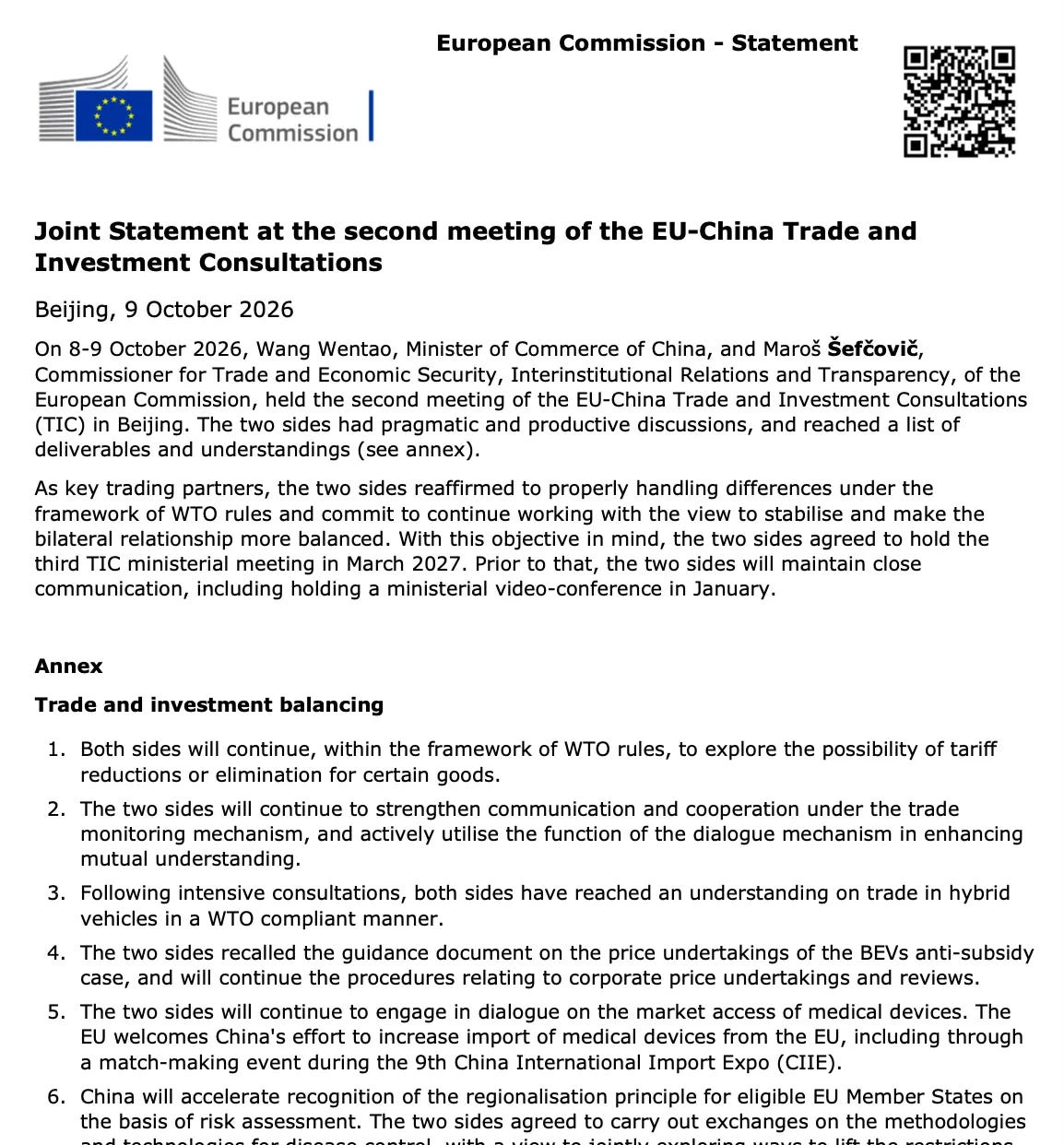
On export controls, China is to further facilitate licensing for rare earths and permanent magnets through the existing expedited process. The European side intends to work with the relevant authorities in member states to advance priority licenses for certain goods with both civilian and military uses. The two sides also agreed on advance warning and greater transparency in procedures for adding companies to control lists and removing them.
In his closing remarks, Šefčovič highlighted three outcomes. The understanding on hybrid vehicles, he said, opens the prospect of reducing Chinese hybrid vehicle exports by more than half relative to the projected trajectory over the next four years. Potential tariff reductions would affect European exports currently worth nearly €4 billion and could save at least €225 million in duties. A further easing of export licensing was the third outcome.
The Chinese business publication Caixin explains that the announced reduction in hybrid vehicle exports refers to the Commission’s forecast for the next four years. It means limiting exports relative to their expected trajectory in the years ahead. The measures intended to achieve this have not yet been disclosed. China’s Ministry of Commerce emphasizes that escalation was avoided and states that Chinese companies’ actual export interests have been safeguarded.
In China’s assessment, the negotiations have initially avoided an escalation. Whether they deliver tangible results or merely buy more time remains to be seen.
A Threat of Retaliation Requires Credibility
The statements issued by both sides after the negotiations make no reference to the paper by Merz and Macron. Whether it nevertheless came up during the talks, and what effect it may have had on the course of negotiations, remains a matter of speculation.
The proposal is nevertheless now on the table and requires further discussion within the EU.
In their accompanying letter to Commission President Ursula von der Leyen, Berlin and Paris place particular emphasis on faster European decisions. For the instrument’s subsequent activation, Merz and Macron propose that a measure put forward by the Commission be adopted unless a qualified majority opposes it. Establishing the instrument in law requires a separate procedure. The proposal is intended to apply regardless of the country targeted and to address severe, persistent, or systemic market distortions.
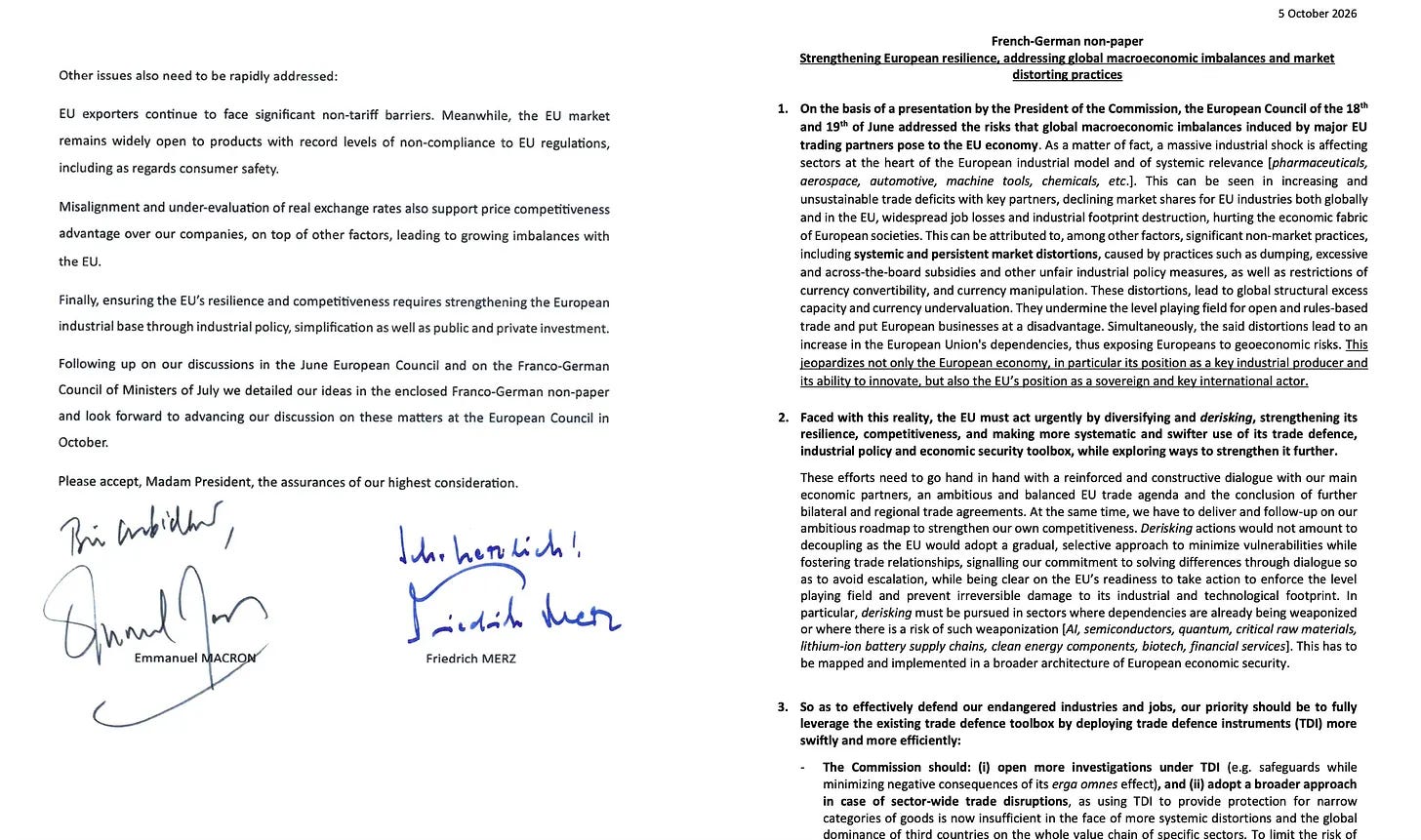
The instrument is intended to enable a broad range of interventions that could, if necessary, extend to immediate exclusion from the single market. The precise scope of such an exclusion remains open.
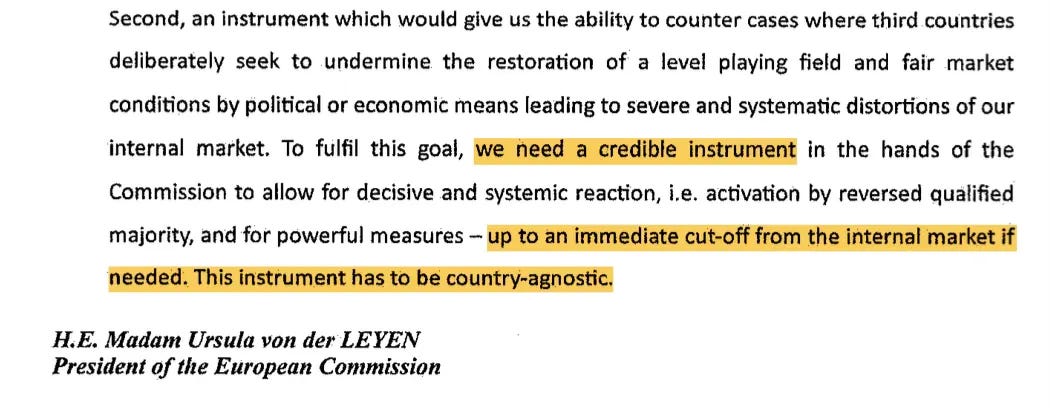
We therefore see two features in the paper whose combination is central to this new “weapon” for potential future trade wars.
“An immediate cut-off.” It remains unclear whether the measure would cover all trade with a country or only individual product groups. The wording allows for a country to be targeted, which would in itself constitute an extraordinarily drastic measure, comparable to the current sanctions on Russia, which still contain exceptions.
Reversing the majority rule. A qualified majority must object, or the measure takes effect.
Viewed in this light, it is understandable that the proposed “cutoff” has become a “weapon,” a “second strike weapon,” or a “kill switch” in media coverage and political debate.
This brings us back to the logic of nuclear deterrence and the proposal’s Cuban Missile Crisis vibes. Of the conditions for successful deterrence outlined above, the first two are particularly relevant here. The threat must be credible. It must also be particularly credible that the party making the threat is prepared to bear the consequences for itself.
In the EU context, this also means that, even under a reversed majority rule, it must be credible that at least a majority of member states will be prepared to bear the consequences of deploying such a powerful trade policy weapon and defend that decision politically at home.
A trade policy instrument with this kind of power is not entirely new. Since December 2023, Europe has had an instrument to counter economic coercion, the Anti-Coercion Instrument, or ACI. Its conditions for use concern attempts to influence sovereign political decisions through trade measures or restrictions on investment. The Commission describes its underlying objective with remarkable clarity.
“The primary objective of the ACI is deterrence. The instrument will, therefore, be most successful if there is no need to use it.”
At its core, the aim is deterrence that makes using the instrument unnecessary. The same can probably be said of the paper by Merz and Macron.
The new initiative also addresses a broader set of problems. Before countermeasures of this magnitude are activated, economic coercion and systemic distortions of competition require a diagnosis that can be substantiated and instruments suited to it. A sound policy must explain which behavior is to change and which economic damage is to be contained.
Further international support emerged during the week. On October 7, 2026, a subset of G20 trade ministers published a joint ministerial statement on structural excess capacity. The signatories include the EU, Germany, France, the United States, India, and Japan. China is not among them.
“We call on all countries to take steps to eliminate structural excess capacity and production in their economies, including by ending the use of non-market policies and practices that distort markets and contribute to the problem.”
Sectoral working platforms are planned, initially covering vehicles, batteries, chemicals, mature semiconductor technologies, and solar modules. This gives Europe an opportunity to coordinate data, diagnoses, and measures more broadly with international partners.
How far this support will extend in a specific future conflict remains to be seen.
Credibility grows with the ability to translate shared positions into decisions and implementation.
Is Europe Ready to Bear the Costs of Retaliation
In 1962, the United States threatened the Soviet Union with retaliation. The resolution of the crisis combined credible military threats with reciprocal concessions and a way out that allowed both sides to save face.
If the EU wants to credibly threaten a cutoff of trade relations in 2026, that threat will have an effect only if it is credible that the overwhelming majority of member states would be willing to bear the associated costs.
For Germany, the recently published semiannual report of the Commission for the Review of Security Relevant Economic Relations between Germany and China, dated October 2, 2026, can help convey the potential costs of a cutoff in trade between the two countries.
“In the China Commission’s assessment, Germany’s overall economic security … in relation to China has deteriorated since the commission was established. German supply chain dependencies on China have intensified …
The strongest dependencies, and those most relevant to security policy, concern critical raw materials that underpin numerous technologies of the future and are indispensable for digitalization, the energy transition, industrial production, and defense technologies. … Estimates suggest that the EU sources up to 90 percent of its requirements for heavy rare earths and certain magnet products directly or indirectly from China. Without rare earths and permanent magnets, there will be neither an energy transition nor a modernization of Germany’s armed forces.
Geopolitical concentration risks resulting from accumulated dependencies are also a form of market failure. Progress in reducing them remains limited. In 2025, as in previous years, China was Germany’s most important source of imports, accounting for 12.5 percent of the total.”
In the context of our argument, supply chain dependencies, China’s importance as a source of imports, and the supply of critical raw materials describe the costs of a cutoff involving China. At least in the case of critical raw materials, the exposure extends beyond Germany to the EU as a whole.
For the European debate, this raises an essential question.
Given these extreme dependencies and the resulting costs of a cutoff, is the threat to use this instrument credible at all?
Our analysis also considers time. A supply interruption can affect production as soon as existing inventories are exhausted. Losing an export market affects orders, margins, and investment. Building new technological capabilities, in turn, requires its own development timelines.
For a critical input, what matters is inventory coverage, qualification of an alternative supplier, approval, and the time until a technically suitable replacement can be delivered. If securing an alternative takes longer than the business can tolerate an interruption, an operational gap emerges. A new trade policy instrument must be assessed against that gap.
A panel of economic experts from Germany and France, also reporting this week, recommends diversifying critical supplies and strengthening capabilities that cushion interruptions and make economic coercion more difficult. At the same time, they call for an assessment of the costs to consumers and companies in each individual case. Their benchmark is a targeted rebalancing of interdependence.
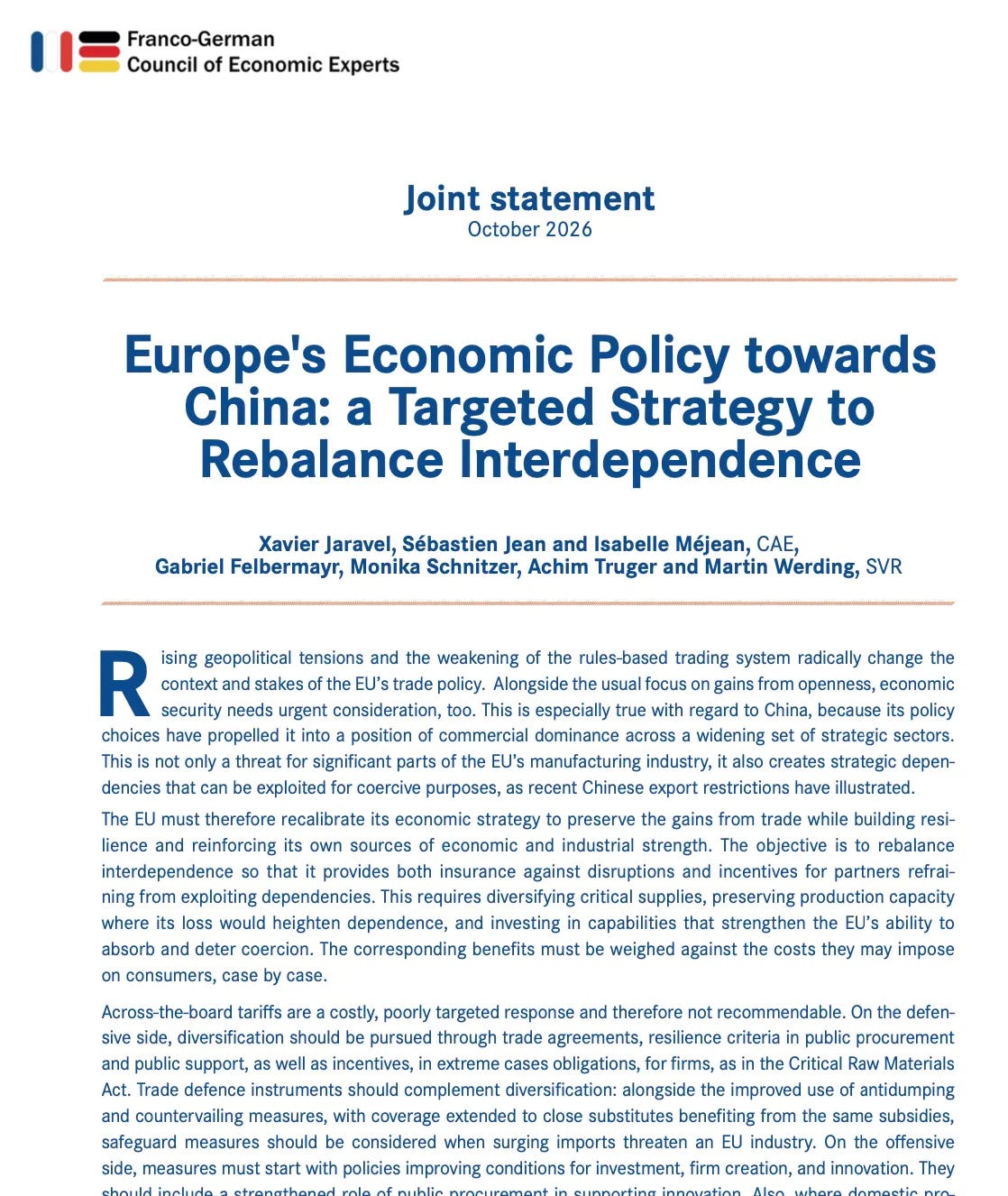
“The EU’s response to China’s growing industrial dominance should target the dependencies that create scope for economic coercion. …
Any such strategy must weigh the gains from resilience and deterrence against the costs ultimately borne by European households. Broad restrictions on Chinese imports or untargeted preferences for European production would impose substantial costs without necessarily improving economic security.”
This requires a precise diagnosis of China’s competitiveness. In his Chatham House report on Europe’s industrial future, James Kynge examines pharmaceuticals, electric vehicles, wind energy, and machine tools. He describes an interplay of research, industrial networks, scale, competition, and state support.
His findings call for taking China’s technological capabilities seriously and improving Europe’s own productivity and investment conditions.
For our argument, this means that European trade protection measures should make a demonstrable contribution to adaptation. That requires a goal for the capabilities to be developed or preserved during a period of protection, a timetable, and an assessment of the resulting costs.
Interests can also diverge within a company. A European group may source Chinese components, conduct research in China, and face Chinese competitors in European markets at the same time. The political category of China exposure must therefore be translated into specific functions, locations, and time horizons.
Room for Negotiation Requires Conditions
One final document from this week is a paper by the Jacques Delors Institute developing a Structural Rebalancing Instrument. The authors propose tariff rate quotas under which additional imports above defined thresholds would face higher duties. The design includes conditions for subsequent easing and a solidarity fund intended to cushion the costs of possible retaliation across member states and sectors. The authors acknowledge that some design questions require further legal examination.
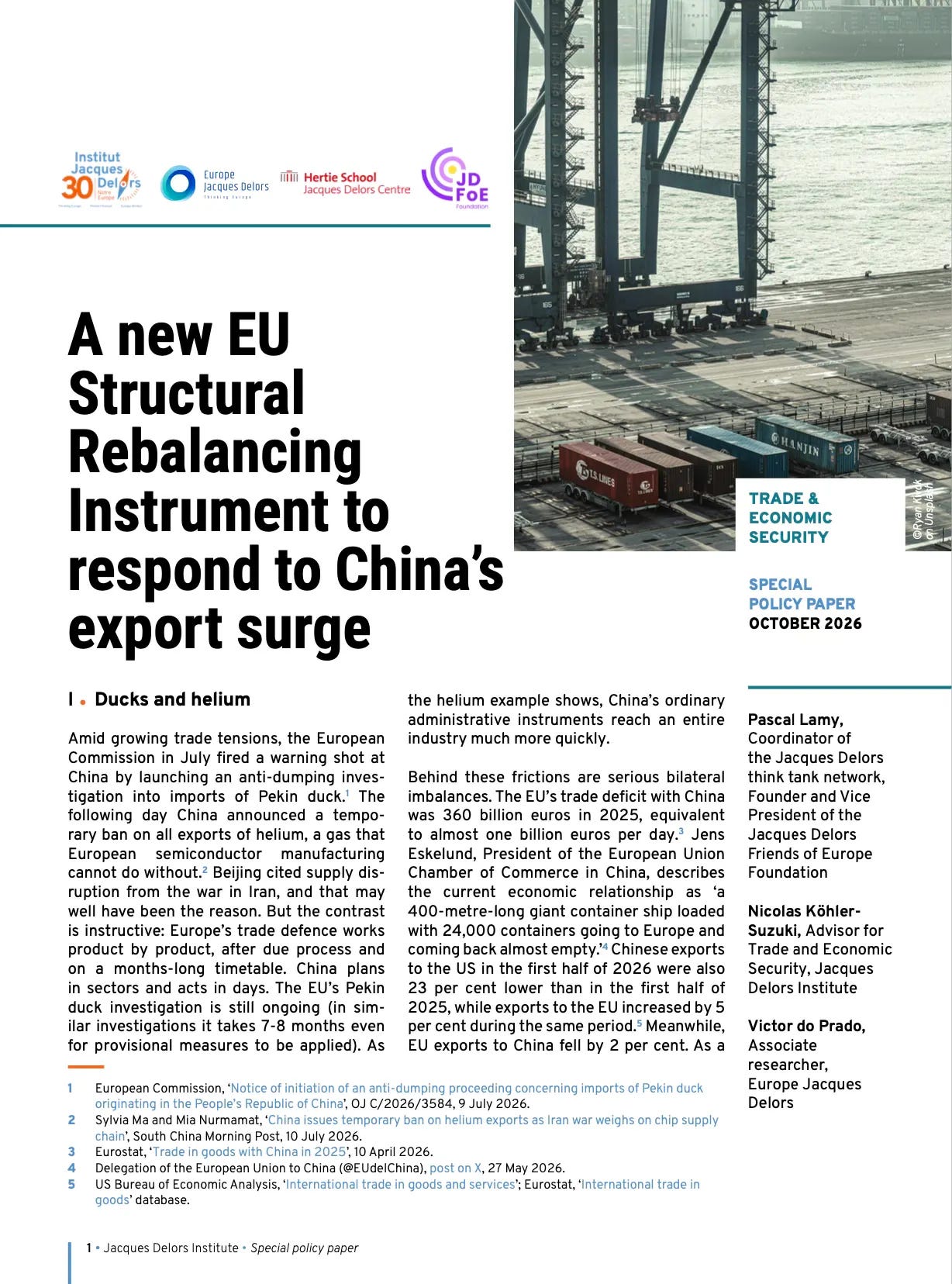
They also address the negotiating strategy toward China.
“So what is to be done? Two routes remain. Plan A is to negotiate with China. Plan B is a new instrument built for the problem. Europe needs both so it can speak softly while carrying a sizeable stick. …
The Commission should ask for three things: (1) verified volume restraint in the sectors where injury is documented, counted through the joint monitoring mechanism the two sides have already built; (2) capacity commitments in the sectors Beijing’s own campaign against ‘involution’ has named; and (3) the exchange rate issue to be placed on the agenda in the IMF and the G20.”
The legal design remains decisive. Conventional agreements on voluntary export restraints are generally prohibited under WTO rules. The legal basis on which the understanding is to be implemented must therefore be clarified.
The three conditions in our analysis nevertheless come together here. An instrument needs a credible prospect of application, the ability to bear its economic costs, and conditions for reaching an understanding. Jointly financing potential consequences could also be regarded as an investment in European cohesion.
The European Council Must Consider Implementation
The European Council sets the EU’s political direction. In our view, its meeting on October 15 and 16, 2026, should produce a mandate to give concrete form to the understanding reached in Beijing and prepare Europe to act effectively in economic affairs.
Three decisions deserve priority.
First, the Commission should present an implementation plan for the understanding reached in Beijing. Companies need clarity on the design of measures concerning hybrid vehicles, on export licenses, and on progress in market access. In our view, an initial public report by the end of November would be appropriate. Where quantified outcomes are promised, the baselines, assumptions, and methods for verifying them should be published.
Second, the Commission and member states should promptly compile an initial joint assessment of critical dependencies and the possible consequences of interruptions. With the participation of affected companies, they should gather specific information on the ability to bridge disruptions, secure alternative supplies, and establish alternative capacity.
Third, it must be clarified whether the instrument proposed by Merz and Macron should be added to the EU’s policy toolkit and what signals could reinforce the credibility of its enforcement.
The design of a new instrument should also specify its triggers, scope, and conditions for easing measures.
China Exposure Belongs on a Timeline
For executive and supervisory boards, assessing the developments unfolding in recent weeks begins with a more precise description of their companies’ own ties to China. Revenue and invested capital alone provide an incomplete picture. Critical inputs, development capabilities, customers, and local partners belong in the same assessment, a review of the company’s China exposure.
Every significant dependency should be linked to the duration of an interruption the business can tolerate and the realistic time needed to establish an alternative. If these periods are far apart, a decision is needed on inventories, alternative sources, capacity, or changes to the business model. The costs and forgone opportunities associated with these precautions must also be assessed.
Companies should also represent their interests to policymakers with reliable data. Those calling for protection measures or warning of their consequences should be able to explain what they would mean for production, customers, employment, and investment. This also improves the quality of the evidence on which European decisions are based.
The second strike weapon and the kill switch signal a new ambition for Europe’s use of economic power.
Its credibility begins with the ability to bear the economic consequences of its own decisions.
Its success will be measured by whether Europe reduces critical vulnerabilities and creates durable conditions for competition and mutual understanding.
A Personal Note
China.Table is once again seeking the Top 100 figures in the German speaking China community and is inviting nominations. If our work makes a meaningful contribution to your understanding of the China debate and to better business decisions, we would be very grateful for a nomination.
Henrike Scholz is accepting nominations at h.scholz@tablebriefings.de until October 23, 2026.

On rare earths, in no uncertain terms the EU was told ‘You are not the target’. In Chinese eyes, Europe simply doesn’t have a war machine to warrant a restriction.