



I would like to share my thoughts after spending two weeks in China in mid-March:
Sentiment is improving. Almost everyone I spoke with in Shanghai and Beijing said they are more optimistic about the economy than they were a year ago. This was my sixth trip to China since September 2024, when the political leadership announced a change in policy direction, and confidence among entrepreneurs, consumers and equity investors has been steadily, albeit slowly, improving.
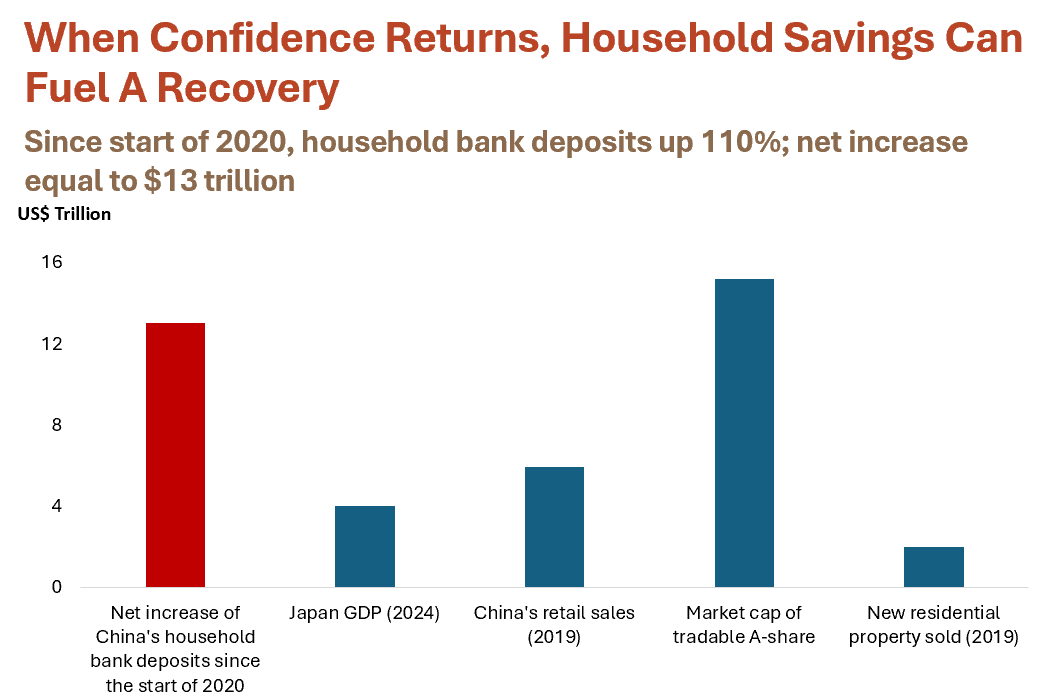
The Chinese consumer is likely to bounce back. Since September 2024, Xi Jinping has switched his policy focus from regulatory control to supporting the return of consumption as the main driver of economic growth. Household savings have more than doubled since the start of 2020, a net increase equal to US$ 13 trillion, and as confidence returns I expect consumers and entrepreneurs to begin drawing on this to spend on goods and services and invest in small businesses.
Deeper government support to further accelerate tech advances. The new five-year plan, published during my visit, provides high-level guidance on an ecosystem to support tech self-reliance and innovation for industrial development. The government is pushing banks and equity markets to finance privately-owned tech firms. If successful, this would boost hiring and sentiment, which would stimulate consumption.
Rising oil prices re-enforce Beijing’s belief in green tech. China is already the world leader in batteries, renewables and electric vehicles, and I heard expectations that the war in Iran will accelerate foreign demand for these goods as the 1970s oil shocks boosted American appetite for fuel-efficient autos made in Japan.
Iran conflict less damaging to China than to the US and its allies. China is better prepared: it reduced its dependence on oil and gas, filled its strategic petroleum reserve, expanded renewable generation, and has lots of coal. Beijing is also able to limit the impact of higher oil prices on retail gasoline prices.
Xi will welcome Trump to Beijing but doesn’t trust him. I heard that China is prepared to receive Trump whenever the war is cooled down to the point where he feels he can travel. Beijing will give Trump the pomp and circumstance he craves but does not trust him enough to engage in serious negotiations. China’s objective is to maintain stability in the bilateral relationship. My contacts do not expect Xi to push Trump to make a significant change to long-standing US policy on Taiwan.
Xi doesn’t plan to invade Taiwan. As on past visits, I heard no domestic political pressure on Xi to use force and no talk of plans to use force to coerce unification. While I was in China, the US intelligence community published its assessment that “Chinese leaders do not currently plan to execute an invasion of Taiwan in 2027, nor do they have a fixed timeline for achieving unification.”
The Chinese economy is likely at an inflection point. It is difficult to predict when this will become consensus, but this is a good time for global investors to pay more attention to China, to visit the country, to look for opportunities in tech, as well as in the consumer sector, which is underowned and undervalued.
More details on these topics follow
Sentiment is improving
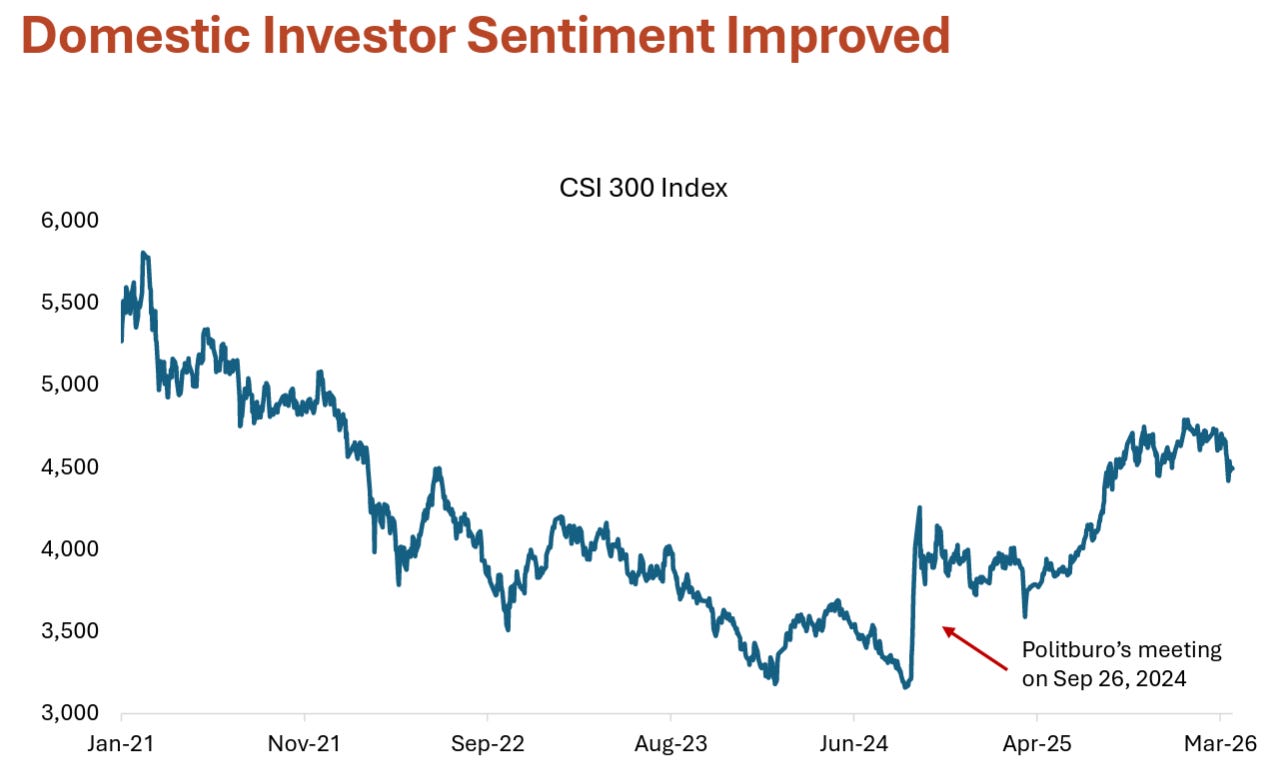
An important benchmark was the Politburo’s September 26, 2024 meeting, when China’s leadership effectively acknowledged that four years of regulatory crackdowns had gone too far, and they started the policy pendulum slowly swinging back towards supporting entrepreneurs and growth.
Since that date, the most important new policy was what hasn’t happened: no new regulatory storms. Last month’s visit was my sixth since that meeting, and there has been a steady, incremental improvement in sentiment among the people I’ve spoken with across 10 cities, with more frequent stops in Shanghai and Beijing. I’ve been asking businesspeople, economists, consumers and Didi drivers if they feel more or less optimistic about the coming 3-5 years compared to a year ago.
Domestic equity investors have been very optimistic, with the CSI 300 index up 27% since the Politburo meeting, through March 30. Chinese investors have remained relatively sanguine since the Iran war began, with the index down 5% through March 30, compared to a decline of 8% for the S&P 500.
Remember JPMorgan’s 2022 declaration that China was “uninvestable”?
Many people told me their confidence was based on the view that the residential property market, where prices are down about 40% from the 2021 peak, is likely to bottom in 2027. No one expects the market to pick back up anytime soon, but stabilization is likely to lead to stronger sentiment. I heard that a new high-end apartment complex in Shanghai sold out immediately after its launch.
Others noted that sales volumes of fast-moving consumer goods and luxury products had strengthened in the second half of 2025, although prices had not increased. I also heard that consumer services, including travel, have been healthy.
One economist reported that wage growth among listed companies had bottomed at 2% YoY in 2024 and accelerated to 4% YoY last year.
A university professor told me that last year very few of his graduate students had received job offers ahead of graduation, but the picture was substantially better this year.
Concerns about deflation have also eased a bit. The producer price index (PPI) remains negative, but there have been five consecutive months of MoM growth in input prices for the first time in many years. The consumer price index (CPI) strengthened a bit during the first two months of the year (both core and headline) and remains in positive territory. Both metrics are likely to continue to rise with higher global energy prices.
The Chinese consumer is likely to bounce back
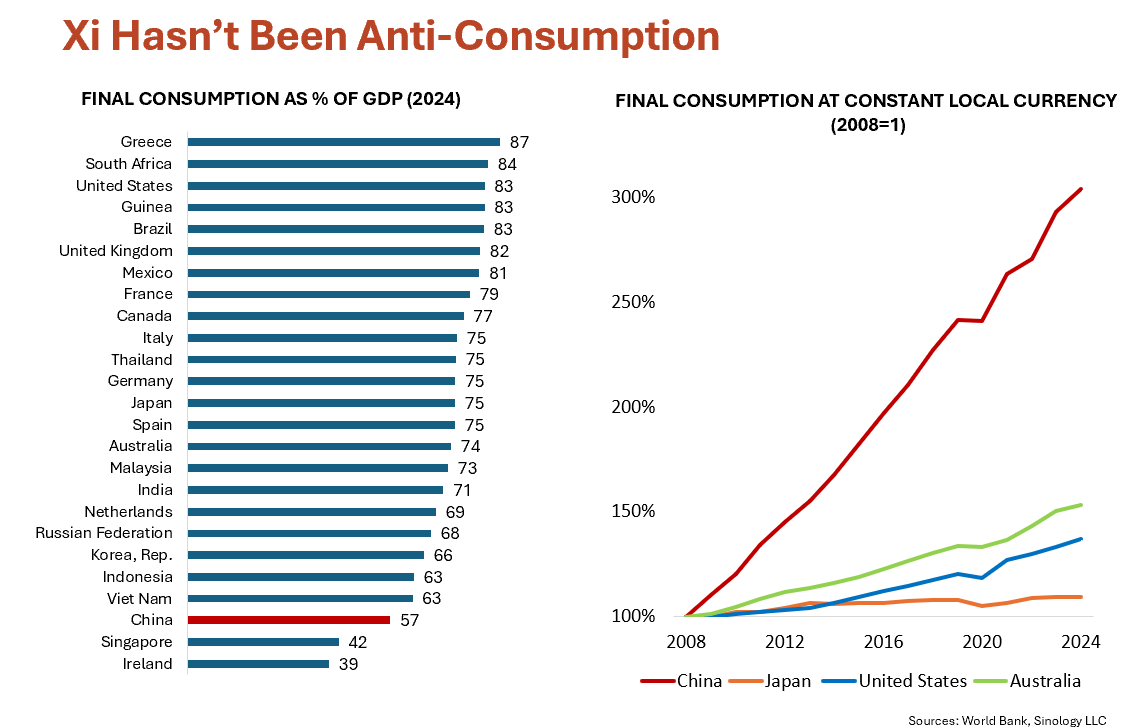
Following the 2024 Politburo meeting, Xi Jinping has signaled through widely publicized statements that boosting consumption is a top political priority. He also acknowledged that industrial overcapacity means China cannot return to its old playbook of using investment stimulus to promote economic growth. And Xi is not proposing to use exports to boost growth. All of his rhetoric is focused on domestic demand: “Expanding domestic demand is a strategic move . . . not a temporary measure to cope with financial risks and external shocks.”
As I explained in a January issue of Sinology, it is important to understand that prior to the 2020 start of Xi’s regulatory storm, consumption was the main engine of China’s economic growth, despite being a relatively small share of China’s GDP.
In the five years before 2020, real final consumption accounted for 64% of China’s GDP growth, while net exports on average contributed only 1% of growth. (The balance was from investment and inventory changes.)
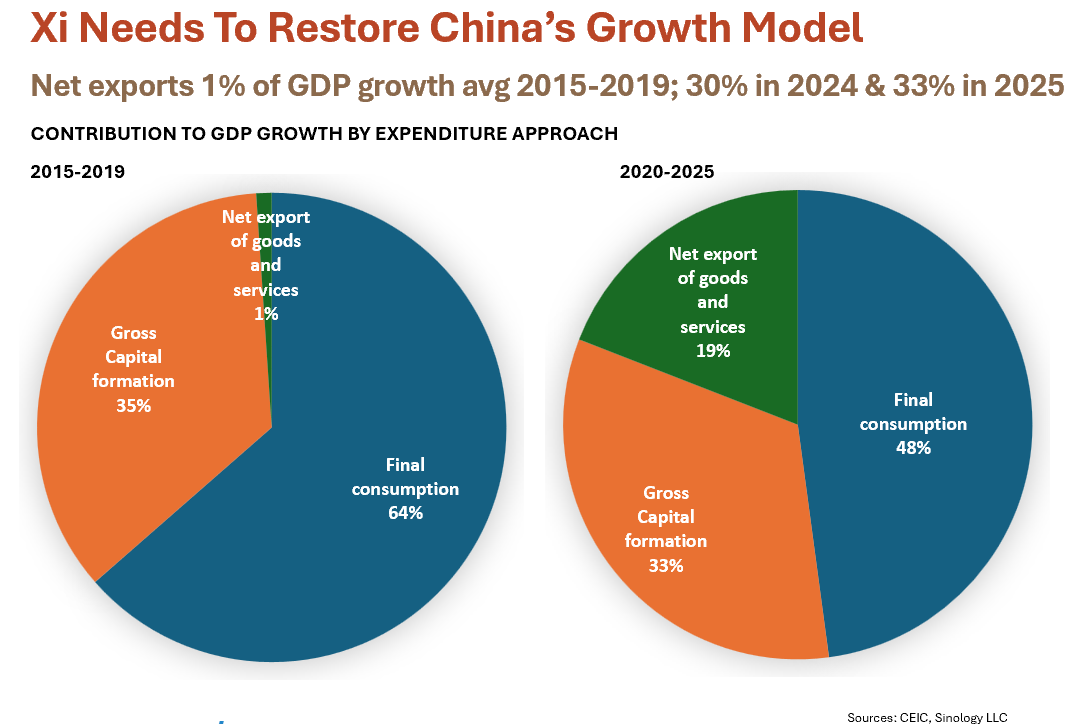
Since the start of the regulatory storm, consumption has slowed, but not collapsed.
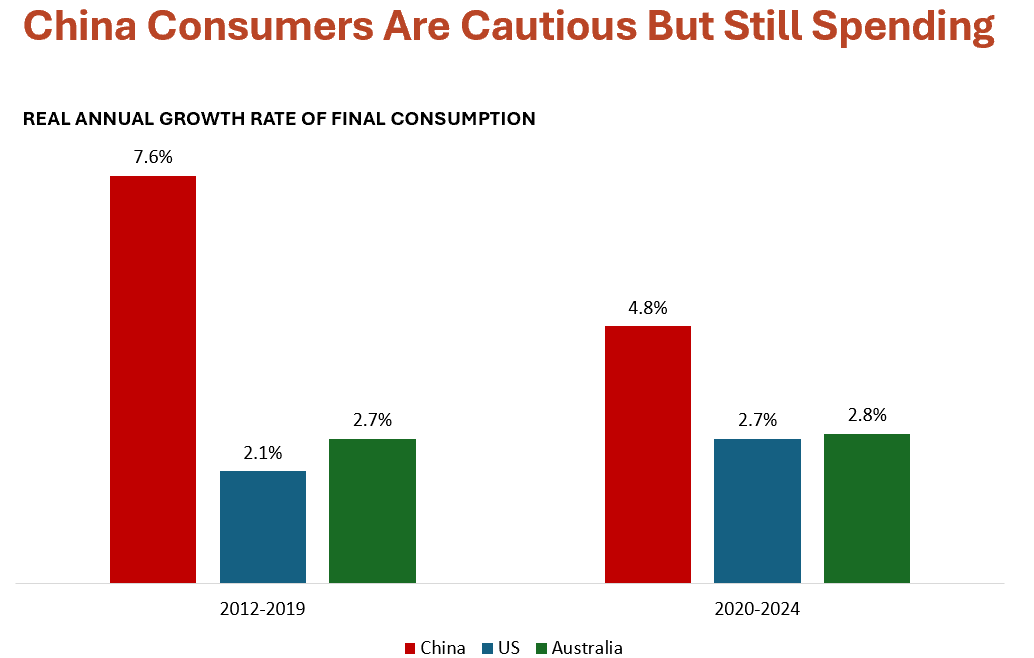
The challenge for Xi is not creating a brand-new consumption focused economic growth model, it is restoring confidence among entrepreneurs and consumers so that the economy returns to the pre-2020 model, with final consumption accounting for almost two-thirds of growth.
Based on the data and my conversations on the ground, I believe that sentiment has reached an inflection point and is gradually improving. I also believe that the government policy pendulum is likely to continue swinging away from regulatory control and towards supporting entrepreneurial growth.
Once confidence returns, households and entrepreneurs – who drive growth in jobs, innovation and wealth – have access to plenty of liquidity to fund more consumer spending, more investment and hiring in their own businesses, and more flows into equities. Household savings have more than doubled since the start of 2020, a net increase equal to US$ 13 trillion.
Deeper government support to further accelerate tech advances
The new five-year plan provides high-level guidance designed to encourage and support tech self-reliance and innovation that will in turn support industrial development and job creation. I heard that the government intends to deepen support for its AI+ action plan, as well as for robotics and semiconductors.
The five-year plan also implicitly acknowledges the absence of deep private equity and venture capital capacity and encourages the state-controlled banks and equity markets to finance privately-owned tech firms. This was underway last year, when loans to smaller tech companies rose 20% YoY, much faster than the pace of overall commercial lending. Small tech firms accounted for 48% of IPO funds raised in Chinese equity markets last year.
It is important to recognize the role of China’s private sector in tech, especially if you read the “Why China Can’t Innovate” article in the March 2014 issue of the Harvard Business Review. Last year, the top six companies shipping humanoid robots globally were Chinese, and all of those were privately owned. Nine of the globally-leading large language models are from private Chinese companies. Six Chinese firms are among the world’s top EV battery makers, and all but one of those are private.
While American tech leaders seem focused on future breakthroughs like “personal superintelligence,” in China the discussion is more grounded, with companies looking for ways to help their customers use AI and robots to improve efficiency and profitability in the near term.
In the last four years, China has added electric generating capacity which is greater than the entire installed capacity of the US, so Chinese tech entrepreneurs are unlikely to encounter power problems.
Rising oil prices re-enforce Beijing’s belief in green tech
In Beijing I heard that the consequences of the Iran war validated the policy choices that led China to become the world leader in batteries, renewables and electric vehicles.
People noted that the 1970s oil shocks led American consumers to change their car preferences, which boosted Japanese makers of smaller, more fuel-efficient autos. The current oil and gas shock might have a similar impact on foreign demand for made-in-China renewable tech, I was told.
Iran conflict less damaging to China than to the US and its allies
Some of my Chinese contacts noted that their country was better prepared than the US for the fallout from Trump’s war.
Oil and gas account for only 27% of China’s energy consumption, compared to 74% in the US, 65% in Australia and 63% in Japan. Last year, 80% of the new generating capacity installed in China was renewables.
China has lots of coal which is used to produce a large share of its chemical feedstocks, as well as more than half of its electricity.
China filled its strategic petroleum reserves when oil prices were low.
And Beijing has a mechanism to defer passing the full increase in oil prices to its consumers.
Xi will welcome Trump to Beijing but doesn’t trust him
I heard that China is prepared to receive Trump whenever the war is cooled down to the point where he feels he can travel. [After I left China, Trump announced he will visit in mid-May, but Iran will have a say in this scheduling.]
Beijing will give Trump the pomp and circumstance he craves but does not trust him enough to engage in serious negotiations, I was told. The Chinese will be happy to agree to do things that are in their interest, such as buying more soybeans and signing non-binding MOUs to purchase Boeing aircraft, but they won’t make any real concessions to a leader they don’t trust. Note that the two sides still haven’t published a written statement of what Trump and Xi agreed to when they met last fall in Korea, and Beijing hasn’t even verbally acknowledged its side of that deal.
China’s objective is simply to maintain stability in the bilateral relationship. That probably suits Trump, as long as his photo ops meet his expectations.
My contacts do not expect Xi to push Trump to make a significant change to long-standing US policy on Taiwan.
It is worth noting that while Trump may be the only politician in Washington who isn’t a self-described China hawk, the American people may be less hawkish. A national poll published in January by the Carnegie Endowment for International Peace found that:
“Nearly three-quarters expected China to overtake the United States in power and influence at some point. Almost half, 47 percent, said China has already surpassed the United States or will do so within the next five years. . . At the same time, a solid majority—62 percent—said their lives would not get worse if China gained more power than the United States.”
Xi doesn’t plan to invade Taiwan
As on past visits, I heard no domestic political pressure on Xi to use force and no talk of plans to use force to coerce unification. While I was in China, the US intelligence community (IC) announced that it “assesses that Chinese leaders do not currently plan to execute an invasion of Taiwan in 2027, nor do they have a fixed timeline for achieving unification.”
In the March 18 report, the IC said China “prefers to achieve unification without the use of force.”
The report notes that “Chinese officials recognize that an amphibious invasion of Taiwan would be extremely challenging and carry a high risk of failure, especially in the event of US intervention.”
This is consistent with what I’ve been writing for many years, including in an October 2025 Sinology, Will Trump Make China Great Again? Excerpt:
There is no evidence that Xi Jinping intends to use force to coerce unification between the mainland and Taiwan. There is no domestic political pressure on Xi to use force. The vast majority of people in China are satisfied with the current situation, with most countries treating Taiwan as part of China, and with Taiwan enjoying informal, de facto independence, but not formal, de jure independence. The political key for Xi is to not be the leader who allows Taiwan to gain de jure independence, rather than to be the leader who uses force to achieve unification.
Using force would raise unacceptable military risks for Xi, as highlighted by the stalemate in Ukraine, where Putin only had to cross a land border. Preparations for a modern D-Day would be readily visible via satellite, and the US intelligence community is not reporting this. The economic risks would be equally unacceptable to Xi. Unlike Russia, China’s economy is globally integrated, and China depends on many strategic imports (oil, LNG, iron ore, soybeans and semiconductors). Conflict would severely disrupt those supply chains.
