


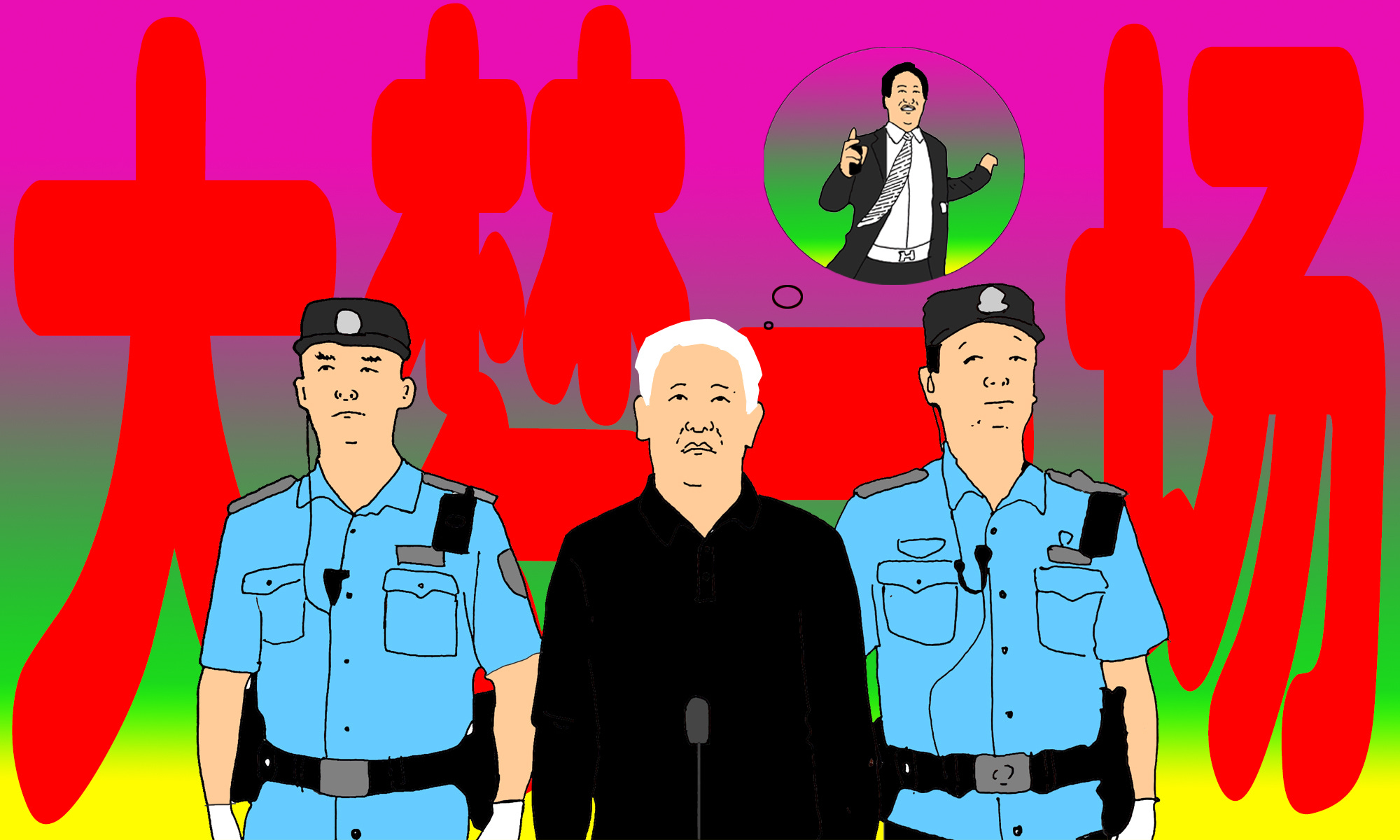
Xu Jiayin (许家印) was once China's richest man. He is the founder of Evergrande (恒大集团) which at its peak one of the world's largest property companies. In 2021 Evergrande became the world's most indebted property developer, and two years later Xu was taken into custody on suspicion of criminal offences. He's not been seen in public since.
On 20 August images appeared of him inside a Shenzhen courtroom. Now with a full head of white hair, Xu stood between two law enforcement officers as he was convicted on eight charges, given a life sentence, and ordered to forfeit everything he owns.
Two of his companies were fined as well. Evergrande Group, the parent, was fined 8.82 billion yuan, around 1.2 billion US dollars. Evergrande Real Estate (恒大地产), its main onshore property arm, was fined a further 7 billion. Fifty-six executives and employees were sentenced alongside Xu, his two sons among them.
The court found that between 2016 and 2021 he had carried out large-scale accounting fraud, taken deposits from the public illegally, run fundraising scams, and bribed his way to control of financial institutions.
Evergrande had grown explosively with China’s property boom since 1996. By 2017 Xu was named China’s richest man with a personal wealth of 280 billion yuan (around $42 billion dollars).
Then when Beijing imposed the “three red lines” (三道红线) on developer borrowing in 2020, Evergrande began to fall apart. By the end of 2022 it owed 2.4 trillion yuan (340 billion US dollars) to banks, suppliers, and the 1.6 million buyers who had paid for homes that were never built. Xu, meanwhile, continued to live in luxury and was moving money and assets out of the business and out of China.
But now, less than a decade since topping the rich list, Xu Jiayin has nothing and will spend the rest of his life in prison.
One article summed up his life with a classical expression:
“He enjoyed thirty years of wealth and glory.
But in the end, it was all just one long dream.”
三十年荣华富贵,到头来,大梦一场。
And with that, we have our Sinica Phrase of the Week.
What it means
“One long dream” (大梦一场) is our translation of a phrase which has its roots in classical Chinese. The four-characters are “great” (大 dà), “dream” (梦 mèng), and “one time” (一场 yì chǎng), a measure word used for events and performances.
The idea of a “long dream” first appeared in the Zhuangzi (庄子), the foundational Daoist text compiled during the Warring States period (475 to 221 BC), attributed to the philosopher Zhuang Zhou (庄周), also know as Zhuangzi (庄子).
His writings treated reality and illusion as difficult to tell apart. In the second chapter, On the Equality of Things (齐物论), he writes:
“While dreaming, one does not know it is a dream. In the dream, one may even try to interpret a dream within it, and only upon waking does one realize it was all a dream.
Only after the Great Awakening will we realize that this life itself is the Grand Illusion, while fools remain convinced they are wide awake.”
方其梦也,不知其梦也。梦之中又占其梦焉,觉而后知其梦也。且有大觉而后知此其大梦也,而愚者自以为觉。
According to Zhuangzi, the “grand illusion” (大梦) is only visible after the “great awakening” (大觉). And it’s only clear it was an illusion, or a dream, when it abruptly comes to an end.
In the same chapter, Zhangzi also writes about the “butterfly dream” (庄周梦蝶):
“Once Zhuang Zhou dreamt he was a butterfly, fluttering about, happy with himself and doing as he pleased. He did not know he was Zhuang Zhou. Suddenly he woke, and there he was, back to being Zhuang Zhou again.
But now he did not know whether he was Zhuang Zhou who had dreamt he was a butterfly, or a butterfly now dreaming he was Zhuang Zhou.”
昔者庄周梦为胡蝶,栩栩然胡蝶也。自喻适志与,不知周也。俄然觉,则蘧蘧然周也。不知周之梦为胡蝶与,胡蝶之梦为周与?
Life being one long dream is a theme which runs through Chinese poetry in the Tang and Song dynasties.
The Tang’s most celebrated poet, Li Bai (李白, 701 to 762), opens one of his best known poems with it:
“Life in this world is like a long dream, so why wear yourself out with toil?”
处世若大梦,胡为劳其生。
The four-character phrase, “one long dream” (大梦一场), first appears in a later work by Su Shi (苏轼, 1037 to 1101), the Northern Song poet, essayist and official. His poem Moon over the West River (西江月), which he wrote on a Mid-Autumn nigh while in exile, begins:
“The worldly affairs are one long dream,
How many cold autumns can a single life endure?”
世事一场大梦,人生几度秋凉?
The poem is about a man looking north from the far edge of the empire at everything he has lost, as if what he previously had was just a dream.
In modern Chinese, “one long dream” marks the moment when an experience or reality turns out to have been an illusion, and abruptly comes to an end. It can be applied to a person’s career, fortune, marriage, or even an empire.
Which is why it fits so perfectly the story of Xu Jiayin, who spent thirty years building the largest property empire in the world. And now, it seems, it was all just one long, elaborate dream.
Andrew Methven is the author of RealTime Mandarin, a resource which helps you bridge the gap to real-world fluency in Mandarin, stay informed about China, and communicate with confidence—all through weekly immersion in real news. Subscribe for free here.
