


This article was translated from the original German and was first published on the Limen China Substack.
The German economy is struggling. So is China’s.
The two countries share some problems, including weak household spending and aging populations. Their starting points and options differ, however.
What if we thought about the return to sustainable growth in both countries as a shared undertaking?
Would new possibilities for a German growth model emerge if Germany and Europe replaced concepts such as “strategic rivalry” with “cooperation and competition” in their debate about China?
What additional opportunities for growth would become visible if Germany and Europe regarded economic cooperation with China as a more integral part of their own industrial renewal?
Last week, we took a close look at the position of the International Monetary Fund, or IMF, which proposes a “New Growth Model” for China.
On November 11, 2026, the German Council of Economic Experts published its annual report on the country’s economic development. Although the report makes no explicit call for a new growth model, its findings can certainly be read as pointing to the need for Germany to develop one as well.
Are there forms of cooperation between the two countries and regions that would support economic development in both? That is the question we explore this week.
We examine Germany’s starting position and the importance of China and other export markets to German economic growth. We consider how the two countries compete in third markets and then turn to Chinese proposals for greater cooperation and reciprocal investment.
Strategic decisions in politics and business require options and scenarios. A well founded decision about the future path of development requires a view of the outcomes that different options would be likely to produce under different scenarios.
In our view, the current European debate about China lacks a discussion of an optimistic scenario. We offer one here. We call it “Taking China at Its Word.”
Let us take China at its word. Let us assume that the country seeks growth, technological strength, and a secure supply of raw materials, and that it needs reliable trading partners, reciprocal investment, and protection for intellectual property to achieve these goals.
What opportunities would Germany have to advance its own economic interests under these conditions?
Germany Also Needs a New Growth Model
Last week, we examined the IMF volume Toward a New Economic Growth Model for China. Its authors describe how, following the property boom, China needs additional demand, more productive investment, and more reliable public finances. Households should be able to spend more of their income, services should play a greater role, and new technologies should raise productivity.
After reading the German Council of Economic Experts’ 2026/27 annual report, we have to ask the same question.
Germany also needs a new growth model.
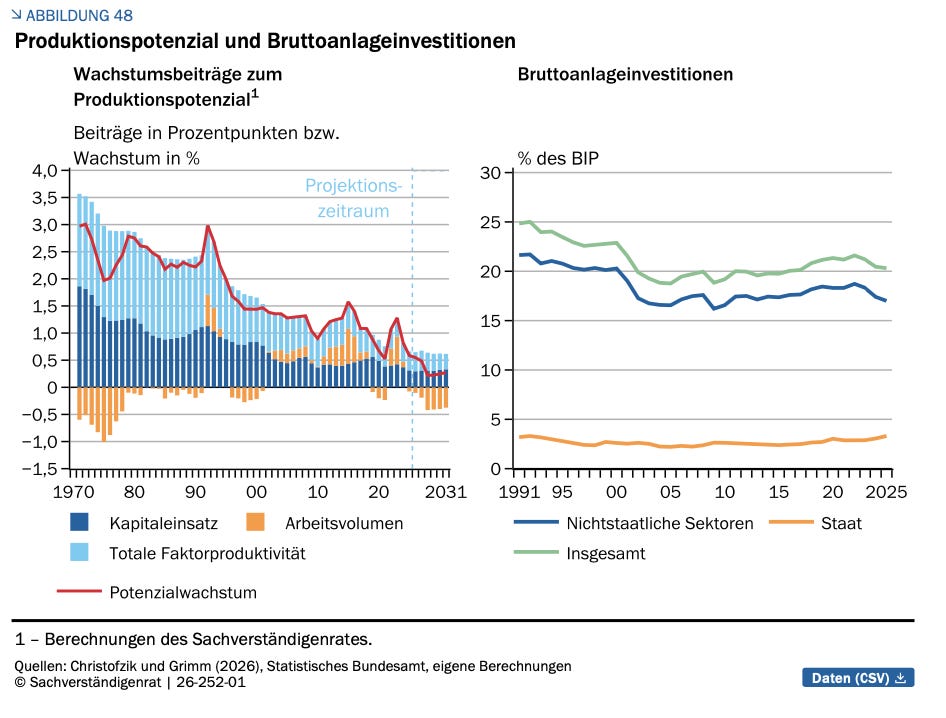
The Council expects private consumption to grow by just 0.3 percent in 2026 and 0.5 percent in 2027. Financing gaps in the federal budget are widening. The population is aging, defense and interest payments require more money, and the social insurance systems need higher revenues. The economic recovery remains too weak to sustain good wages and a state that can pay its bills.
Gross fixed capital formation is expected to grow by just 0.1 percent in 2026. Government spending supports economic activity while adding to the pressure on public finances. Germany’s potential growth rate also remains below 0.5 percent over the next five years.
Back in June, Harri Kemp, an economist in the IMF’s European Department, identified weak investment and exports as major causes of Germany’s growth slowdown in Drivers of Germany’s Growth Downturn.
The question of a new growth model thus arises for both countries.
Germany’s starting point remains its industrial capabilities. The country has limited natural resources and depends on imports for energy and many industrial raw materials. Its most important resource is its people, their education, and their experience. Political stability and the existing industrial infrastructure provide the setting in which this combination can once again produce successful businesses.
Germany’s domestic market is too small for this business model. The European single market substantially expands sales opportunities and provides substantial support to the economy through exports. Beyond Europe, German industry needs customers in global markets to finance development, specialized manufacturing, and high quality jobs.
Germany cannot and does not want to be the cheapest location. Its ambition must be to use innovation and engineering to develop products and services whose quality makes an economic difference. To remain competitive at home, in China, and in other global markets, companies must aspire to the following.
“We want to offer the best product on the market, something customers cannot buy anywhere else.”
A new German growth model must show how these products can continue to be developed and made in Germany and reach their customers from there.
That includes technologies and partners from other countries.
China could play a considerably larger role in this renewal than its current share of German exports might initially suggest.
What Exports Contribute to Germany’s Economy
The scale of that role also depends on how much of Germany’s economic activity is connected to exports. According to the report, exports of goods and services totaled around €1,816 billion in 2025, equivalent to roughly $2.05 trillion. Relative to nominal gross domestic product, that represents an export ratio of around 40 percent. Germany has the highest export ratio in the G7, with France next at just 33 percent. International markets sustain a substantial part of Germany’s economic base.
This ratio measures the value of exports relative to economic output. An exported product often contains imported inputs. Value added in Germany comes from the additional work performed within the country.
The contribution of foreign trade to annual economic growth depends on changes in exports and imports, whose combined effect is captured by net exports. A time series from Germany’s Federal Statistical Office shows how important this driver of growth has been at various points. Between 2000 and 2007, foreign trade contributed an average of almost one percentage point to average annual economic growth of 1.6 percent. In accounting terms, net exports thus generated a little over three fifths of growth. Their importance was especially clear in 2004, when they contributed 1.6 percentage points to overall growth of 1.2 percent. Domestic demand held growth back that year.
Since the middle of the 2010s, foreign trade has mostly provided small or negative additional contributions to growth. The last positive contribution from net exports of at least one percentage point was in 2012. Exports continued to grow between 2013 and 2019, with rising imports largely offsetting their contribution. More recently, exports themselves have weakened. German exports fell in real terms for three consecutive years from 2023 through 2025.
Against this backdrop, the Council expects a recovery in 2026, with its effect weakening again in the following year.
Source German Council of Economic Experts, Table 10, page 78
Foreign trade held growth back substantially in 2025. Exports fell by 0.9 percent in real terms, while imports rose by 2.9 percent. This year, the forecast projects real export growth of 3.5 percent. After allowing for imports, which are also increasing, foreign trade contributes 0.5 percentage points to expected growth of 1.3 percent.
The Council expects exports to keep rising in 2027. Their contribution of 0.7 percentage points to growth is offset in accounting terms by the increase in imports.
“Net exports are not expected to contribute to GDP growth in 2027.”
The export sector remains important to production and employment in Germany. The additional growth contributions from foreign trade have weakened, however. The decline in real exports and losses in international markets also show that Germany must renew its capacity to compete as an exporter.
A renewed growth model must therefore strengthen that capacity and turn additional orders from abroad into more investment, value added, and well paid jobs in Germany. How successfully it does so will depend on its products, production conditions, and the development of its markets.
China Buys About as Much from Germany as Italy Does and Shapes Competition Worldwide
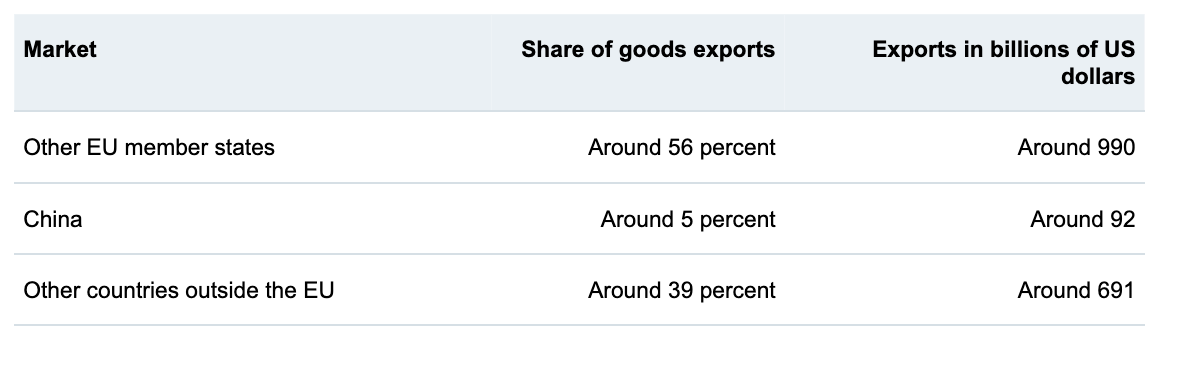
Consider the distribution of German goods exports. The annual figures published for 2025, adjusted for calendar and seasonal effects, amount to approximately $1.77 trillion. More than half goes to other EU member states.
Market
Share of goods exports
Exports in billions of US dollars
Other EU member states
Around 56 percent
Around 990
China
Around 5 percent
Around 92
Other countries outside the EU
Around 39 percent
Around 691
Source Destatis, annual figures for 2025. Our calculations and conversion to US dollars
The share of just over five percent going to China becomes easier to grasp when compared with another market. As a direct buyer of German goods, China is roughly on a par with Italy, to which Germany exported goods worth about $95 billion in 2025. The China business can carry much greater weight for individual industries and companies, however.
China’s importance to the German economy also lies in its influence on other markets. Chinese companies compete in Europe, supply components to manufacturers in other countries, and establish their own operations there. They are also changing the conditions under which German companies earn the other roughly 95 percent of their export revenue.
On page 62, the Council accordingly describes the current recovery in terms of export destinations. Demand from the EU provides substantial support to goods exports. Exports to China continue their downward trend. Within Europe, demand from the major euro area economies and from Eastern Europe is providing momentum.
Europe is therefore the most important setting in which Germany must develop its industrial competitiveness together with its partners.
Losing Ground in Global Markets Calls for a New Response
Trade economists Sonali Chowdhry, Katharina Erhardt, and Julian Hinz examine the pressure on Germany’s position in Competing with China in third markets.
Between the comparison periods of 2012 through 2014 and 2022 through 2024, Germany’s market share in third markets, weighted by product category, fell by 1.98 percentage points. The study’s analysis of Germany covers all destination countries outside Germany and China, including European markets.
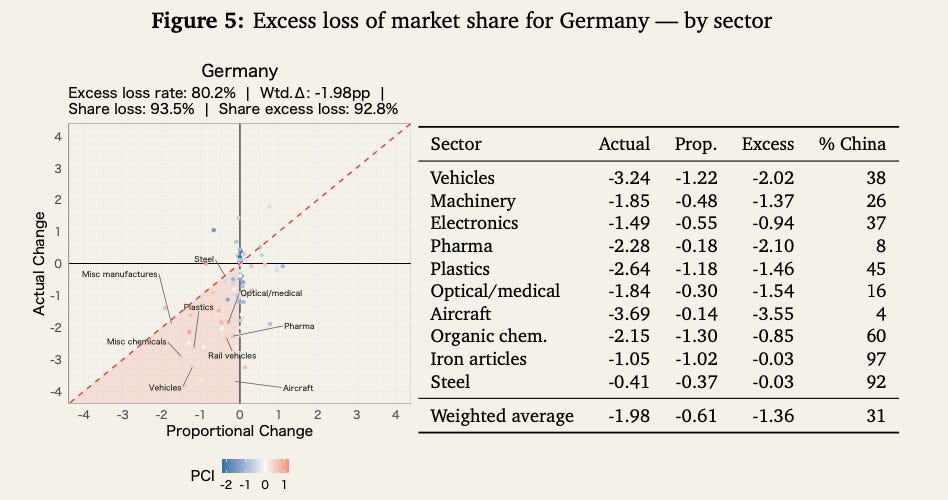
The authors compare this decline with a scenario in which China’s expansion displaces all other supplier countries proportionately. Under that scenario, Germany would lose 0.61 percentage points, around 31 percent of the observed decline. That leaves roughly two thirds of the decline as the portion by which Germany was affected more severely than other countries. Germany has thus also lost ground relative to other exporters. This points to additional challenges to its competitiveness, whose specific causes the study leaves open.
“China’s export expansion alone cannot explain all observed losses.”
This is a central finding for our starting proposition. Technological experience and a sophisticated product portfolio can sustain an international position only if companies continually develop them. Future demand must be reflected in today’s development budgets and investments.
How does this loss relate to the five percent of Germany’s export business that goes to China? The five percent refers to Germany’s own exports. The 1.98 percentage points describe Germany’s position in destination markets relative to all supplier countries.
A scenario of stronger or renewed cooperation with China therefore also concerns Germany’s competitiveness in the larger markets outside China.
The Demand China’s Industrial Transformation Could Create
China’s plans to modernize its industrial base could generate new demand for German exports. China wants to improve its industry’s technological capabilities, use energy more efficiently, and raise productivity. This creates requirements for equipment, processes, and industrial services that German companies can address with their capabilities.
The implementation program for energy efficient equipment for 2026 through 2028, for example, identifies efficient motors, industrial heat pumps, and refrigeration equipment as targets for modernization. Modernization is also intended to improve how equipment works together within a production system. For German suppliers, this is a familiar economic problem. More precise controls or the use of waste heat can save a factory operating costs and improve its competitiveness.
China’s national five year plan also calls for increased imports of urgently needed advanced equipment and services used in production.
Germany should take a particular interest in identifying where the technical capabilities of its own products can offer distinctive economic value for China’s modernization.
A Look at Jiangsu’s Plans
Using our Limen China Provincial Strategy Navigator, we analyzed Chinese provincial plans for corresponding modernization projects and selected one example from our findings.
Jiangsu Province’s action plan for 2026 through 2028 translates the national direction into tasks for eight industries, including steel, cement, glass, and petrochemicals. It combines technical improvements to industrial facilities with funding instruments and an assessment of modernization needs. Facilities operating below the specified efficiency thresholds face a firm deadline.
能效未达到强制性能耗限额标准限定值和基准水平的项目,应于2028年底前完成改造。
“Projects whose energy efficiency does not meet the prescribed limits and reference levels under mandatory energy consumption standards must be upgraded by the end of 2028.”
Here, national goals become regional investment tasks. Companies can focus their search for customers on industries, installed equipment, and deadlines.
German exports can play a role where specialized components, development, and plant engineering in Germany can deliver a particularly capable solution.
Winning Business Together in Other Markets
In other global markets outside China, the question is what roles German suppliers can take on in production networks developed further, potentially together with Chinese companies.
The OECD paper Economic security in global production makes China’s role in these networks visible. In 2024, China was the largest foreign supplier of value added in around 40 percent of the relationships examined between destination countries and industries. In 2000, the share was only around four percent.
“Bilateral trade statistics alone do not fully reveal indirect dependencies across global value chains.”
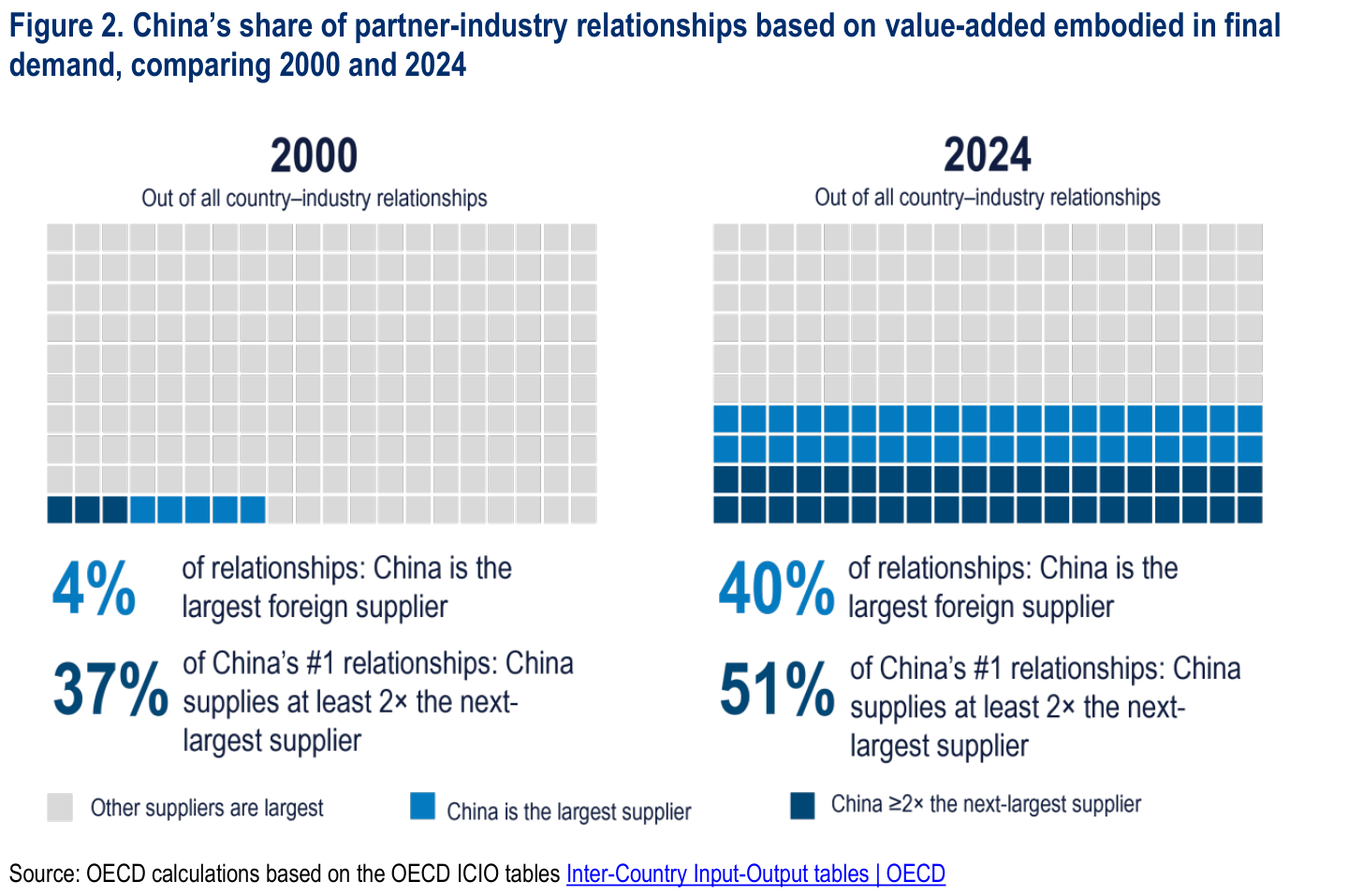
Source OECD, Figure 2, page 4. The study covers 4,606 relationships between destination countries and industries.
Chinese suppliers can therefore play several roles at once for German companies. They are competitors, supply intermediate inputs, or become customers themselves. A Chinese plant engineering company entering a market in Southeast Asia, for example, may need highly specialized components and development services from Germany. A German company, in turn, can use Chinese equipment to produce its own export offering more economically.
For German exporters to remain successful over the long term, they need to retain and develop sophisticated roles in these relationships. These may include distinctive technical solutions, the integration of complex systems, or reliable support during operation. The returns must finance the next stage of development and the jobs it requires in Germany.
Cooperation with Chinese companies can strengthen this market position if both sides reach additional customers together, accelerate development, or create more economical offerings. The German company must also continue to learn. The technical contribution that is in demand today must evolve with customers’ requirements. Chinese partners are pursuing their own advancement and will also expand their capabilities. Mutually recognizing and robustly defending their respective interests, while cooperating constructively and without excessive mistrust, is likely to be the key to a successful partnership.
Putting Chinese Investment to Work for Germany’s Renewal
What holds at the company level also holds at the macroeconomic level. China has a strong interest in Europe as a market and as an investment location.
German companies generate the largest share of their goods exports in Europe. Chinese companies are also investing in production and distribution in Europe. This gives Germany an opportunity to bring Chinese capital, technologies, and new industrial capabilities into its own economic renewal.
China has used foreign investment and technological cooperation to support its rise for decades. German companies have contributed by building production facilities, training employees, and bringing experience in industrial manufacturing. Building its own capabilities was an essential part of this cooperation for China. Germany should show a comparable willingness to learn.
In our conversation on October 17, 2026, Henry Huiyao Wang, founder and president of the Beijing based Center for China and Globalization, proposed combining German precision manufacturing with new Chinese technologies. He identified Southeast Asia, Latin America, Central Asia, and Africa among the potential markets the two sides could serve together.
In our view, the potential learning extends beyond individual technologies. Industrial renewal also requires the ability to develop new products quickly, test them in the market, and manufacture them at scale. Germany can learn from the speed and pragmatism of successful Chinese companies. This can help it turn engineering expertise into marketable products sooner.
The Council also sees substantial potential for productivity gains from spreading new technologies and successful practices more quickly across companies. This task has an international dimension as well. Where Chinese companies have developed more capable technologies or production processes, investment and partnerships can accelerate their adoption in Germany.
Chinese investment becomes particularly valuable for Germany when it creates, or at least preserves, sophisticated production, development, and lasting customer relationships. Local suppliers can win additional orders, employees can acquire new skills, and research institutes can connect their work with industrial applications. Investment in energy technology or modern production equipment can also affect the costs and productivity of other companies.
This presents policymakers with a demanding task. They must offer an attractive business location and assess investments beyond their immediate employment effects, considering the economic capabilities they build in Germany. Good infrastructure, qualified employees, and fast permitting are part of this task. Competition and transparent conditions for public funding are equally important. Progress would be visible in additional value added, productive investment, and well paid jobs in Germany.
Trade policy measures can influence competition in the European single market and create time for industrial adjustment. Companies must use that time to invest and develop new products that can also compete in other global markets. European economic policy must therefore also consider which Chinese technologies and investments could accelerate this progress.
The Scenario of Taking China at Its Word
This approach requires a different starting point for the political debate.
Let us work through a scenario in which China wants to strengthen its economy, do business, and continue increasing its prosperity. Germany and the EU pursue the same economic goals for their societies. Both sides examine what forms of cooperation could help them achieve those goals.
Let us call this thought experiment “Taking China at Its Word.” We assume that the participants are interested in economic agreements that deliver lasting benefits. Searching for additional opportunities together then becomes a normal part of economic relations. Companies can cooperate in some areas while competing for customers and returns in others.
Gesine Weber, Zoha Naser, and Sarah Tzinieris introduced the concept of “coopetition” into the European debate about China in their article The EU and its China agenda: limited cooperation under rising tensions.
“The case of EU-China relations demonstrates the broader global relevance of coopetition in an era of fragmented multipolarity. As the world transitions from a liberal order to a more competitive geopolitical landscape marked by rival blocs, the capacity of actors like the EU to balance cooperation and rivalry will shape global governance outcomes. In this respect, EU-China coopetition serves as both a test case and a template for managing interdependence under conditions of strategic tension.”
For Germany and the EU, this scenario entails a substantial shift in attitude. China must also be considered a potential partner in Germany’s renewal. German companies look for connections between their strengths and the capabilities of Chinese companies. Policymakers establish reliable rules under which those connections can develop. Trust can grow from verifiable agreements and the experience of implementing them.
In her dissenting opinion in the report, Veronika Grimm also argues that other policies should support progress on a growth agenda.
“Finally, it is crucial to ensure that progress under a growth agenda is not undermined by other policy decisions. This concerns, for example, … unnecessarily protectionist measures toward China. [These] could trigger countermeasures that, given Germany’s industrial and trade structure …, would hit its economy particularly hard.”
The economic effects of Germany’s own China policy therefore also belong on its growth agenda.
An Investment Agreement as the Next Policy Step
A concrete economic policy step follows from this scenario. Germany should work within the EU to advance negotiations on a renewed investment framework with China.
In our interview, Henry Wang argued for reviving and developing the comprehensive investment agreement that has already been negotiated.
An investment agreement can make market access more binding, the treatment of foreign companies more predictable, and create procedures for resolving disputes. This gives companies a better basis for decisions about new factories, development capacity, and long term partnerships. Greater predictability can help secure financing for commercially sound projects.
A foundation exists in the Comprehensive Agreement on Investment, or CAI, agreed in principle at the end of 2020. In the spring of 2021, the European Parliament blocked further steps toward its conclusion after China imposed sanctions on European lawmakers and institutions. In April 2025, Parliament announced that China had lifted the sanctions on its members, their families, and its committees. Approval of the agreement remained unresolved, and the CAI now appears to be under discussion between the partners again.
The European Commission describes commitments in the draft agreement on market access, rules for state owned enterprises, transparency requirements for subsidies, and rules against forced technology transfer. It also includes commitments on working conditions and the environment, together with enforcement procedures between the parties. More extensive investment protection was designated as a separate negotiating task.
A renewed framework should connect this foundation with today’s industrial development. European companies need reliable access to Chinese markets and fair conditions of competition. Chinese investors need predictable conditions for long term projects in Europe. Voluntary agreements and effective protection of intellectual property can facilitate joint research, training, and industrial development. In disputes, agreed rights must also be enforceable in practice.
Germany would have a particular interest in how this could generate additional investment and technological learning. Companies and policymakers should identify specific projects in which Chinese capabilities strengthen Germany’s industrial base and German expertise creates new sales opportunities. Trade in goods and tariffs must be addressed in the negotiations intended for those issues. An investment framework could provide greater certainty for the longer term corporate decisions on which this cooperation rests.
Germany needs growth to stabilize its public finances, fund its social insurance systems, and support good wages. To achieve this, it must renew its industrial capabilities and succeed with them in international markets. Cooperation with China within a competitive relationship could make that path easier.
The next policy step would be a renewed European investment framework with China that enables such projects and provides a reliable basis for carrying them out.
