


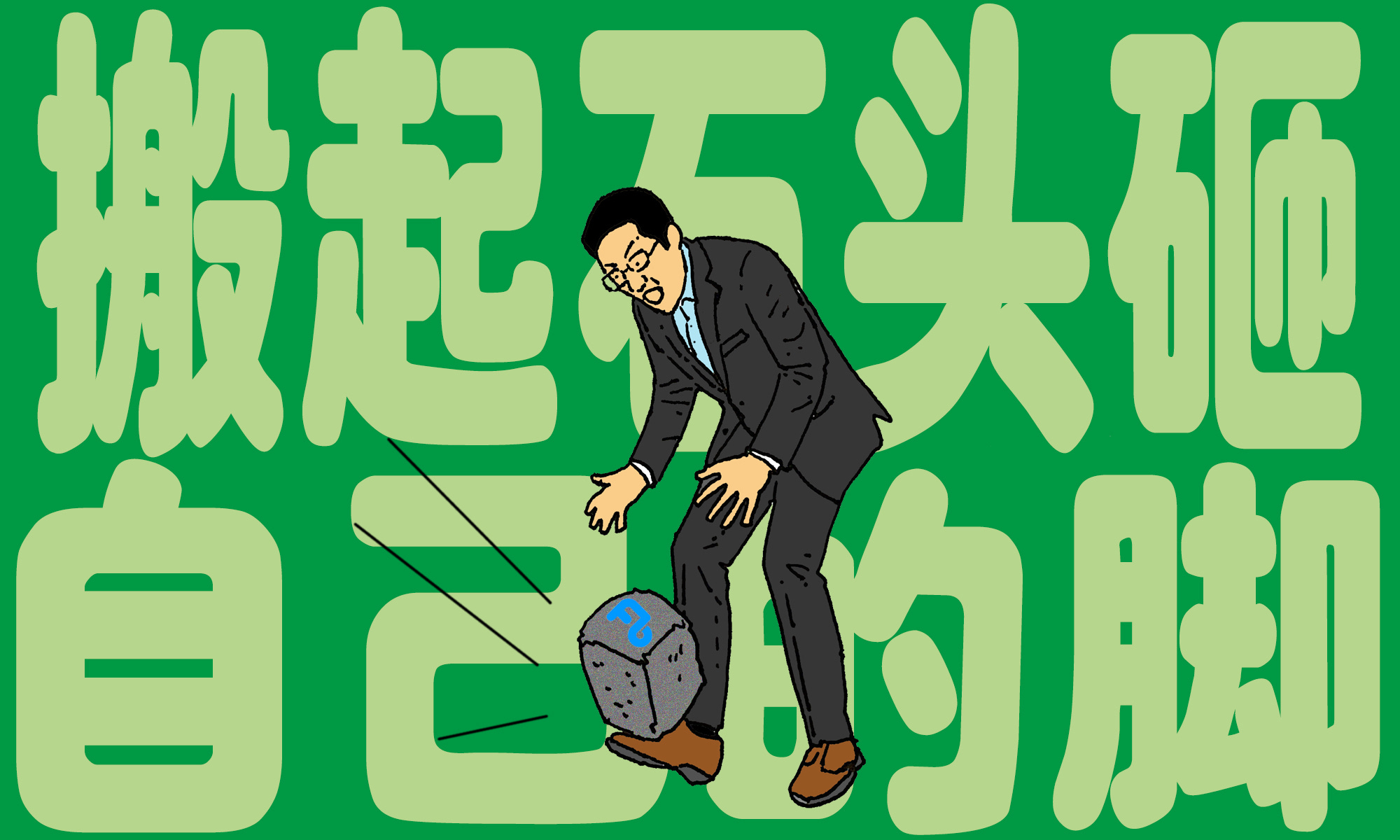
Our phrase of the week is: “shooting yourself in the foot” (搬起石头砸自己的脚 bān qǐ shí tou zá zì jǐ de jiǎo)
Context
Zhang Xiaolong (张小龙) is the CEO of the listed company Fenbi Technology (粉笔科技). Fenbi is one of China’s biggest online education platforms, specialising in civil service exam (考公) preparation. Millions of students in China pay for Fenbi’s services to get them through that gruelling exam.
Recently, Zhang Xiaolong was invited to give a lecture at the School of Philosophy at Renmin University (人大), the top university in China for training hopeful civil servants. The hundred or so students were in the room were exactly the kind of people who go on to sit that civil service exam, and potentially become Fenbi customers.
Zhang’s talk was meant to cover exam prep and job-hunting. But at the last minute, Zhang changed his topic to “Career Planning in the AI Era” (AI时代的职业规划).
And in under an hour, he managed to insult the students, tell them they had no hope of passing the civil service exam, brag about how rich he was, and how much money he’d recently made trading US tech stocks using AI.
Throughout his speech the room stayed quiet, and some students left early.
Rather than take this in his stride, Zhang began to rant angrily and uncontrollably at the audience. He refused to take questions, told them they were hopeless, and walked out.
The news of Zhang’s outburst spread fast on social media. Many of Fenbi’s own students started demanding refunds, and the company’s share price tumbled. Zhang issued one apology, and another.
“He built his name on civil service exam prep and makes his money from civil service exam candidates, yet he disparages those very candidates so openly.
Zhang Xiaolong shooting himself in the foot like this is both deeply baffling and purely farcical.”
靠考公起家,赚考公人的钱,却如此露骨地贬低考公人——张小龙这种搬起石头砸自己的脚的行为,十分令人费解,也十分黑色幽默。
And with that, we have our Sinica Phrase of the Week.
What it means
“To shoot yourself in the foot”, or, literally “to lift a rock only to drop it on your own foot” (搬起石头砸自己的脚 bān qǐ shí tou zá zì jǐ de jiǎo), is a colloquial Chinese saying.
It does not have a single ancient origin, unlike so many other Phrases of the Week. Dictionaries record it in two forms: the longer colloquial version above, and a tighter four-character idiom, “lift rock, smash foot” (搬石砸脚).
The four-character form is usually traced to a 1973 martial-arts novel by the Taiwanese writer Wolong Sheng (卧龙生). The longer version is most often sourced to Below the Wuling Mountains (武陵山下), a novel about the Communist campaign to wipe out bandits after 1949, by the military writer Zhang Xing (张行).
Its most famous use, though, is by Mao Zedong (毛泽东). He used the phrase to describe what he saw as then British Prime Minister Neville Chamberlain’s policy of appeasing the fascist powers. The remark, from a 1939 interview with the Xinhua Daily (新华日报), was later collected in his Selected Works:
“To lift a rock only to drop it on one’s own foot — that is the inevitable result of Chamberlain’s policy.”
搬起石头打自己的脚,这就是张伯伦政策的必然结果。
Mao was borrowing an existing folk saying, not coining it. And he used “to hit” (打) where the common phrase today uses “to smash” (砸).
Today the phrase is common in political and economic commentary, and in business too. The nearest English equivalent is “to shoot yourself in the foot”, which is how we translate it here.
China’s Ministry of Commerce used it in May 2025, after Washington warned that using Huawei’s Ascend (昇腾) AI chips anywhere in the world would breach US export rules. The ministry said the restrictions would ultimately backfire:
“The result can only be to shoot oneself in the foot.”
其结果只能是搬起石头砸自己的脚。
And that is precisely what Zhang Xiaolong did in his speech last week.
He has built his fortune on the fees of civil service exam candidates, then stood in front of a room of those students, and told them they were worthless. So now his customers are demanding refunds, his share price is tanking, and his reputation is in pieces.
Andrew Methven is the author of RealTime Mandarin, a resource which helps you bridge the gap to real-world fluency in Mandarin, stay informed about China, and communicate with confidence—all through weekly immersion in real news. Subscribe for free here.
