


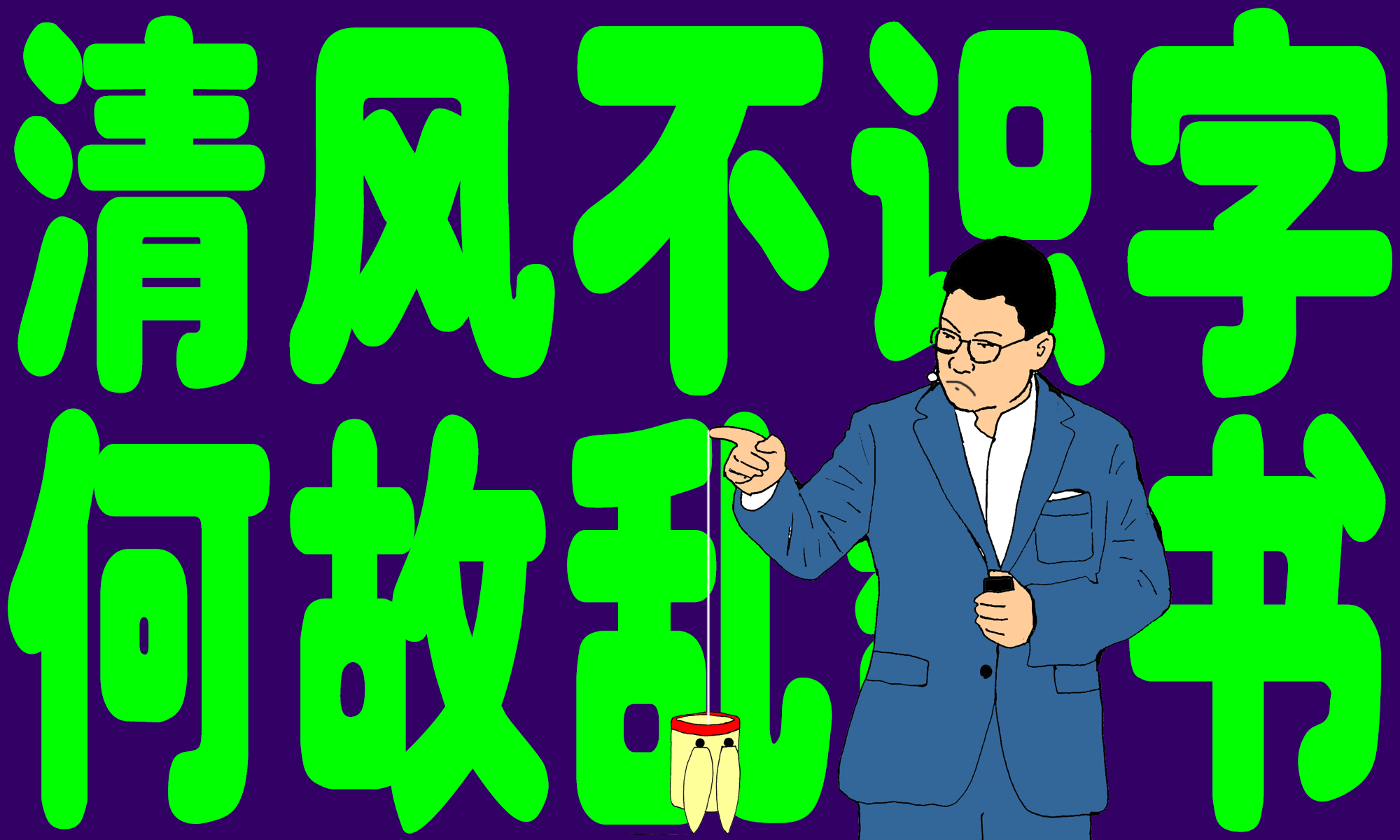
Our phrase of the week is: “the breeze cannot read, so why, then, does it riffle through my book?” (清风不识字,何故乱翻书 qīngfēng bù shízì, hégù luàn fānshū)
Context
Huawei (华为), one of China’s biggest and most powerful companies, has been humbled by a cheap children’s toy.
That toy is called a “bamboo cicada” (竹知了). It’s made of a short section of bamboo and a piece of string, and sounds like a cicada when spun.
In recent weeks, netizens somehow connected the bamboo cicada’s buzz to the unveiling of Huawei’s AITO M9 (问界M9) SUV back in December 2023. The event was hosted by Richard Yu (余承东), the head and public face of Huawei’s smart car business. Yu is well-known for his over-the-top language at these events, dropping claims like Huawei is “way ahead” (遥遥领先) of the competition.
The sound of the audience’s reaction to one of his claims at that 2023 launch, and Yu’s own distinctive rapid-fire way of speaking, were likened to the buzz of the bamboo cicada toy.
From mid-July, content creators began mixing the toy’s high-pitched sound into footage of the launch. At first it was no more than a niche joke and a minor trending topic. But around July 23, some bloggers received notices that their videos had been flagged for infringement. As takedown requests from Huawei’s legal team mounted, the story was catapulted to the top of hot search lists in early August. Soon, there were reports that even videos of people simply shaking the toy were being removed.
A backlash against Huawei followed. In response, the company issued a statement denying any blanket campaign against the toy or people posting about it. But this only invited further ridicule. One widely shared essay called it the worst PR disaster in Huawei’s history.
Another writer went on to use a cryptic reference to imperial censorship from nearly 300 years ago to characterise Huawei’s heavy-handed tactics to silence the public:
“The public may be uneducated, but that doesn’t mean you can abuse your power.”
老百姓可以不识字,但你不能乱翻书。
And with that, we have our Sinica Phrase of the Week.
What it means
“The public may be uneducated, but that doesn’t mean you can abuse your power” is a modern reworking of a famous line of verse from the time of the Qing dynasty (1644–1912).
The original is:
“The breeze cannot read, so why, then, does it riffle through my book?”
清风不识字,何故乱翻书。
It’s attributed to Xu Jun (徐骏), a young scholar in the Hanlin Academy (翰林院), the elite secretariat of the imperial court. Xu was also the son of Xu Qianxue (徐乾学), one of the most senior officials under the Kangxi (康熙) emperor, who reigned from 1661 to 1722.
That line was nothing more than an observation from Xu at his desk, describing how he noticed a breeze blowing through the room flipping the pages of a book as if it were a person. And yet, the breeze was unable to read the words.
In 1730, under Kangxi’s son and successor, the Yongzheng (雍正) emperor, Xu Jun made a fatal slip in a memorial.
He miswrote “Your Majesty” (陛下 bì xià), accidentally writing the first character as one which evokes the meaning of “prison beast” (狴犴 bì àn), a mythical tiger-like creature, whose image was carved on prison gates. The two characters (陛 vs 狴) are pronounced exactly the same (bì), and are almost identical in form, just differing by one component.
The Yongzheng emperor took offence at this slip. Xu was stripped of his title, removed from office, and had his writings searched.
In their investigation, the Qing officials found the line beginning “the clear breeze…” (清风). They concluded this was a seditious attack on the Qing empire’s Manchu rulers, because “clear breeze” (清风) shares a character with the name of the dynasty, Qing (清).
The innocuous line was interpreted as something much more serious:
“The Qing rulers are uneducated, so they have no business meddling in Chinese culture.”
So Xu was convicted and executed.
In the years that followed, “the breeze that cannot read” (清风不识字) became synonymous with the Manchu rulers’ paranoia and abuse of power. The story is retold in the Classified Anthology of Qing Anecdotes (清稗类钞), a compendium of Qing stories assembled by the writer Xu Ke (徐珂) in 1916, four years after the empire’s fall.
The case became one of the most notorious of the Qing “literary inquisitions” (文字狱), or “prisons of the written word”. These were waves of prosecutions where officials combed books, poems and even examination papers for hidden sedition. Their defining feature was that guilt lay in what a suspicious reader could find hidden in the words on the page, such as imagined puns, homophones, and allusions.
Today, “the breeze cannot read” (清风不识字) is shorthand for the misreading of innocent words by the powerful and the thin-skinned. Netizens use it whenever a harmless post is deleted by over-anxious, risk-averse censors. In this modern form, “riffling through the books” (乱翻书) refers the to censors, not the breeze.
So the warning to Huawei is not to echo the heavy-handed instincts of the Qing rulers by silencing the innocent. Which is why we translate this week's phrase as: "The public may be uneducated (in the law), but that doesn't mean you can abuse your power."
Andrew Methven is the author of RealTime Mandarin, a resource which helps you bridge the gap to real-world fluency in Mandarin, stay informed about China, and communicate with confidence—all through weekly immersion in real news. Subscribe for free here.
