


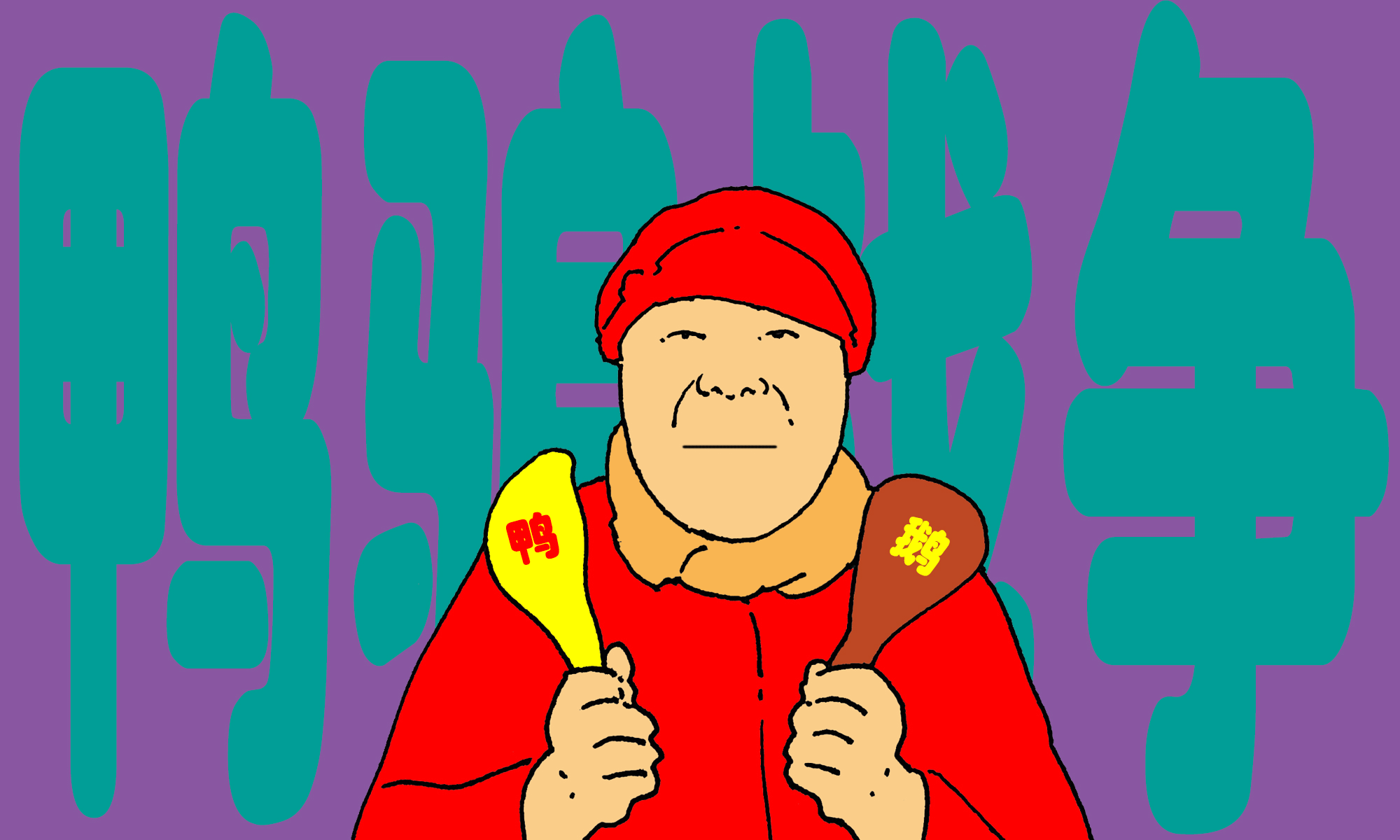
Our phrase of the week is: “The Great Duck-Leg Scam War” (鸭骗战争 yā piàn zhàn zhēng)
Context
For more than a decade, a roadside vendor known to students across Beijing as “Goose-Leg Auntie” (鹅腿阿姨) sold roast goose legs from a tricycle cart outside the city’s most prestigious universities: Tsinghua, Peking, and Renmin Universities.
She had no shopfront and no delivery service, just a charcoal grill, and a three-wheeler.
Her real name is Chen Xiufeng (陈秀凤). She came to Beijing from Jiangsu in 2,000, first selling fruit at the southwest gate of Peking University. Around 2011 she switched to grilling goose legs. By late 2023 “Goose-Leg Auntie” was a campus legend. Students in the three universities competed to lure her to their campuses.
But earlier this month that all came crashing down.
It was triggered when Chen shared in a customer group chat an announcement admitting she had been using duck legs, not goose legs, for fifteen years. She added that she had been reported to the authorities by a customer and was now cooperating with an investigation.
Her post was shared on social media and went viral.
Beyond the shock and anger of many customers at being deceived for years, there was also humorous mockery of elite students who were made fools of and unable to discern the difference between duck and goose legs.
One viral post framed the saga in the language of a great historical conflict:
“The hashtag #GooseLegAuntieScandal# briefly shot to the top of the trending searches.
Turning the saga into what can only be described as “The Great Duck-Scam War” fought on the campuses of Peking and Tsinghua Universities.”
#鹅腿阿姨塌房#一度干到热搜第一,这就是一场属于清北的“鸭骗战争”。
And with that, we have our Sinica Phrase of the Week.
What it means
“The Great Duck-Leg Scam War” (鸭骗战争 yā piàn zhànzhēng) is a newly invented internet slang phrase, coined in the days after Goose-Leg Auntie’s downfall. The characters are “duck” (鸭), “to deceive or scam” (骗) and “war” (战争).
The pronunciation and tones of the characters in “duck-scam war” (鸭骗战争) are exactly the same as the “Opium War” (鸦片战争 yāpiàn zhànzhēng), the mid-nineteenth-century conflicts between Qing China and Britain that opened the country to the foreign opium trade and are remembered in China as the start of its “century of humiliation”.
There were two Opium Wars, so students dubbed the Goose-Leg Auntie affair as the “Third Duck-Leg Scam War” (第三次鸭骗战争), casting themselves as the latest generation to be humbled and humiliated by a superior invading force.
The phrase joins a long list of animal-based Chinese expressions for deception. Such as our 2023 Phrase of the Year, “calling a rat a duck” (指鼠为鸭), which is a riff on the ancient idiom “calling a deer a horse” (指鹿为马) meaning to deliberately misrepresent something as its opposite.
The humour of this new phrase pokes fun at the victims of the scam. They are the country’s brightest students, elites who are selected through a punishing exam system. They supported and happily bought from Goose Leg Auntie for years and never once noticed they were eating duck, not goose.
So a case of mislabelled meat has become a grand reckoning, with the students on the losing side. Which is why we translate this phrase as The Great Duck-Leg Scam War.
Andrew Methven is the author of RealTime Mandarin, a resource which helps you bridge the gap to real-world fluency in Mandarin, stay informed about China, and communicate with confidence—all through weekly immersion in real news. Subscribe for free here.
