


Listen to my narration of Jay’s column in the embedded player above! – Kaiser
When American forces removed Nicolas Maduro from Venezuela, it prompted international crises on numerous fronts. Many of them concerned the United States’s renewed “Monroe Doctrine,” as well as the challenge to — some would say destruction of — international law and principles of national sovereignty. In the hours after Maduro’s seizure, Trump and his representatives said repeatedly that Venezuela had become a staging ground for America’s “adversaries” to project power, acquire resources, and establish a presence in the region.
Just hours before the American operation began, Maduro received his last international visitor: China’s special envoy to Latin America Qiu Xiaoqi (Eric Olander described the visit in the China-Global South Newsletter). Whether it was coincidence that Chinese diplomats were the Maduros’s last visitors to the Miraflores palace or there was something more to it (did the Chinese have intelligence about what was about to go down?), the presence of PRC officials in Venezuela illustrates that when Trump talked about “adversaries” in Venezuela, he was referring, at least in part, to China.
The U.S.-China relationship has been the world’s most important bilateral relationship, at least since the end of the Cold War. Sometimes combative and sometimes collaborative, the United States and the People’s Republic have jointly defined much of the last century. It’s useful to go back to the beginning — even before the PRC was formally established — to January of 1947, when one of America’s most famous diplomats tried, and failed, to resolve the Civil War that would end with Mao as China’s head of state.
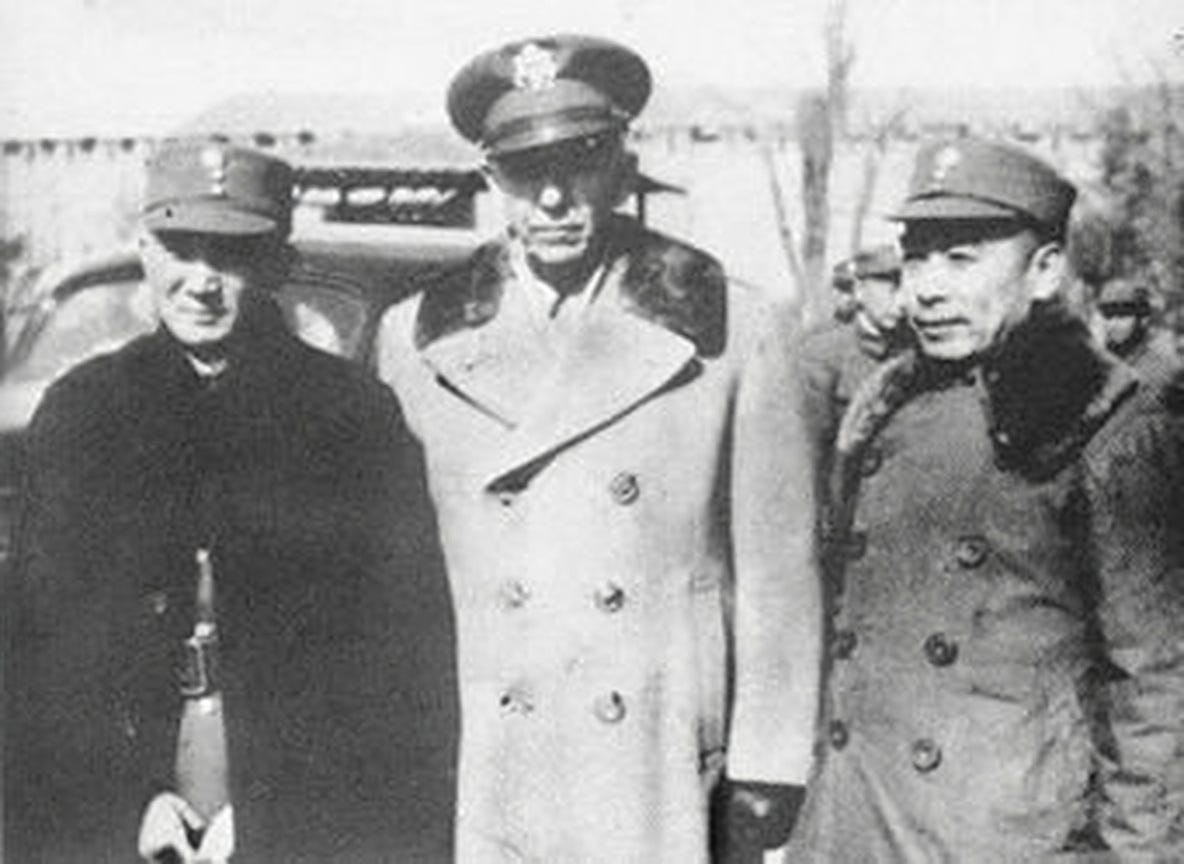
In the fall of 1945, George Marshall was one of the world’s most acclaimed military leaders. He had served as U.S. Army Chief of Staff and was the first American to be promoted to the rank of five-star general. Hailed by Winston Churchill as the architect of the victory, Marshall was not chosen to lead the D-Day invasion of Normandy in part because President Roosevelt did not want to part with Marshall as Chief of Staff.
The war won, Marshall looked forward to retirement, which began with a discharge ceremony in December 1945. As Daniel Kurtz-Phelan describes it in his book The China Mission: George Marshall’s Unfinished War, 1945-47, Marshall and his wife had barely been home an hour, in Leesburg, Virginia, when the phone rang. President Truman apologized for interrupting Marshall’s retirement, but he needed him for one more mission: to settle the conflict between China’s uneasy allies — and mortal enemies — the Nationalists and the Communists.
Mao Zedong’s Communist Party and Chiang Kai-shek’s Nationalist Party had been united in a so-called Second United Front, fighting against Japan since 1937. The alliance had not been easy after the Nationalists nearly eliminated the Communists in April 1927. The Communists barely survived Chiang’s extermination campaigns, undertaking the Long March that left them — what remained of them — isolated in northwest China. Public pressure, and ultimately his kidnapping, would eventually compel Chiang Kai-shek to ally with the Communists against Japan, forming this Second United Front (the first having ended in the 1927 massacre).
The alliance was never much of one. The two armies coordinated only loosely, and more than once they did battle against each other, most notably in the New Fourth

