


The last iteration of this column found Beijing occupied by the troops of eight nations in the wake of the Boxer Uprising. Those nations had imposed on the Qing dynasty a draconian indemnity, along with other terms. The dynasty remained — somehow — in power and insisted that it continued to be one of the world’s great powers, but anyone observing would know that this was delusional. This fact was not lost on China’s representatives abroad, who on September 22, issued a memorial to the throne calling on the dynasty to immediately undertake “enlightened law reform in order to preserve sovereignty.”
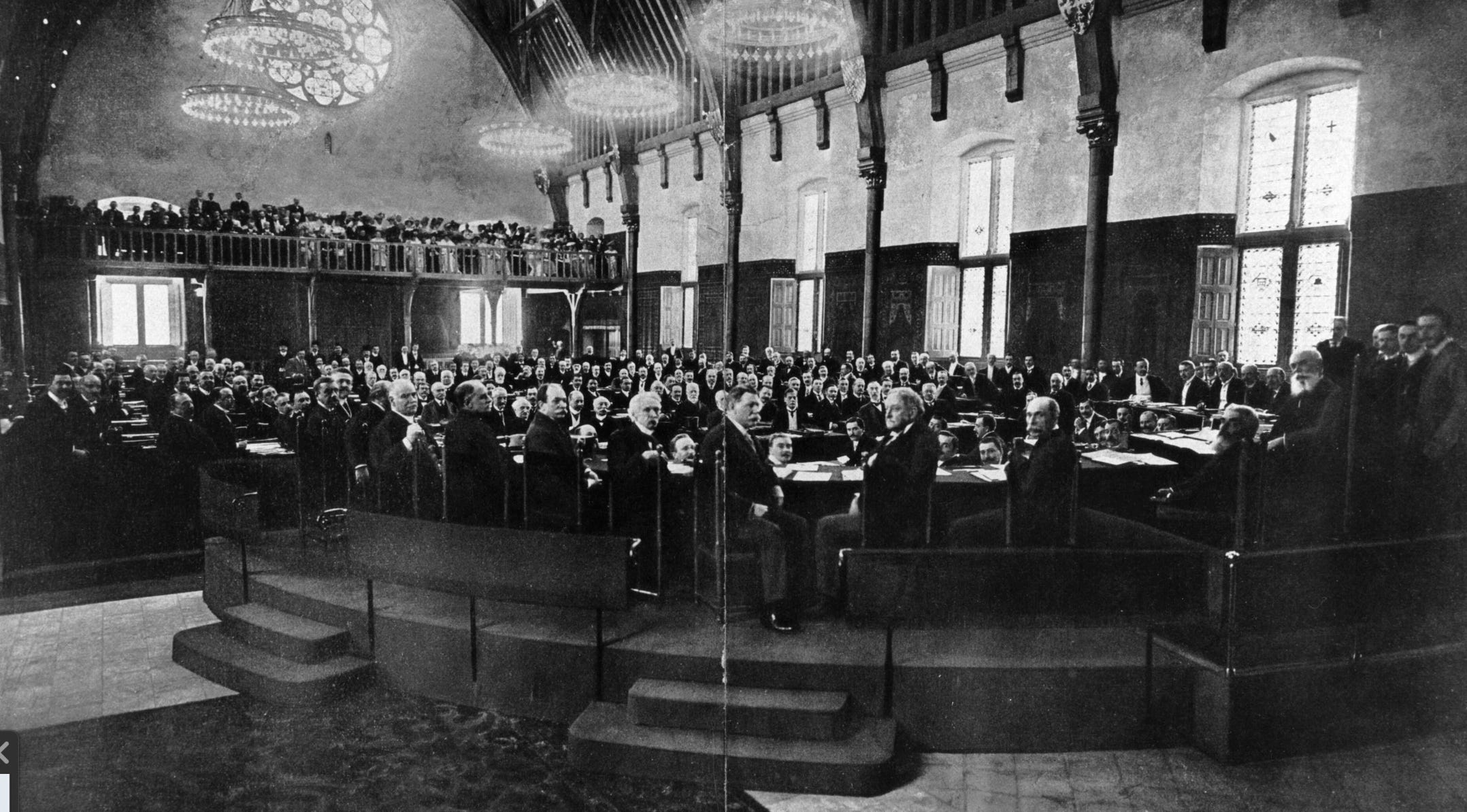
The diplomats’ worry was focused specifically on discussions that had taken place in the Netherlands. There, at the Second Hague Conference on international law, concerns about China’s status in the world had been made plain in what came to be known as the “third class state incident.” Historian Ryan Martinez Mitchell in his book, Recentering the World, describes the incident as “generally forgotten in the Global North, [but] a major episode in international legal history for [China and] other then-marginalized states.”
The incident had to do with proposals to create a permanent international court, a concept that had proven difficult to implement, although numerous states endorsed the idea in concept. Details about the size, powers, and membership of such an institution remained out of reach. At the 1907 meeting, an American plan was announced for a court of sixteen or seventeen members. Membership would be assigned according to population, assuring that the world’s people would be fairly represented. A new court would be constituted every 12 years, with the eight most populous states holding the status of “great powers” and be permanent members of the court. The remainder would rotate among the rest of the world’s countries with terms of varying lengths. States would be eligible for terms of ten, four, two, and, at the low end, one year–again, based on population.
All of which would seem to suit China, as one of the world’s most populous states, quite well — even with the major if predictable caveat that the population of each state was to be assessed including its colonies. This embrace of imperialism calculated that the world’s most populous state was Britain and its empire, but even so Qing China had nearly as many people as the British empire, and was more populous than any other state by a wide margin (according to this system of counting in which, for example, India would be included in Britain’s count).
But the assembled European powers had other ideas. The “gunboat diplomacy” of the Opium Wars had been barefaced “might makes right,” but in subsequent years

