


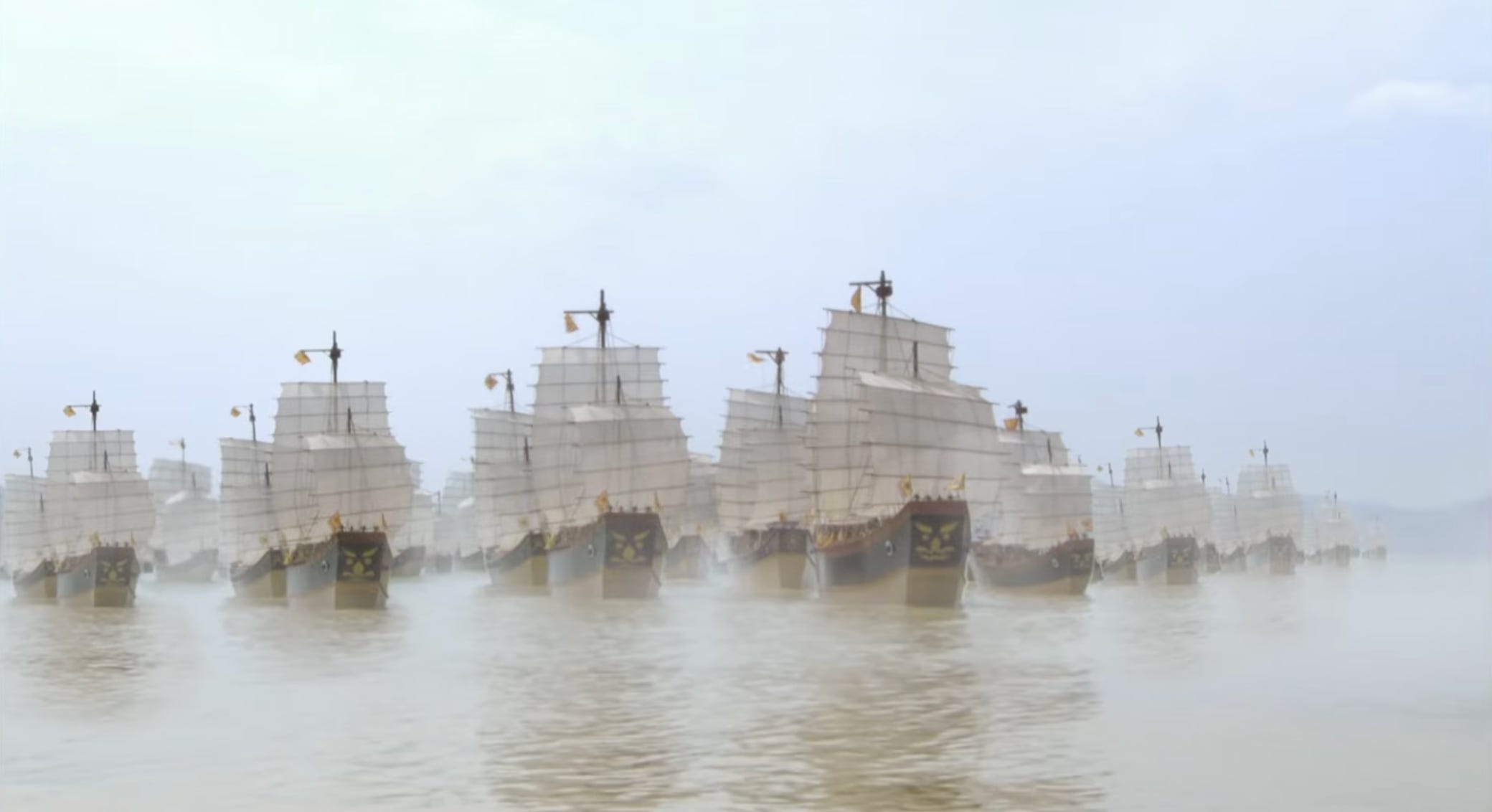
China is not always known for its naval history. With apologies to Admiral Zheng He and his treasure fleet that navigated from Nanjing to the Middle East and East Africa in the 1400s, China’s maritime past is rarely celebrated, and often not remembered.
Which is not to say that Chinese sailors deserve to be ignored. So, for This Week in China’s history, let’s look back to a pivotal naval battle as Zhu Yuanzhang pursued his bid to establish what would become the Ming Dynasty, the 1363 Battle of Lake Poyang 鄱阳湖.
The battle is full of hooks to tempt the 21st century historian seeking to draw in an audience. It was one of — by some measures the — largest naval battle ever. Reliable estimates are hard to come by, but historian Tonio Andrade is comfortable with the claim that half a million people, and several hundred vessels, participated in the battle. Even more significant, Poyang Lake saw the first documented use of firearms in shipborne warfare, foreshadowing the blazing broadsides of the age of sail (though perhaps not as specifically as some portrayals would have you believe).
Today, the setting does not suggest itself as a location for a naval battle of any sort, let alone one of the magnitude that took place in the summer of 1363. The lake is China’s largest freshwater lake, but if you’re imagining North America’s Great Lakes, think again. Poyang is just a fraction of even the smallest of those lakes. The lake’s surface area has always varied in size, seasonally, and in the rainy season it can reach 1500 square miles, so it’s formidable (by comparison, Utah’s Great Salt Lake covers about 1000). Iin recent years Lake Poyang has dwindled, beset by climate change and starved by the Three Gorges Dam. Its seasonal variation has grown even greater and during the dry season–typically late fall–Lake Poyang is often a mere puddle compared to what it once was, in some years almost disappearing entirely, covering fewer than 100 square miles.
But in the waning years of the Yuan Dynasty, Lake Poyang was larger than it is today— some sources say more than twice its current size — and late summer is its seasonal peak. And in 1363 it became the key to China’s civil war.
Zhu Yuanzhang, the man who would found the Ming as the Hongwu Emperor, had risen in prominence as part of the Red Turban Rebellion, an uprising with roots in millenarian Buddhist principles but which came to serve as a broad umbrella for those with grievances against the Yuan. By the middle of the 1350s, Zhu was one of several powerful generals in the Red Turban movement, with some 20,000 troops at his disposal. By 1360, that number had grown to perhaps 100,000, and Zhu ruled from his capital in Nanjing over as many as eight million people, including much of Zhejiang, Jiangsu, and Anhui provinces.
Zhu was certainly one of the most powerful men in China, but he was just one of several men with even greater ambitions. Besides Zhu, Chen Youliang 陈友谅, based in Jiujiang (Jiangxi), and Zhang Shicheng 張士誠, based in Suzhou, were the best positioned to succeed the Yuan and form a dynasty that would rule China. And when, early in 1363, Zhu moved his armies north against Zhang Shicheng, Chen Youliang saw an opportunity.
Lake Poyang was positioned at the boundary between the two men’s territories. Chen’s plan was to organize an invasion fleet and attack the city of Nanchang, Zhu Yuanzhang’s main garrison on the lake that guarded the entry to the Yangtze. After taking Nanchang, Chen could then move downriver and take Zhu’s capital at Nanjing.
Contemporary sources place the size of Chen’s fleet at 600,000. That is accepted as an exaggeration, but even at half that size (as seems likely) it was as large a force as could be mustered anywhere in the world at that time. The central feature of Chen’s fleet were “tower ships”: three decks high with armored sides. These vessels were not

