


You have almost certainly seen it, probably many times.
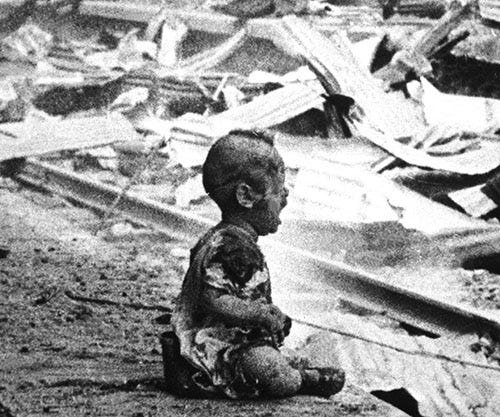
A young child sits crying, maybe screaming, depicted in a black-and-white photograph. The child appears to be alone, wearing sandals and disheveled — maybe bloodstained? — clothes. The background is the wreckage of Shanghai’s South Station. Corrugated metal siding is strewn across the tracks, blown from their place by Japanese bombs.
In 1937, Japan had just embarked on its full-scale invasion of China (though encroachment on China’s territory had begun in 1894 in the Sino-Japanese War, and then continued in 1931 invasion of Manchuria). Starting with the Marco Polo Bridge Incident in July, Japanese armies invaded coastal cities. The campaign included some of the first known aerial bombardment of civilians, an atrocity brought to global awareness in large part through this photograph.
The word “iconic” is overused but it’s appropriate here. The image is so heartbreaking and visceral that it has become almost a universal image of the cruelty of war. The picture’s status makes it therefore a little shocking to hear it described by journalist Harold Isaacs as “one of the most successful propaganda pieces of all time.” To get at what Isaacs meant requires a little unpacking of the photograph, how it was taken and published, and what the meaning of “propaganda” is.
Taken by Chinese-American H.S. Wong (Wang Haisheng 王海升), known in English as “Newsreel,” the photo first appeared in the pages of Life Magazine, the American pictorial weekly published by Henry Luce. Luce was, and would remain, the most powerful American voice in “the China lobby.” He had himself been born in China’s Shandong province to Presbyterian missionary parents, before moving to the United States for prep school in Connecticut and then Yale. Launching a magazine empire that would come to include, besides Life, Time, Fortune, and Sports Illustrated.
From the start of his career, Luce retained an attachment to China, and used his media (and whatever means he could bring to bear) to influence American policy. Virulently anti-Communist, Luce made Chiang Kai-shek and his American-educated wife May-ling Soong household names in the United States: they would appear, together or separately, on the cover of Time 11 times. As Japanese pressure, and then aggression, against China increased, Luce worked hard to drum up support in the United States for Chiang’s government and against Japanese expansionism in Asia.
Which brings us back to the photograph at the Shanghai South Railway station. It is without doubt one of the most powerful illustrations of war. The child, alone, in pain, and under attack, represents the entire Chinese nation. The caption in the magazine

