


Listen to my narration of This Week in China’s History in the embedded player above! - Kaiser
I’ve written before in these pages about the An Lushan rebellion, the 8th-century uprising that fractured the Tang dynasty and ended one of China’s brightest Golden Ages. In that earlier column, I detailed more about An Lushan’s rebellion — one of the longest and deadliest in human history — that brought the Tang to the brink of collapse. I encourage you to return to that earlier chapter for an introduction to that cataclysm, but today I’ll focus on An Lushan’s own personal destruction.
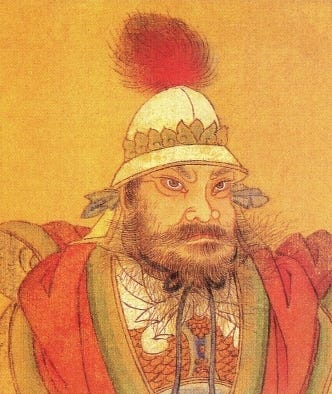
An Lushan proclaimed his new Yan dynasty on February 5, 756 (as if either of those dates would have been meaningful to him, but never mind), shortly after capturing the Tang’s eastern capital, Luoyang. Plans to swiftly occupy the western capital, Chang’an, and depose the Tang emperor went awry, however, and it would be six months before Chang’an fell. The emperor and his entourage fled for the southwestern mountains, a flight immortalized in Bai Juyi’s poem, 長恨歌 Song of Everlasting Sorrow. An Lushan took his place on the throne, as emperor of China (at least one of them)
But as is often the case, ruling proved more difficult than conquest. Although the Tang court had fled, it survived, based in its mountain stronghold in Sichuan. Tang and Yan armies waged war against one another across central China. Rivalries within the rebellion consumed the court at Chang’an. An Lushan himself, afflicted by numerous ailments, became paranoid and lashed out at members of his entourage, seemingly without provocation.
At this point, it is important to note that our sources about An Lushan are far from neutral. One of the first tasks of any Chinese dynasty is to write the history of its predecessor. Wanting to ensure their legitimacy, each dynasty typically presents its forebears as worthy and noble…until they weren’t. The “dynastic cycle” becomes nearly clichéd, as the early rulers of each dynasty are almost universally portrayed as wise and strong, while the last emperors are depicted as dissipated and corrupt.
Alongside this, though, dynastic histories are quick to portray rebels as unworthy threats to the Mandate of Heaven. Had An Lushan’s Yan dynasty defeated the Tang entirely and taken its place as one of China’s official dynasties, he would have been portrayed as the valiant founder of a dynasty. This was not to be, though, and the histories of the Tang dynasty are unsympathetic, depicting An as erratic and power-hungry. Such depictions, for the reasons I have suggested, are best taken with a grain of salt. They are, though, what we have.
With this in mind, An Lushan is shown to be a violent and cruel emperor. His physical presence and thuggish temperament verged on the monstrous: he was said to have grown so obese that his weight crushed a horse he sat upon. Ulcers spread across his body, and his eyesight failed to the point of blindness. He lashed out even at his most trusted associates, including a eunuch who had served with him for decades, Li Zhuer 李猪儿. After first designating his son An Qingxu 安慶緒 his chief deputy and heir, he then switched his support to another son, sowing dissent and treachery within the court.

