


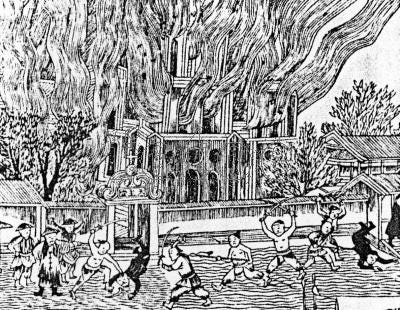
Some things that are true can disguise the truth. For instance, it is common to point out that China — unlike most nations in Asia and Africa — was not made a European colony. Although parts of the country came under foreign control — many of which I have written about here, like Hong Kong, Zhoushan, Guangzhouwan, Qingdao, and parts of Shanghai — the empire, and later the Republic, remained independent. That is not to say that Chinese did not feel oppression from colonial attitudes and actions. Indeed, the interactions between foreigners and Chinese shaped China’s modern history in fundamental ways.
Such was the case in Tianjin in the spring of 1870. The city and the surrounding region, like much of China, had been turned upside down in the preceding decades as European colonialism flooded the empire in the years following the Opium War. Foreigners, and foreign interests, spread inland from the coast and along China’s rivers, especially in the Treaty Ports. Tianjin — the port city of Beijing — was not among the first Treaty Ports opened by the Treaty of Nanjing in 1842, but was included in a second round of ports opened following the Second Opium, or Arrow, War. In the spring of 1861, the foreign presence in Tianjin increased sharply.
The terms of the treaties ending the Second Opium War permitted Christian activities and institutions in treaty ports. In Tianjin, one of those was a mission led by the Lazarist Chinese priest, Joseph Tsiou. Tsiou’s priority was baptizing gravely ill infants — some of whom had been abandoned as acts of infanticide. From Tsiou’s perspective, his work was merciful, offering innocent souls entry to heaven. (The fate of unbaptized babies is a surprisingly complex theological debate, which includes the now-out-of-favor notion of “limbo,” but this column takes no official stance on such matters.)
To the non-Christian people of Tianjin, though, the effects of Tsiou’s ministry seemed clear: he sought out infants — sometimes paying for the privilege — and the great majority of them died soon after he took them in. Tsiou himself died of illness just months after beginning his mission; he was soon replaced by a French order, the Sisters of Charity. These nuns followed the practice of a Catholic society called the Holy Childhood Program, focused on the baptism and education of infants and which had grown explosively across the world starting in the 1840s. (Historian Henrietta Harrison has detailed the work of the Holy Childhood Association in China, which had branches in many treaty ports.)
The Sisters of Charity continued the work that Tsiou had begun. By 1870, there were ten nuns in Tianjin working to educate, baptize, and care for abandoned infants. The project was becoming increasingly controversial in the eyes of the local population. The nuns’ focus on infants, many of whom were sick or poorly nourished, meant that most of the children they brought in died soon thereafter. The pattern was unmistakable, even if the reason for the correlation was not sinister.
It was true that the sisters sometimes offered money to parents to surrender their babies. In the nuns’ eyes, this may have been a double-charity, benefiting the parents’ who had been driven to desperation while also helping the child, either in the present or in the afterlife (perhaps both), but it created a troubling incentive. Motivated by

