


In recent years, China’s rise has been one of the most important aspects of geopolitics. From various vantage points, observers have framed China as a more benign alternative to Western-style imperialism, or as a disruptive challenger to the post-World War II order, or as a hypocrite disguising its ambitions as benevolence, or as a clear-eyed practitioner of realpolitik, contrasting American moral paternalism. That list is neither nuanced nor exhaustive, of course, but in each case we see an acknowledgment that China is a dominant regional power and, at the very least, an important global player.
And as often as we use the phrase “China’s rise,” we don’t often make clear just what it is rising from. It’s a fool’s errand to find one single moment that represents China’s nadir in terms of global influence, but I’ll play the fool for this exercise and suggest April 17, 1895. On that day, events were underway that would see China reduced to a minor player in world affairs, and a subordinate power even in its own backyard. The Treaty of Shimonoseki would end the first Sino-Japanese War decisively in Japan’s favor, leaving the Qing empire defeated and dismembered.
The war had begun in the summer of 1894. Then, it was Japan, not China, that was the rising global power, seeking hegemony in East Asia and respect abroad. Japan’s quest for resources and strategic positioning collided in the Korean peninsula with Qing China’s claims to regional dominance. Both sides used disingenuous claims that they were supporting Korean autonomy — neither side was in truth interested in Korea serving as anything other than a vassal state or colony — to intervene on behalf of their proxies. Fighting took place first on the Korean peninsula and surrounding waters, and the Japanese advance was steady. Naval defeats all but destroyed the Qing Beiyang Fleet early in the war, and Japanese forces invaded China, advancing down the Liaodong peninsula. Port Arthur fell in November, 1894. Ten weeks later, Japanese marines captured the northern Shandong port of Weihaiwei and destroyed what was left of the Qing fleet in port, “ending Chinese naval power,” as historian Sarah Paine wrote, “for more than a century.”
On a map of the region, China’s predicament at this point is obvious. Port Arthur, on the north, and Weihaiwei, on the south, controlled the entry to the Bohai Sea and, therefore, the approaches to Beijing. The Qing court was left with little choice but to sue for peace.
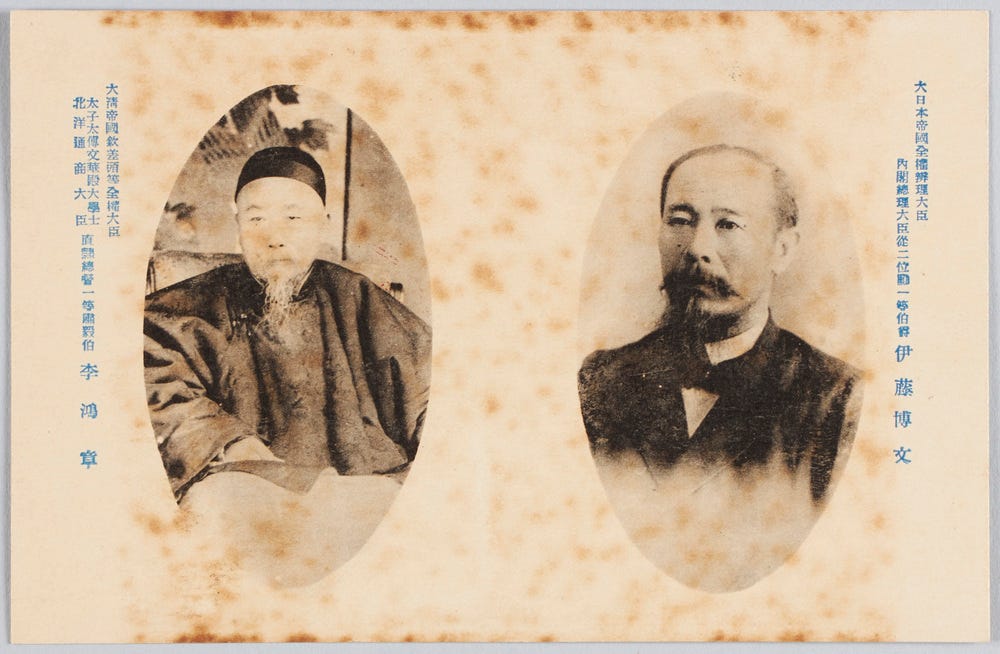
On March 19, the Qing delegation arrived in Shimonoseki, at the southernmost tip of Japan’s main island of Honshu. Comprising some 100 bureaucrats and diplomats, the Chinese side was led by Li Hongzhang, one of the empire’s preeminent statesmen who had been in the halls of power for decades after his central role in winning the Taiping Civil War for the Qing. He was, both literally and figuratively, a towering figure, standing six feet tall (exceptional for the time), his height accentuated by the flowing traditional robes he wore. Li’s reputation for loyalty, integrity, and honesty matched his dignified demeanor, commanding respect from all around him.
Meanwhile his counterpart, Itō Hirobumi, cut a very different figure. He stood nearly a foot shorter than Li, short even by the standards of the day. His clothes were also a stark contrast, wearing a western-style military that was festooned with medals. “Chronically insecure,” writes historian Paine in her definitive history of the Sino-Japanese War, “he craved praise to his face and decorations on his chest.” Itō was also known to be disrespectful to subordinates and was late to cabinet meetings because he lingered at a geisha house.
But the two men’s personal integrity belied their positions as they began negotiations in the Shuntarō guesthouse. The hotel itself was familiar to Itō as it was his visit in 1888 that had made it the first place to legally serve Fugu, the pufferfish that can be fatal to eat if not prepared correctly. Itō had arrived there, as the hotel now tells it, during a storm that had left the fleet unable to fish. With nothing else on hand, the chef had been forced to serve Fugu, which although illegal had long been a local delicacy. After its chef demonstrated his ability to prepare the delicacy, Shuntarō became the first place in Japan licensed to offer the risky meal. (The original structure was destroyed in the second world war, but the rebuilt hotel still bears the same name and is open for business!). Whether they ate Fugu or not, the delegations began their negotiations in late March. They were conducted, it’s worth noting, entirely in English — Li speaking through an interpreter, while Itō spoke English fluently.
But in any language, Li had little leverage. The Qing forces had been all but annihilated and Japan’s navy was unchallenged in Chinese waters. Nothing stood in the way should Japan decide to take the capital, Beijing. Li’s only hope was to convince western powers to intervene on China’s behalf, a hope built on the proposition that the colonial powers would be loath to see Japan ascendant to the point that it could challenge their own ambitions in the region. As the talks went on, it became clear that Japan would press its advantage.
Ironically, Li’s position was improved in a turn of events that nearly took his life. As Li returned to his accommodations after the fifth day of negotiations, a would-be assassin shot him in the face at close range. Miraculously, the shot did not kill the Qing diplomat, but lodged in his face. As Paine describes it, “Li decided not to have the bullet removed. He preferred to get on with negotiations.
The bullet remained lodged deep under Li’s nose, a souvenir from his first trip abroad and a continuing source of discomfort.”
The Japanese were deeply embarrassed at their inability to keep a foreign diplomat safe on their own territory. Ultranationalists, like the one who had shot Li, had been a recurring problem for Japanese leaders: a Japanese policeman had scarred the future Tsar Nicholas with a sabre while the heir was on a goodwill tour in Japan four years earlier — and the attack on Li tempered the Japanese demands.
More modest they may have been, but the Japanese peace terms were humiliating for Qing China. In just a few clauses, China’s dominance in East Asia was erased and the Qing state flipped from colonizer to colony: Korea’s tributary relationship to China was terminated. The Liaodong peninsula, the Pescadores Islands, and Taiwan were all ceded to Japan, along with a substantial war indemnity. Chinese ports, on the coast and up its rivers, were opened to Japanese ports, and economic interests were conceded.
Barely had the ink on the treaty dried, though, when the European powers who had refused to intervene on the behalf of the Chinese found themselves uncomfortable with the new circumstances. Realizing that Japan was now a mainland Asian power, Russia, France, and Germany through a so-called “Triple Intervention” compelled Japan to give back the Liaodong peninsula in exchange for a greater indemnity.
The intervention was a mixed blessing for the Qing. It did preserve the territorial integrity of the empire (at least on the mainland) but the fact that the European powers were able to protect Chinese interests when the Chinese themselves were not illustrated the empire’s weakness. And the retrocession of the Liaodong peninsula provoked outrage in Japan, especially after the peninsula was leased to Russia. Ten years later, Russia and Japan would be at war with one another over Chinese territory.
Even mitigated by the Triple Intervention, the impact of the Treaty of Shimonoseki was enormous. Now China was clearly a second-rate regional power, far from the global actor it had been and even pretended to be just decades earlier. And the precedent that was established by Japan’s territorial acquisitions — even with the return of Liaodong, Japan acquired Taiwan and the Pescadores, as well as economic interests on the mainland — opened the door for other imperial powers. The insidious “most favored nation” clause in the treaty regime that began in the 19th century meant that every country with imperial ambitions toward China could bring with them the expectation that they too could claim pieces of the Qing empire. A scramble for concessions that would see pieces of China given to France, Britain, the United States, Germany, Russia, and others was underway.
Once commanding tribute and respect from its neighbors, China was now at the mercy of its much smaller neighbor, which was prying apart the Qing empire. Japan’s presence in China would increase steadily through 1945. It’s no exaggeration to point to Shimonoseki as a crucial inflection point in the relationship of Taiwan to the mainland, which today sits as the central tension between China and the United States.
