


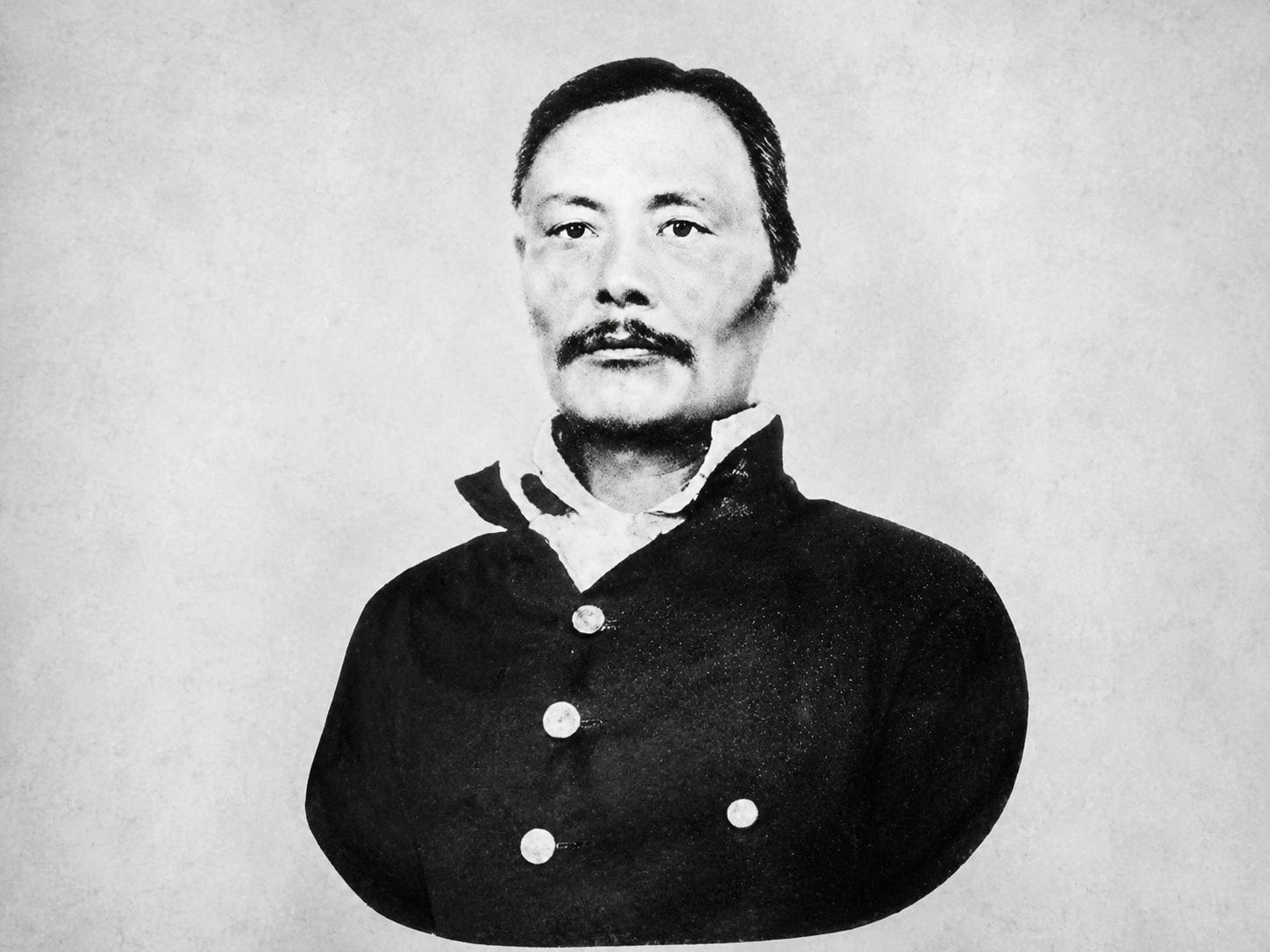
The decades following the fall of the Qing dynasty were full of colorful characters who managed to accrue personal power and wealth (often at the expense of the people who lived in the areas under their control). The abrupt end to the imperial system — even if many elements of society, culture, and politics persisted — meant that the people who had successfully risen to power suddenly found themselves needing to reinvent themselves. Some of those who succeeded in this would emerge as “warlords” when Yuan Shikai died and the Chinese republic collapsed. Some, though, never had that chance.
One such man was Xu Baoshan 徐宝山. Xu, born in 1866, built his career as a smuggler, moving salt around the lower Yangtze valley in defiance of the imperial monopoly. By the end of the 20th century, according to historian Paul Martin, Xu had nearly 10,000 people working for him and some 700 vessels at his disposal to move salt up and down the river and the coast. Going by the nickname “Tiger,” Xu negotiated expertly a complex space between Qing authorities and would-be revolutionaries, oscillating, in Martin’s description, “between conflict and cooperation depending on which policy best served to maximize Xu’s interests at any given time.”
To illustrate Xu’s skill, he was appointed as an official by the Qing government to oversee their anti-smuggling efforts in Jiangnan, the lands south of the Lower Yangtze — a relatively easy brief since his own organization was responsible for most of the illegal trade in the region. He could now use his official office to persecute rivals. What had previously been ruthless business practices became law enforcement. And after 1911, Xu seized control of Yangzhou and, at first, rallied his troops to fight against the rebels. But then, rather than going down with the Qing ship, Tiger Xu made a deal with the anti-dynastic forces. He agreed to side with the new Republic as long as he could retain control over, and the revenue from, the salt manufacturing and distribution apparatus that he had, by turns, been bypassing or enforcing for the previous decades. The Qing dynasty was gone, but Xu Baoshan had strengthened his own wealth and power in its wake.
But power in the years following 1911 was precarious. Xu’s influence and location made him crucial for anyone wanting to strengthen power in the lower Yangtze, which was in turn an essential part of any aspiration for nationwide power. Yuan Shikai had recognized this and bought Xu’s loyalty with money — reportedly a quarter of a million taels — and favors — he gave Xu’s son a military appointment. Then, when Yuan revealed his dictatorial ambitions by murdering his political rivals,

