


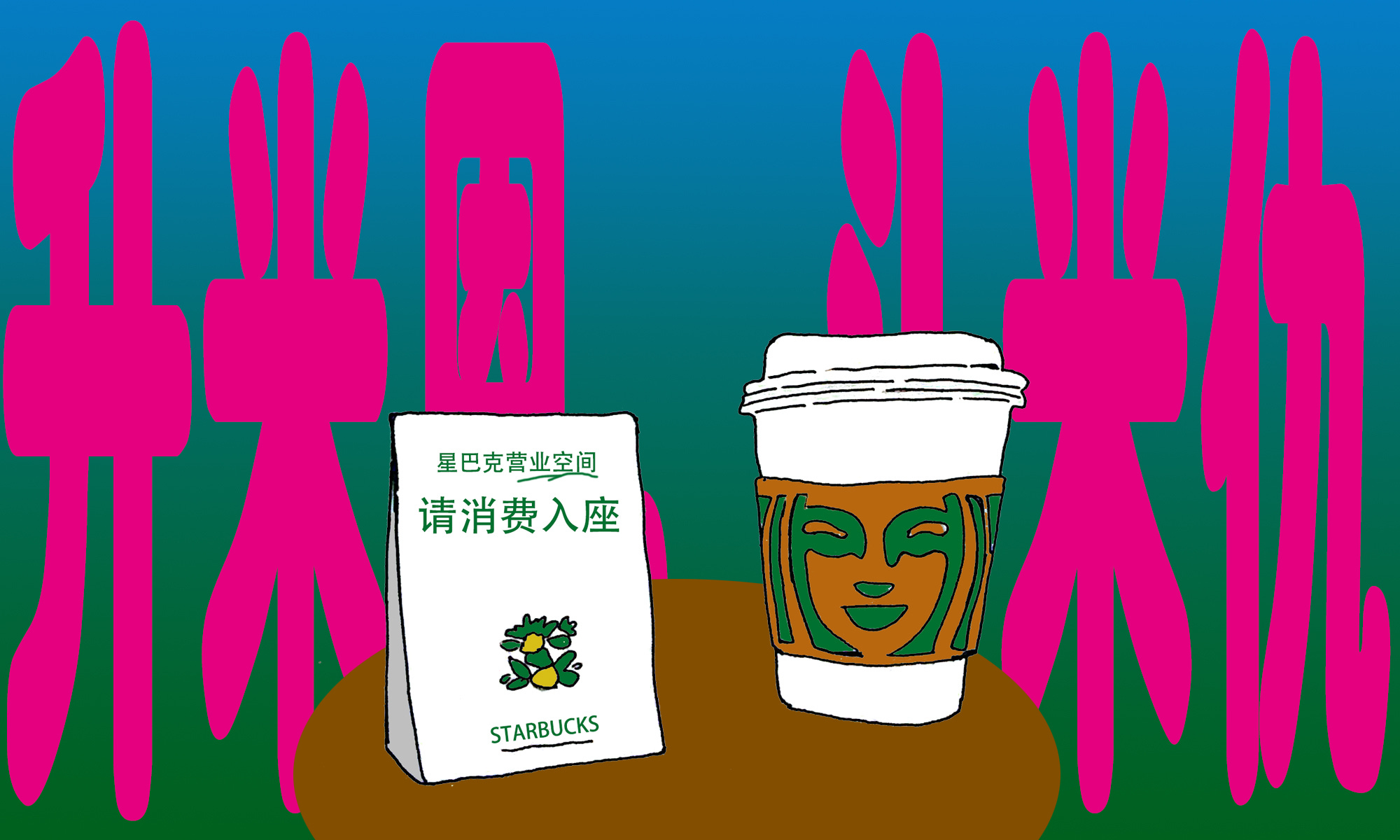
Our phrase of the week is: “too much kindness breeds resentment” (升米恩,斗米仇 shēng mǐ ēn, dǒu mǐ chóu)
Context
On 22 October, Starbucks China introduced its new policy of “seats are reserved for paying customers” (消费入座).
This is a big change to the Starbucks model in China. For the last 30 years, it has been built around the idea of being a “third space” (第三空间): somewhere between home and the office where people can sit, relax, work or meet friends, without having to buy anything.
The term was coined by the American sociologist Ray Oldenburg in 1989. Starbucks made it part of its brand as it expanded worldwide, bringing it to China with its first Beijing store in 1999.
In the US, Starbucks scrapped its open-door policy in 2025. Now China is following suit, and not everyone is happy about it.
Critics say customers have long paid for this right to the “third space” through the premium built into every 30-yuan coffee. But supporters see it differently. Comfortable chairs, air conditioning and free power don’t come cheap. And when non-paying visitors take up space, those who do buy something are often left without anywhere to sit and enjoy their expensive coffee.
Many comments on the issue also say the free seating has been taken for granted, using an old saying to make the point:
“People got so used to free seating without needing to buy anything that they started taking it for granted.
How is that any different from ‘too much kindness breeds resentment’?”
以前没要求消费入座,习惯反倒变成理所当然,这与升米恩斗米仇有什么区别?!
And with that, we have our Sinica Phrase of the Week.
What it means
“Too much kindness breeds resentment” is our translation of a well-known colloquial expression in Chinese. Broken down, it reads very differently: “a sheng of” (升 shēng), “rice” (米 mǐ), “gratitude” (恩 ēn); “a dou of” (斗 dǒu), “rice” (米 mǐ), “resentment” (仇 chóu).
Literally, it translates as “a sheng of rice earns gratitude, while a dou of rice earns resentment”.
The sheng (升) and the dou (斗) are traditional Chinese units for measuring grain by volume. One sheng is about a litre, just under two pints. One dou is equal to ten sheng, or about ten litres, a little over two gallons.
This contrast of measures is being used as a metaphor for a small amount of help being appreciated, and a much greater amount of generosity being taken for granted. So when that help stops, the person who received it ends up resenting the person who gave it.
The saying is often traced to The Scholars (儒林外史), a satirical novel by Wu Jingzi (吴敬梓), written in the Qing dynasty. Wu Jingzi (1701–1754) was a scholar from a once-prominent family during the Qing period. Wu squandered his inheritance and turned his back on the imperial civil service exams. His novel mocks the scholars who devoted their lives to passing them. It’s regarded as one of the great works of classical Chinese fiction.
In Chapter 22, a character named Bu Cheng (卜诚) complains about a man he and his brother had supported:
“As the old saying goes: ‘A dou of rice creates a friend; an a dan of rice creates a foe!’
This is our own doing for spoiling him!”
自古”一斗米养个恩人,一石米养个仇人”!这是我们养他的不是了!
Here, a dan (石) is equal to ten dou, or about 100 litres, roughly 22 gallons, which is equivalent to one hundred sheng. And, as mentioned above, a dou is about ten litres, a little over two gallons. So the measures here are ten times larger, but the point is the same: give too much, and eventually you will be resented.
Over time, the expression settled into the shorter, more common form,“a sheng of rice earns gratitude, a dou of rice earns resentment” (升米恩,斗米仇). And a fuller eight-character variant also is used with the verb “to cultivate” (养) inserted:
“a sheng of rice raises gratitude, a dou of rice raises resentment”
升米养恩,斗米养仇
In modern Chinese, the saying is still a warning that giving too much can breed dependence, then entitlement, and eventually resentment. It’s one of those universal truths, wherever you’re from. And if, like me, you’re the parent of teenagers, you’ll know exactly how that feels!
But translated literally the saying means little to an English reader. Which is why we decided to translate it as “too much kindness breeds resentment,” which carries the same meaning as the original. Other common candidates in English include “no good deed goes unpunished” and “give them an inch and they’ll take a mile.”
For Starbucks, the phrase sums up the so-called customers who, over the last 30 years, came to take those free seats and the “third space” for granted, and are now upset it’s no longer available.
Andrew Methven is the author of RealTime Mandarin, a resource which helps you bridge the gap to real-world fluency in Mandarin, stay informed about China, and communicate with confidence—all through weekly immersion in real news. Subscribe for free here.
