


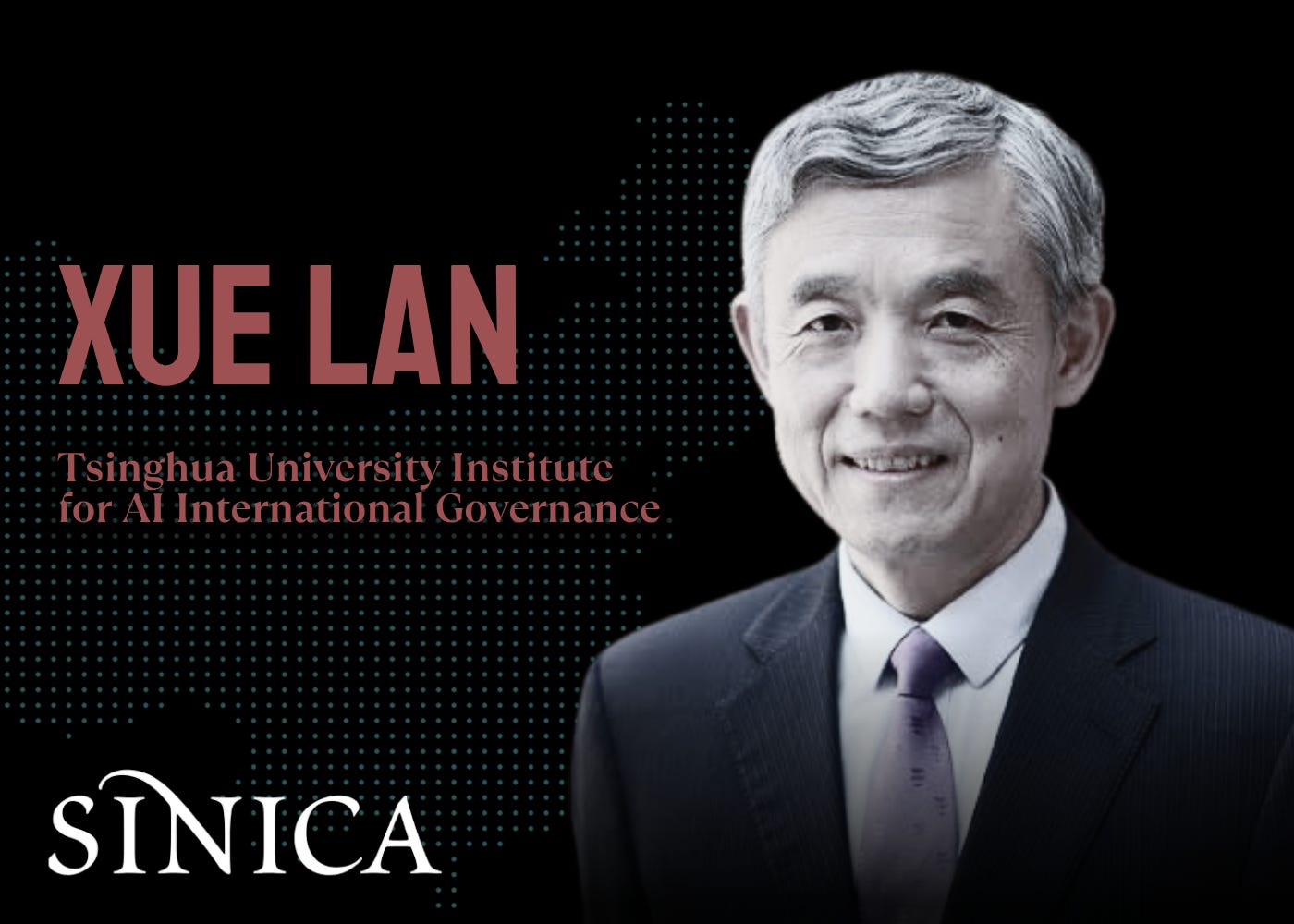
Transcript (courtesy of the fantastic CadreScripts) further down the page. Image by Keya Zhou. Listen in the embedded player above!
Recorded live from the Davos on Air booth at the World Economic Forum’s Annual Meeting of the New Champions in Dalian, this special episode of Sinica tackles the “pacing problem”: the widening gap between how fast AI moves and how slowly regulation can catch up. I sit down with Xue Lan, dean of Schwarzman College at Tsinghua University and one of the architects of China’s concept of “agile governance,” to unpack what that term means in practice. He traces China’s regulatory evolution from the 2017 AI plan through the generative AI rules and the 2021 tech crackdown, compare Chinese, American, and European approaches, and ask whether Beijing’s adaptive style can travel to other political systems — including liberal democracies.
00:09 – Live from Dalian: the “pacing problem” and why AI has turned it into a chasm
03:18 – Introducing Xue Lan, dean of Schwarzman College and architect of “agile governance”
04:34 – Why AI’s pace makes it uniquely hard to regulate
06:01 – Defining agile governance: mindset, partnership over adversary, and light-touch tools
11:54 – From the 2017 AI plan to today: China’s two-track approach to tech and governance
20:07 – Balancing development and security amid the US-China AI race
23:24 – Revisiting the 2021 tech crackdown: failure of the model, or agility of a different kind?
26:14 – The “DeepSeek moment,” open-weight models, and regulatory uncertainty by design
37:10 – EU comprehensiveness vs. US patchwork vs. China’s modular, adaptive approach
46:59 – Can agile governance travel to liberal democracies? Finding common ground on global AI risk
Transcript
Kaiser Kuo: Welcome to this special edition of the Sinica Podcast, a weekly discussion of current affairs in China, coming to you this week from Dalian, from the Davos on Air booth at the World Economic Forum’s annual meeting of the New Champions, also known as Summer Davos.
In this program, we look at books, ideas, new research, intellectual currents, and cultural trends that can help us better understand what’s happening in China’s politics, foreign relations, economics, and society. Join me each week for in-depth conversations that shed more light and bring less heat to how we think and talk about China.
I’m Kaiser Kuo. For over 20 years now, I’ve had the distinct privilege of working with the World Economic Forum as an official writer. And this year, they’ve asked some podcasters to team up with them to bring you shows both under the World Economic Forum banner and under the banner of their own podcast. So, I’m delighted to be able to do this this year with Sinica.
Listeners, please support my work by becoming a paying subscriber at sinicapodcast.com. I do need your help to keep doing this work and to keep bringing you these conversations.
Technology has always run ahead of the rules meant to govern it. Scholars call this the pacing problem, the chronic lag between what innovators can do and what regulators have figured out how to actually handle. We’ve seen this with nearly every major new wave of technological innovation. Recent examples would include Uber and Airbnb, for example, or how regulation really had to catch up much earlier than that. You could go back to the advent of the automobile.
Cars hit the roads before anyone had invented things like speed limits or driver’s licenses or traffic lights or even the concept of jaywalking. I was lucky enough to be in China and to have a front row seat to watch this whole thing unfold when the Internet really took off in China in the late 1990s. In recent years, artificial intelligence has turned that lag into a real chasm, and nowhere is the dilemma more vivid than in China, a country trying to do two things at once that often can pull in opposite directions to, on the one hand, unleash technological development at extraordinary speed, and on the other, to keep that development firmly within bounds that the state can manage.
Out of that tension has come an idea, “agile governance,” that has worked its way into the global policy vocabulary. The question I want to explore today is whether it’s a genuine model that others can borrow or whether it’s something so deeply rooted in China’s particular system that it can’t really be transplanted. And there’s no better place to ask it than here in Dalian, where this year’s theme is Innovating at Scale. It makes the governance question really more urgent than ever because scaling at innovation, scaling innovation itself, also means scaling the risks of technology.
So, my guest is one of the people who has thought longest and hardest about all of this. Xue Lan is dean of Schwarzman College at Tsinghua University. And because I’ve been involved with Schwartzman for many years, really since its inception, that’s how I know Dean Xue best, but he’s also director of Tsinghua’s Institute for AI International Governance. He’s a Cheung Kong Distinguished Chair Professor with a doctorate in engineering and in public policy from Carnegie Mellon University in Pittsburgh.
He chairs China’s National Expert Committee on the Governance of Next Generation AI. And some of you may recall that was one of those, from China, who spoke to Senator Bernie Sanders of Vermont on cooperation on AI governance back on April 30th of this year. Crucially, for our purposes today, he is also one of the intellectual architects of this very concept of agile governance as a concept in Chinese policymaking. So, there are few people who are better placed to tell us what it really means and whether it travels. Dean Xue, it is a real pleasure to have you at last here in Dalian, and a warm welcome to Sinica.
Xue Lan: Thank you, my pleasure.
Kaiser: So Dean, let’s start with the basic problem. Every regulator faces what’s been called this pacing problem, technology evolving faster than the rules that can keep up with it. This isn’t genuinely new, but it does seem newly acute. What makes it so? It’s not just AI either. It’s biotech. It’s robotics. It’s new materials. It’s quantum. And more, yes?
Dean Xue: I would still argue that AI is really unique. I think partially because AI has been changing so fast. If you look at the other technologies, I think that very few that can develop so fast. I mean, think about the frontier models.
Kaiser: Right.
Dean Xue: In the last few years, I think it’s maybe every half year, not every two months and every month, even just few weeks. So, the rapid evolution, I think, it’s just really unseen.
Kaiser: Yeah.
Dean Xue: I think that’s part of one aspect. The other thing is also the impact on so many domains daily life of our economic activities. So bio maybe is in certain sectors, but not in all. AI, you can’t think of it, an area that AI would not touch on.
Kaiser: Right.
Dean Xue: Yeah.
Kaiser: Yeah, absolutely. So you are very closely associated with this concept of agile governance. So maybe in just a couple of sentences for our listeners, what does that actually mean? And just as importantly, what is it a reaction against? Agile can sound like a Silicon Valley slogan, you know, move fast and break things. So, how is the governance version different from simply light touch regulation or from deregulation?
Dean Xue: Sure. Indeed, I think those two words actually are kind of a very strange combination. We think about the governance, of course, it’s very official, very formal, is going to take a long time, and so on. So you have that image there. Agile is something that’s light, quick, and then the change fast. So those two combinations, I mean, it’s kind of weird combination. But that’s exactly what I think that we’ve been trying to achieve. That is, you want to achieve the function of governance. But at the same time, the way you achieve that is not through the traditional, you know, official approach.
But rather you try to learn from the, you know, in other spheres, for example, in industry and so on. You try to accelerate. So that’s the combination that we’re trying to achieve. I think, in general, I think there core elements, what I see as really embodied in the so-called the agile governance. And the first thing is that, you know, I’m a scholar of public policy. So, when we think about governance, we think about regulations, you always try to study this thing very thoughtfully, I mean, very thoroughly.
And so, you want to make sure that you’re not leaving any gaps. You want to review all the evidence, all the problems and so on. And then you come up with a comprehensive, accurate kind of a regulations that you very thoughtfully deliberated. And then you go through, you know, very elaborative process, being reviewed by experts, by stakeholders, and going through the kind of a due process, then to get your final thing coming out.
And that’s the regular governance that we have to go through. Very unfortunately for a technology like AI, by the time you’ve gone through that process…
Kaiser: The thing you’re regulating has changed.
Dean Xue: The thing you’re regulating has already changed. It’s totally been the way. So, what do you do? And that’s so in a way, if you really want to be useful, you really have to change your mindset. You can’t be comprehensive. You can’t be accurate on everything. And you really have to move fast. That’s the, I think, the first thing is that you have to change your mindset. The second thing I that you also have to change the idea that the regulator and the regulatee, the companies being regulated, you are the enemy. You are playing the cat and mouse game.
