


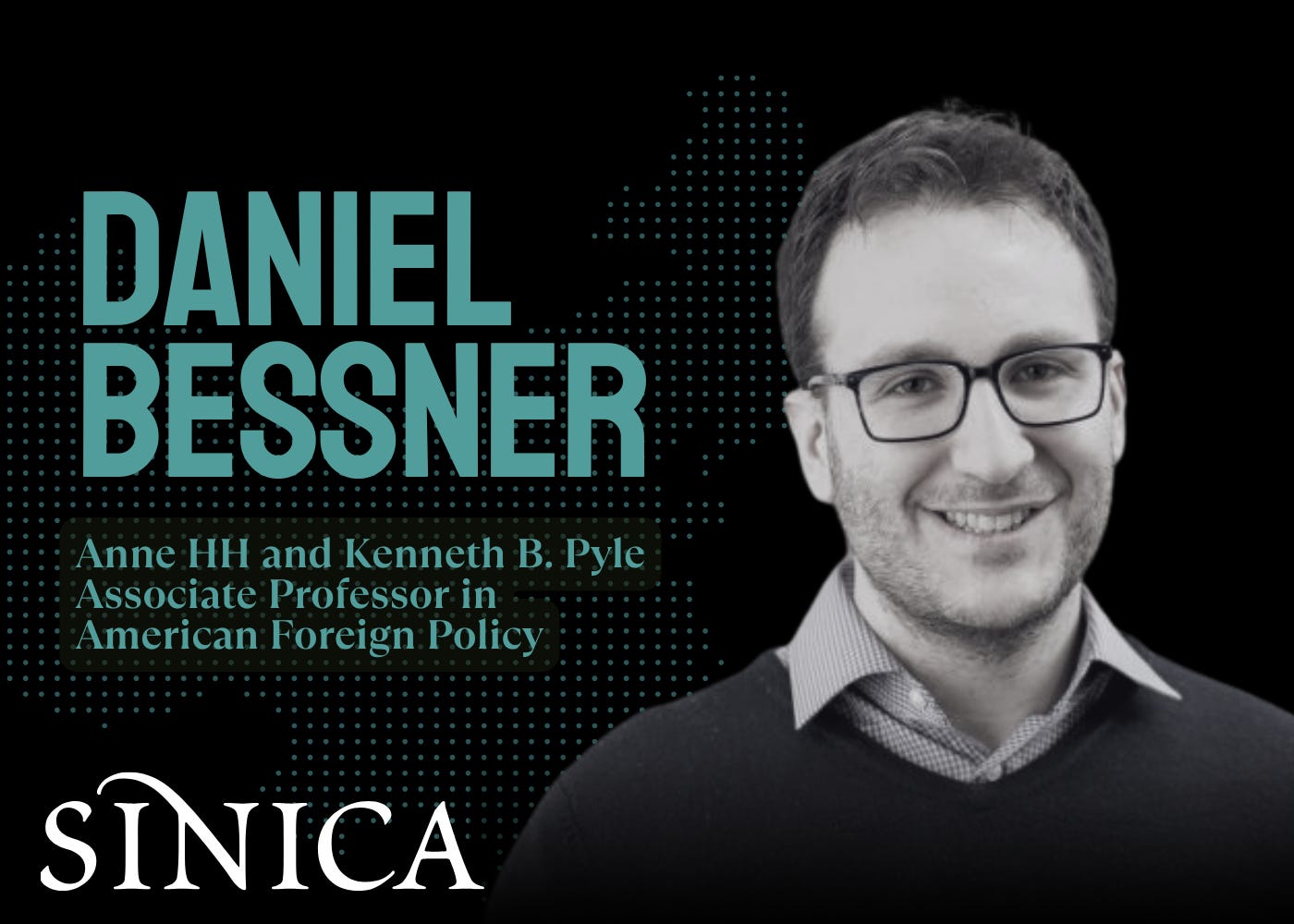
Transcript, courtesy of CadreScripts, further down the page. Image by Keya Zhou.
This week on Sinica, I speak with Daniel Bessner, the Anne H.H. and Kenneth B. Pyle Assistant Professor in American Foreign Policy at the Henry M. Jackson School of International Studies at the University of Washington and co-host of the American Prestige Podcast. If you follow U.S.-China relations even casually, you can’t avoid hearing that we’re in a new Cold War — it’s become a rhetorical reflex in D.C., shaping budgets, foreign policy debates, media narratives, and how ordinary Americans think about China.
But what does it actually mean to call something a Cold War? To think clearly about the present, I find it helps to go to the past, not for simple analogies but to understand the intellectual and ideological machinery that produced and now sustains a Cold War mentality. Danny has written widely about the architecture of American power, the rise of the national security state, and the constellation of thinkers he calls Cold War liberals who helped define the ideological landscape of U.S. foreign policy. We explore how Cold War liberalism reshaped American political life, how the U.S. came to see its global dominance as natural and morally necessary, why the question of whose fault the Cold War was remains urgent in an age of renewed great power rivalry, the rise of China and anxiety of American decline, and what it would take to imagine a U.S.-China relationship that doesn’t fall back into old patterns of moral binaries, ideological panic, and militarized competition.
6:20 – Danny’s background: from Iraq War politicization to studying defense intellectuals
11:00 – Cold War liberalism: the constellation of ideas that shaped U.S. foreign policy
16:14 – How these ideas became structurally embedded in security institutions
22:02 – The Democratic Party’s destruction of the genuine left in the late 1940s
27:53 – Whose fault was the Cold War? Stalin’s sphere of influence logic vs. American universalism
31:07 – Are we facing a similar decision with China today?
34:23 – The anxiety of loss: how decline anxiety distorts interpretation of China’s rise
37:54 – The new Cold War narrative: material realities vs. psychological legacies
41:21 – Clearest parallels between the first Cold War and emerging U.S.-China confrontation
44:33 – What would a pluralistic order in Asia actually look like?
47:42 – Coexistence rather than zero-sum rivalry: what does it mean in practice?
50:57 – What genuine restraint requires: accepting limits of American power
54:14 – The moral imperative pushback: you can’t have good empire without bad empire
56:35 – Imperialist realism: Americans don’t think we’re good, but can’t imagine another world
Paying it forward: The Quincy Institute for Responsible Statecraft and Responsible Statecraft publication; The Trillion Dollar War Machine by William Hartung and Ben Freeman
Recommendations:
Danny: Nirvana and the history of Seattle punk/indie music (forthcoming podcast project)
Kaiser: Hello China Tech Substack by Poe Zhao (hellochinatech.com)
Transcript:
Kaiser Kuo: Welcome to the Sinica Podcast, a weekly discussion of current affairs in China. In this program, we look at books, ideas, new research, intellectual currents, and cultural trends that can help us better understand what’s happening in China’s politics, foreign relations, economics, and society. Join me each week for in-depth conversations that shed more light and bring less heat to how we think and talk about China.
I’m Kaiser Kuo, coming to you this week from my home in Chapel Hill, North Carolina.
Sinica is supported this year by the Center for East Asian Studies at the University of Wisconsin-Madison, a national resource center for the study of East Asia. The podcast will remain free, as always, but if you work for an organization that believes in what I’m doing with the show and with the newsletter, please consider lending your support. You can reach me at sinicapod@gmail.com. And listeners, please do your part by supporting my work. Become a paying subscriber at sinicapodcast.com. You will enjoy, in addition to the podcast, the complete transcript of the show, essays from me, as well as writings and podcasts from some of your favorite China-focused columnists and commentators.
And of course, you will also be able to bask in the knowledge that you’re helping me do very important work in the world. So, do check out the page, see all that is on offer, and consider helping out.
If you follow U.S.-China relations even casually, you can’t avoid hearing that we’re already in a “new Cold War,” and it becomes a kind of rhetorical reflex, I think, in D.C., a framing that shapes budgets, foreign policy debates, media narratives, and really even the way that ordinary Americans think about China. But what does it actually mean to call something a Cold War? How do these frameworks get made in the first place? And what happens when we let that language of existential conflict actually drive our politics and our policy?
To think clearly about the present, I find it often helps to go to the past, not in search of simple analogies of which I’m often suspicious, but to understand the intellectual and ideological machinery that produced and now still sustains a Cold War mentality. That’s where I think the work of today’s guest is especially illuminating. The historian Daniel Bessner is the Anne H.H. and Kenneth B. Pyle Assistant Professor in American foreign policy at the Henry M. Jackson School of International Studies at the University of Washington. Danny is also one of the co-hosts, along with Derek Davison, of the exceptional American Prestige Podcast from The Nation, which I think Sinica listeners would very much enjoy.
He’s written widely in an impressive roster of publications about the architecture of American power, the rise of the national security state, and really, the constellation of thinkers he calls Cold War liberals who helped define the ideological landscape of U.S. foreign policy in the 20th century and beyond. I’ve now read several of his more recent writings, like an essay titled Empire Burlesque from a few years ago, which was the cover story, actually, in Harper’s. I read that with great interest after Adam Tooze linked to it in Chartbook just recently. I also read a very provocative piece he contributed to the Ideas Letter, where I’ve also written, as you listeners know, and in the introduction to a forthcoming edited volume called Cold War Liberalism in Historical Perspective that Danny was kind enough to share with me.
These remarkable pieces together compel us to reconsider not just the origins of that first, maybe only Cold War, but the deeper political habits and cultural assumptions that made it possible. And that, once again, as I suggested, may be steering the U.S. toward another confrontation of that sort, this time with China, of course. Basically, I realized that this is the guy I can finally have on the show to try and plumb the depths of and explore the origins of American hegemonic primacy, something we talk about an awful lot on this program.
So, over the course of our conversation, we’re going to explore how Cold War liberalism reshaped American political life, how the United States came to see its own global dominance as both natural and kind of morally necessary, and why the question of whose fault the Cold War was actually remains pretty urgent and relevant in an age of renewed great power rivalry. We’re also going to talk about the rise of China, the anxiety of American decline, and what it would take to imagine a U.S.-China relationship that doesn’t fall back into these old patterns of moral binaries, into ideological panic, and militarized competition. So, it’s a rich set of themes, historical, philosophical, and deeply contemporary. I am delighted to explore them today with someone who has thought about these issues, really more clearly and more provocatively than almost anyone else writing today. Danny Bessner, welcome to Sinica.
Danny Bessner: Well, thank you so much for having me. And I had no idea you’re in the Triangle. I did mine at Duke.
Kaiser: Yeah, I did, I knew that. I saw that.
Danny: Yeah. So, it’s always nice to talk to someone from Research Triangle. Also, if people do want to check out American Prestige, I would just point them to americanprestigepod.com.
Kaiser: Yeah, I’ll make sure to put a link to that, of course, in the show notes. And it’s great. I think, as I said, Sinica listeners are going to find a lot of interesting perspectives there that are not really too far away from the ones that tend to appear on this show. Danny, this is your first time on Sinica. So, you are not a China-focused scholar, per se. Maybe you could say a little bit, by way of introduction, what it is that you do focus on academically, what’s moved you in your intellectual and personal life, professional life, I guess, closer to the China space. Enough so that you’ve caught the attention of somebody like me.
I mean, besides the fact that you guys also interviewed Mike Brenes. You’ve actually had him on a bunch of times, right? As well as Van Jackson. I had Mike and Van on the show. I think you will probably have heard this one just last week. He’s also a regular guest on your podcast. And I talked to them about their book, of course, which is not unrelated to your own work when I was up at Yale a couple of weeks ago. So, yeah, tell us a little bit about where you came at this from.
Danny: For sure. And, actually, by the time this is released, listeners will be able to look at our eight-part series, I believe, on the history of modern China that we did with Yidi Wu, that we’re calling Chinese Prestige. So, check that out if you’re interested.
Kaiser: Oh, wow.
Danny: Yeah, I think it would be of significant interest to people who like Sinica. But basically, academically, I’ve studied what has been termed or I at least termed defense intellectuals, the thinkers who helped define the common sense of what U.S. foreign policy should be. I’m very much a product of the Iraq War in the sense that I was politicized in the 2000s. And my experience of U.S. foreign policy as an adult or as a young adult, and then into an adult, has been just one of nonstop failure, nonstop intervention and collapse, the destruction of other people’s lives, literally, and in terms of deracinating them.
So, that’s really what got me interested in U.S. foreign relations and studying how it came to be that U.S. dominance became the assumption of so many Americans, and
