


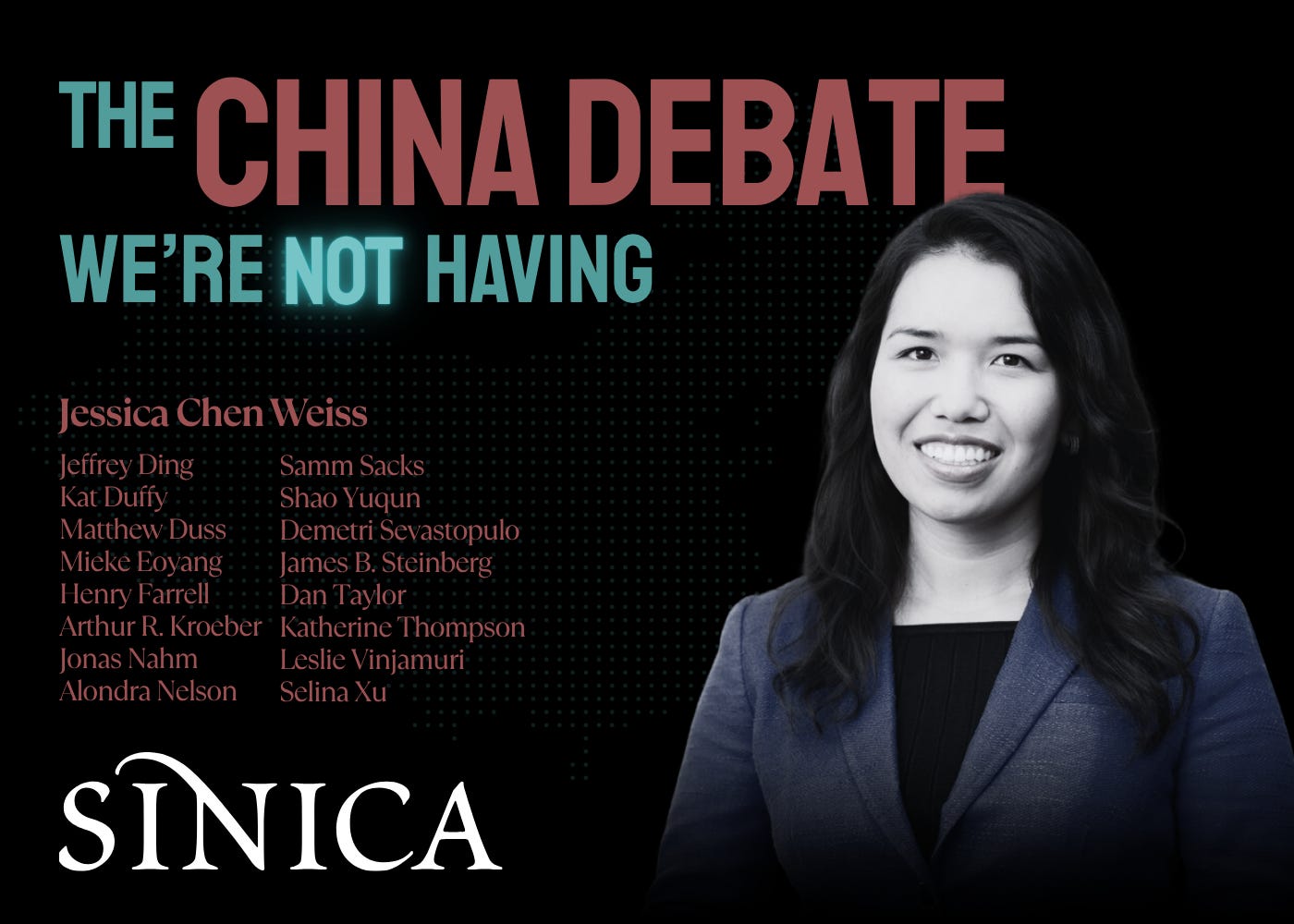
Transcript (courtesy of the fantastic CadreScripts) further down the page. Image by Keya Zhou. Listen in the embedded player above!
This week’s episode features audio from a day-long conference hosted by the Institute for America, China, and the Future of Global Affairs (ACF) at Johns Hopkins SAIS, held on April 3rd in Washington, DC. The conference, titled “The China Debate We’re Not Having: Politics, Technology, and the Road Ahead,” brought together a wide range of scholars, former officials, and analysts to interrogate some of the foundational assumptions underlying US policy toward China — a conversation I found compelling enough to share directly with Sinica listeners, with the full blessing of the organizers.
You’ll hear two segments in this episode.
Opening Remarks — Jessica Chen Weiss
ACF’s inaugural faculty director Jessica Chen Weiss opens the conference by framing its central provocation: that much of the prevailing US policy discourse assumes an intrinsically zero-sum competition with China, and that this assumption has not been adequately examined. She argues for a more rigorous, evidence-based conversation — one that takes seriously the possibility that American and Chinese interests are competitive but not necessarily adversarial, and that may even leave room for complementarity in some domains. She previews the day’s three thematic sessions — on what China wants, what the United States wants, and the stakes of technological and AI rivalry — and situates the whole enterprise in what she describes as a hinge moment in world history.
Session 1: What China Wants
Moderated by Demetri Sevastopulo of the Financial Times, the first panel takes up the deceptively simple question of what China is actually trying to achieve on the world stage — and whether its ambitions are as expansive as much US policy discourse assumes.
Jessica Chen Weiss argues that China’s core objectives remain relatively modest and sovereignty-focused: security, development, and legitimacy within an order long dominated by the United States. She pushes back on the idea that China is eager to assume the burdens of global leadership, noting that Chinese interlocutors are acutely aware of the domestic overextension that has constrained American power. Sevastopulo coins — with Weiss’s amusement — the term “China-first” to describe Beijing’s orientation.
Dan Taylor, drawing on his decades in the Defense Intelligence Agency, urges the audience to take Chinese leadership statements seriously rather than projecting worst-case intentions onto them. He notes that Beijing still sees itself as a developing nation with enormous domestic work ahead, and that its articulated goals leave considerable room for interpretation before one arrives at the conclusion that China seeks to displace the United States as global hegemon.
Arthur Kroeber adds an economic dimension, tracing how China’s export-driven model has generated massive global surpluses — and why the resulting tensions with trading partners are, in his view, a structural problem rather than evidence of strategic malice. He argues that much of what looks like geopolitical aggression is better understood as the consequence of an economic model operating at enormous scale with insufficient domestic demand to absorb its own output.
Shao Yuqun, speaking from her perch at the Shanghai Institutes for International Studies, offers the most pointed challenge to the panel’s relatively sanguine framing. She argues that the United States’ own behavior — erratic policy, withdrawal from multilateral commitments, and the disruptions of the Trump era — has itself destabilized the order that American strategists claim to be defending. She is measured but direct, and her presence gives the conversation a texture that too many Washington panels lack.
The discussion ranges across China’s Iran diplomacy, the prospects for a US-China summit, the question of whether Beijing is exploiting Trump-era tensions to deepen ties with traditional US allies, and — in a lively closing exchange — who the next generation of Chinese leadership looks like (with Kroeber’s deadpan answer, “Xi Jinping,” getting the biggest laugh of the session).
Guests:
Jessica Chen Weiss, David M. Lampton Professor of China Studies, Johns Hopkins SAIS; Inaugural Faculty Director, ACF
Dan Taylor, Adjunct Researcher, Institute for Defense Analyses; Senior Fellow, Johns Hopkins SAIS ACF
Arthur Kroeber, Founding Partner, Gavekal Dragonomics
Shao Yuqun, Director, Institute for Taiwan, Hong Kong & Macao Studies, Shanghai Institutes for International Studies
Moderator: Demetri Sevastopulo, US-China Correspondent, Financial Times
Remaining sessions from the conference — on what the United States wants, tech rivalry and competing visions of the future, and a fireside chat between Henry Farrell and Alondra Nelson on the AI race reconsidered — will be released over the coming weeks.
Transcript
Jessica Chen Weiss: All right, well, welcome everybody. My name is Jessica Chen Weiss. I’m the inaugural faculty director of the Institute for America, China, and the Future of Global Affairs, or ACF, here at SAIS. We’re delighted to welcome you here today. It’s a moment of great flux, which means a lot of risk, but also great opportunity. As the song by Buffalo Springfield put it, there’s something happening here, but what it is it ain’t exactly clear.
So, I’m hoping that you emerge from today’s conversation with a clearer picture of what exactly is happening here. And I think at this critical juncture in world history, It’s vital that we look afresh at key assumptions and principles, both about China, about the United States’ own purpose here at home and abroad, as well as about the nature of the technological developments that are reshaping our economies and societies. These, we feel,
are not the debates that we’re having often enough. And so today we tackle these foundational questions head-on to add rigor, and humility, civility, and creativity to advance a more sober, strategic and evidence-based conversation about U.S. public and policy conversation about China.
Much of the prevailing policy conversation assumes an intrinsically zero-sum competition between the United States and China, where any progress that China makes comes at an expense to or a threat to American interests. Yet we feel that this assumption has not been sufficiently unpacked. And today we interrogate the degree to which U.S. and Chinese interests are intrinsically adversarial, competitive but not necessarily zero-sum, or even potentially complementary or cooperative. A more refined assessment on both sides of the Pacific is necessary to illuminate what a new resting state, if you will, for U.S.-China relations could be beyond whatever the summit anticipated for May ends up producing.
So, we begin today with a whole session on what it is that China wants. And here I’m very pleased to feature one of our new ACF insights, which you may have picked up on your way in, or if not, you can scan the QR code from our Senior Fellow Dan Taylor on how to predict China’s intentions, how to parse the Chinese leadership statements and goals in ways that don’t quite add up to the common assertion that China seeks to replace the United States as the global hegemon. But this is only one way to look at China’s intentions.
We also need to understand the competing objectives and constraints that shape how China is navigating this moment. We look next at what China wants, or sorry, what the United States wants, and then how China fits into that. There was a consensus, we feel, that China posed the greatest challenge to U.S. interests and to the global order. But this administration has chosen a different approach, one centered more on economic balance, and a decent peace, they call it, in the Asia-Pacific. We may have, in fact, reached “ peak competition” under the last administration, as a senior Biden official put it in one of the private roundtables we hosted this spring.
So, the old consensus may be dead, but a new consensus has not yet been born. And it is particularly a moment, important that we examine what and re-examine what it is that Americans want from the U.S. relationship with China and in the world, and that we do so by examining the evolving landscape of opinion in both parties. We then turn to the AI tech and cyber domains, because this is where many of the most vital stakes live, where unintended escalation risks sit, where the economy and society is being reorganized around this idea of pursuing AI dominance.
So, what does success in this domain look like? And is it sufficient to “beat China”? And how are competing approaches to AI, to industrial strategy and cyber stability, redrawing the landscape of technological competition and risk? And so that’s where we will end the day with. I’m really pleased to share a conversation between Henry Farrell and Alondra Nelson on beyond the language of an AI race, what should we be aiming for? Who gets to decide? What is the affirmative vision that should underpin U.S. strategy in this domain? So, this is a moment of great transition. I’m delighted that you are all here with us today to examine where it might lead. It is collectively ours to shape. So, let’s get to work.
Let me first welcome the first panel up to the stage.
Demetri Sevastopulo: Good morning, everyone. Can you hear me okay? Yeah, perfect. So, I think you know who the panelists are because you’ve come here to hear them speak. But let me just very, very quickly introduce them. On my right, Jessica Chen Weiss, Faculty Director at SAIS’ Institute for America, China, and the Future of Global Affairs — ambitious title. Then we have Dan Taylor, who’s a former senior China intelligence analyst in the intelligence community, and, among other things, is a senior fellow also here at SAIS. We then have Arthur Kroeber, who’s the founding partner of Gavekal Dragonomics. I apologize for my Irish accent.
And finally, we have Shao Yuqun, Director of the Institute for Taiwan, Hong Kong, and Macau, at the Shanghai Institute for International Studies. So, I’m going to jump right in. We’re going to answer all the questions and solve all the world problems in the next 40 minutes. And if we don’t solve them, then you have 20 minutes to ask questions to make up for where I have failed. Let me start the question for all of you, and Jessica, maybe I’ll start with you given that you’re here.
What role does China want to play in the world? And how do you think its goal or its ambition has shifted in recent years? And then a little bit later, I’m going to talk specifically about Iran. So more broadly, in the last few years, and looking to the future, what is China trying to do on the world stage?
Jessica: Thanks so much, Demetri, and to you for being here, convening this important conversation. I’d say that what China wants in the world is sort of defined by a sort of a set of minimal objectives — sovereignty, security, and development. But what that means in the context of a shifting global order isn’t exactly clear. They certainly want to feel safe and secure and prosperous in a world that the United States has long dominated. And so, there’s been an effort to create much greater legitimacy and, in fact, leadership in the international order. I think that though the role that some, I think, are looking to China in this moment to step up where the United States has perhaps pulled back.
And I don’t think that they’re quite ready to do so. If anything, I think that Chinese leadership and experts that I’ve spoken with have a far greater sense of the domestic constraints that have, in fact, inhibited America’s global leadership. And China’s not eager to kind of repeat those mistakes of being an overextended global superpower while not attending to some of the more pressing challenges at home.
Demetri: So, you see more of a kind of a, I mean, America-first has taken a diversion into Iran, but you see China-first as their, is that a good way to describe China’s policy?
Jessica: Absolutely. You may have coined it just now.
Demetri: Dan, the same question. What do you think?
Dan Taylor: So, China-first, that’s fascinating. I’ll have to remember that. I think it’s important, in my previous career, we would always start trying to define terms and frame what we’re talking about and look for evidence. And if you go back to what the leaders in Beijing said they want their role to be in the world, it gives them a lot of room to define that as they evaluate the situation. And you guys can read the paper apparently that’s out there in the hall. But this general idea that they evaluate starting point their own level of development, their own level of various terms, comprehensive national power, and they’d still see themselves as being behind the so-called developed nations. And there is a lot of work still to be done domestically building their own pathway toward their great rejuvenation of the Chinese nation.
So, that leads to a lot of internal focus on their own needs and the needs of their own population and their own development. And related to that is their evaluation of the international environment, which is… we’re in changes unseen in a century or whatever, even beyond that by now, probably. So, they have to think about what their place is in that environment. And I don’t think they’re in a particular hurry to step forward and take on huge additional burdens in the international system at a time when they are still focused on developing domestically. Yes, increasing their influence in the international system, but not replacing it or establishing one that puts tremendous additional burdens on China.
Demetri: Just very quickly, I mean, as you said, there’s massive change happening right now. And what normally would happen in 10 years, 50 years, sometimes feels like it’s happening in a week or 24 hours in my business. Do you think the Chinese political system is nimble and adept enough to kind of adapt quickly to what’s happening in real time now?
Dan: Well, I think the general approach they’ve taken of observing the situation and finding their opportunities where they want to push themselves forward or not, but not feeling compelled to push themselves forward to take a leadership role everywhere means that they can evaluate this chaotic environment and they can at least believe that they have some time to adapt to it without having to do rapid change to how they approach the world. And we haven’t seen them take huge changes to how they approach the international environment. They’re relatively consistent even while the world is changing around them.
