


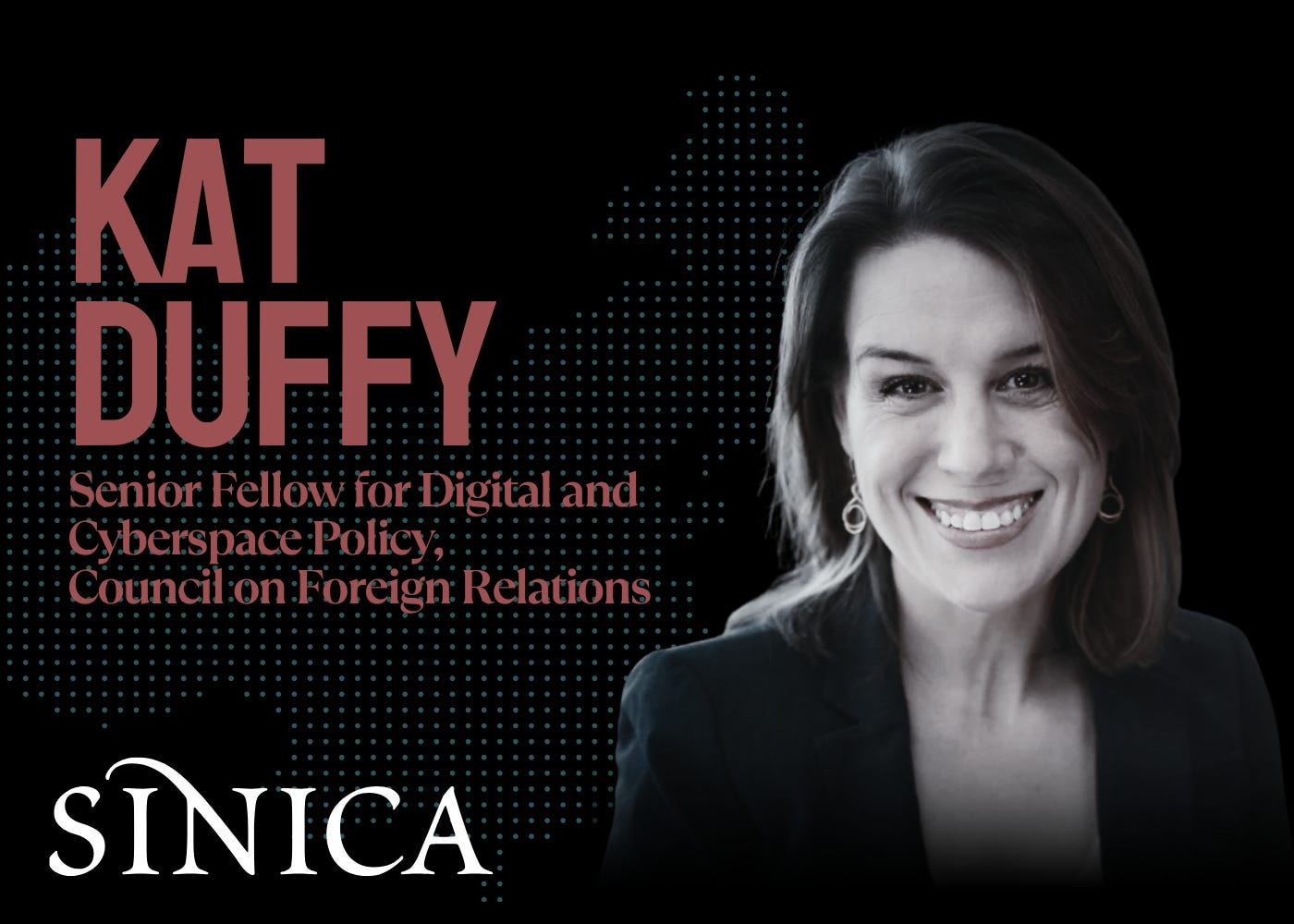
Transcript courtesy of the fantastic CadreScripts. Image by Keya Zhou. Listen in the embedded player above!
This week I’m sharing the third installment from the day-long conference convened by the Institute for America, China, and the Future of Global Affairs (ACF) at Johns Hopkins SAIS on April 3rd in Washington — “The China Debate We’re Not Having: Politics, Technology, and the Road Ahead.” The first two episodes featured Jessica Chen Weiss’s opening remarks and the panels on what China wants and what the United States wants. This week’s panel — “Tech, Rivalry, and Competing Visions of the Future” — turns to the domain that, more than any other, has come to define how Washington thinks about the U.S.-China relationship: technology, and especially AI.
Once again, my deep thanks to Jessica Chen Weiss, ACF’s inaugural faculty director, for organizing this terrific conference and for so generously letting me share this audio with Sinica listeners.
Moderator Kat Duffy of the Council on Foreign Relations opens by interrogating the very framing of the panel: is “rivalry” actually the right word for what’s going on between the U.S. and China in tech? The panelists give a range of answers — from “yes, because both sides believe it is” to Samm Sacks’s pithy rejoinder that “rivalry serves specific actors and specific interests.” From there the conversation ranges across the FCC’s recent move to bar most foreign-made routers, the pitfalls of framing AI competition as a sprint to AGI rather than what Jeff Ding calls a “diffusion marathon,” the many internal Chinas that get flattened in DC discourse, the cybersecurity reciprocity problem (Volt Typhoon, Salt Typhoon, and what President Trump tellingly admitted about all of it), and what it would actually mean for the U.S. to compete by being its best self — what one panelist memorably calls “Americamaxxing.” There’s a lot of substance packed into this hour, and a lot of generative pushback against received DC wisdom.
The audience Q&A at the end takes up the role of race and xenophobia in the discourse — a topic that, as one questioner pointedly notes, had been conspicuously absent from the day’s earlier discussions.
Panelists:
— Samm Sacks, Senior Fellow, New America and Yale Law School
— Jeff Ding, Assistant Professor of Political Science, George Washington University
— Mieke Eoyang, Visiting Professor, Carnegie Mellon University; former Deputy Assistant Secretary of Defense for Cyber Policy
— Selina Xu, Lead for China and AI Policy, Office of Eric Schmidt
Moderator: Kat Duffy, Senior Fellow for Digital and Cyberspace Policy, Council on Foreign Relations
Transcript
Kat Duffy: Now we’re on. Hi, everyone. Good afternoon. If we could get seated, we’ll hop into the last panel of the day. I send out extensive notes before panels that I moderate, and I would like to take this moment to thank Samm and Selina for following our dress code of black and white. And Jeff and Mieke, I don’t know what happened. You know what I mean? It was really right up at the top, just black and white. In honor of the AI China-U.S. discourse.
So, with that, everyone, welcome. I hope everyone has been having a wonderful day at this wonderful forum. I’m Kat Duffy, Senior Fellow at CFR for Digital and Cyberspace Policy, and I have the pleasure of moderating today’s panel on tech, rivalry, and competing visions of the future. We are joined by four exceptional panelists, none of whom I actually gave a dress code to.
And I’m going to ask each of them to quickly introduce themselves because there is nothing worse than someone reading you a bio you can already read. And so with that, Sam, can we start with you?
Samm Sacks: Thank you, Kat. Samm Sacks, I’m a senior fellow at New America and Yale Law School. I’ve worked on Chinese technology policy for the better part of 15 years, both in the national security community as a linguist and in the private sector. I’m writing a book now on data and trust in the context of U.S.-China relations with the University of Chicago. Next year, hopefully, it will be out.
Jeff Ding: Hey, everyone. My name is Jeff Ding. I’m an assistant professor of political science at George Washington University, just a short bike ride away.
Mieke Eoyang: Hi, I’m Mieke Eoyang. I’m a visiting professor at Carnegie Mellon University and formerly of the department formerly known as Defense, where I was the deputy assistant secretary for cyber policy. Before that, with a long career in both think tanks and on Capitol Hill, working for various national security committees.
Selina Xu: Hi, everyone. I’m Selina. I lead China and AI policy work at the office of Eric Schmidt. So, great to be here.
Kat: Fantastic. And thank you all for being pithy. I appreciate it. So I want to start with a first popcorn question to each of you. I want to really like one or two sentences max. We’ve heard today on panels that discuss sort of what China is looking for, what the United States is looking for. And the word rivalry features very heavily in the discussion of this panel. Is that the right frame? Do you think that rivalry is part of where we should be centering this discourse? One or two sentences, and we’ll start actually with Selina and come backwards.
Selina: Yeah, I think the word rivalry kind of connotes a lot of different assumptions, right? One is that it’s more of a zero-sum kind of competition, that if one side gains advantage, the other side kind of loses out. In AI, it’s not exactly clear. I mean, there’s various technologies, but I think AI is the one that I focus the most on. It’s unclear if there are destabilizing impacts from AI that happen in China that the U.S. would be immune to that.
So, I think, one, that’s one of the problems I have with the term rivalry or, to the large extent, when you talk about, like, an AI arms race or, like, race to AGI. The other one, I think, is whether people in both the U.S. and in China have a desired clear end state that they’re both trying to get to is also unclear. We don’t know if China is also trying, for example, to race towards artificial general intelligence, if they really believe that there is this permanent decisive advantage that can accrue once you reach that state.
And then I think the last one that I would be curious to hear other people’s thoughts on here is whether the U.S. and China are doing similar approaches to AI, if both of them are really trying to embrace, for instance, what we see in the United States and in Silicon Valley. Like trying to scale their compute in order to get to ever larger and more intelligent models. And if that’s really what China’s strategy is, whether by necessity it cannot, for example, because of compute, or whether there is another strategy that they’re approaching. So, unclear if they’re running in the same kind of lane at all and trying to get to the same end state.
Kat: Mieke?
Mieke: Yeah, I think rivalry is the right term just because whether or not it should be the right term, whether or not that accurately describes the relationship, there is
