


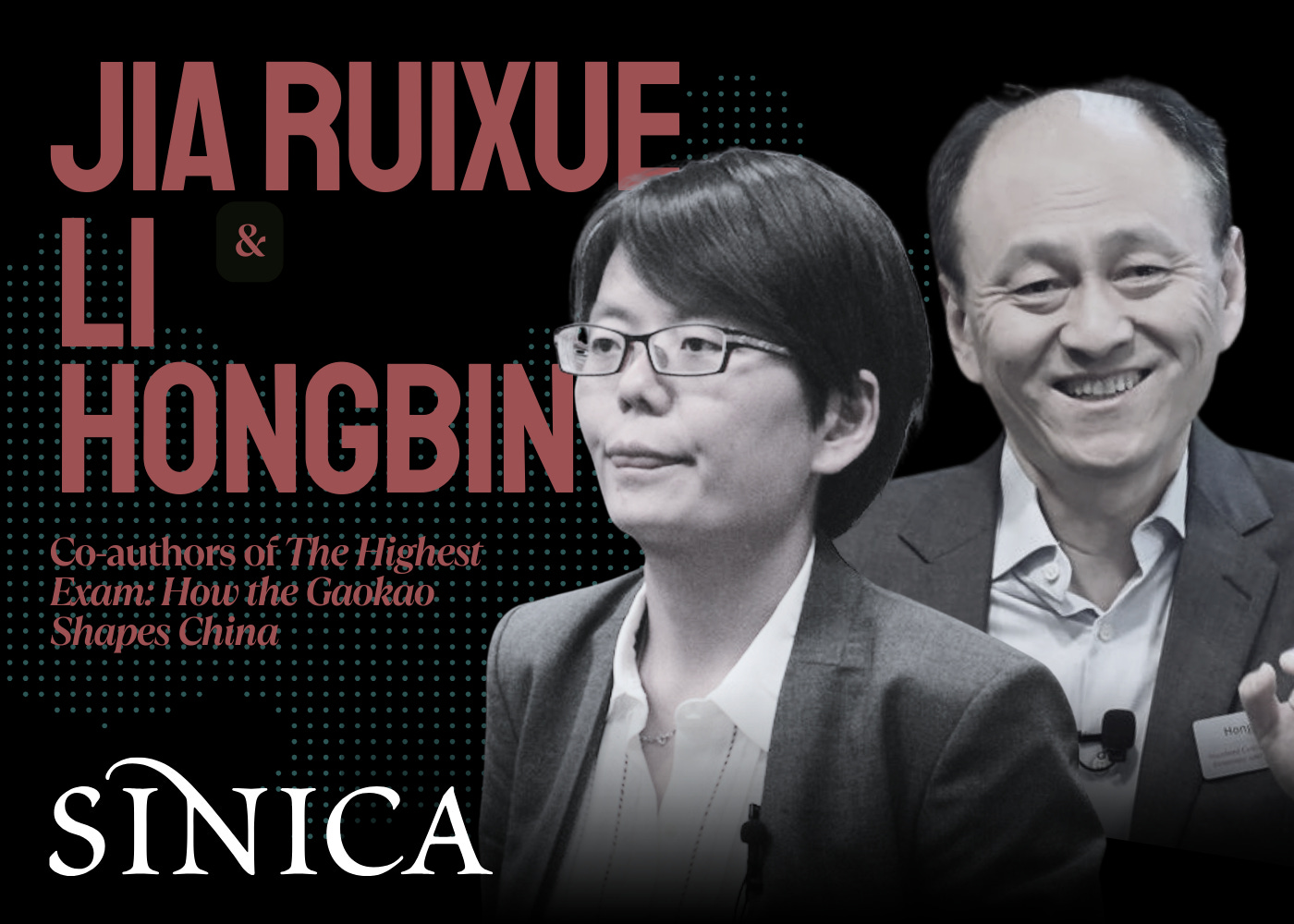
Transcript, courtesy of CadreScripts, further down the page. Image by Keya Zhou. Listen in the embedded player above!
This week on Sinica, I speak with Jia Ruixue and Li Hongbin, coauthors of The Highest Exam: How the Gaokao Shapes China. We’re talking about China’s college entrance exam — dreaded and feared, with outsized ability to determine life outcomes, seen as deeply flawed yet also sacrosanct, something few Chinese want drastically altered or removed. Cards on table: I had very strong preconceptions about the gaokao. My wife and I planned our children’s education to get them out of the Chinese system before it became increasingly oriented toward gaokao preparation. But this book really opened my eyes.
Ruixue is professor of economics at UC San Diego’s School of Global Policy and Strategy, researching how institutions like examination systems shape governance, elite selection, and state capacity. Hongbin is James Liang Chair at Stanford, focusing on education, labor markets, and institutional foundations of China’s economic development.
We explore why the gaokao represents far more than just a difficult test, the concrete incentives families face, why there are limited alternative routes for social mobility, how both authors’ own experiences shaped their thinking, why exam-based elite selection has been so durable in China, what happened when the exam system was suspended during the Cultural Revolution, why inequality has increased despite internet access to materials, why meaningful reform is so politically difficult, how education translated into productivity and GDP growth, the gap between skill formation and economic returns, how the system shapes governance and everyday life, and the moral dimensions of exam culture when Chinese families migrate to very different education systems like the U.S.
6:18 – What the gaokao actually represents beyond just being a difficult exam
11:54 – Why there are limited alternative pathways for social mobility
14:23 – How their own experiences as students shaped their thinking
18:46 – Why the gaokao is a political institution, not just educational policy
22:21 – Why exam-based elite selection has been so durable in China
28:30 – What happened in late Qing and Cultural Revolution when exams were suspended
33:26 – Has internet access to materials reduced inequality or has it persisted?
36:55 – Hongbin’s direct experience trying to reform the gaokao—and why it failed
40:28 – How education improvement accounts for significant share of China’s GDP growth
42:44 – The gap: college doesn’t add measurable skills, but gaokao scores predict income
46:56 – How centralized approach affects talent allocation across fields
51:08 – The gaokao and GDP tournament for officials: similar tournament systems
54:26 – How ranking and evaluation systems shape workplace behavior and culture
58:12 – When exam culture meets U.S. education: understanding tensions around affirmative action
1:02:10 – Transparent rule-based evaluation vs. discretion and judgment: the fundamental tradeoff
Recommendations:
Ruixue: Piao Liang Peng You (film by Geng Jun); Stoner (a novel by John Williams)
Hongbin: The Dictator’s Handbook
Kaiser: Furious Minds: The Making of the MAGA New Right by Laura K. Field; Black Pill by Elle Reeve
Transcript:
Kaiser Kuo: Welcome to the Sinica Podcast, a weekly discussion of current affairs in China. In this program, we look at books, ideas, new research, intellectual currents, and cultural trends that can help us better understand what’s happening in China’s politics, foreign relations, economics, and society. Join me each week for in-depth conversations that shed more light and bring less heat to how we think and talk about China.
I’m Kaiser Kuo, coming to you this week from my home in Chapel Hill, North Carolina.
Sinica is supported this year by the Center for East Asian Studies at the University of Wisconsin, Madison, a national resource center for the study of East Asia. The Sinica Podcast is and will remain free. But if you work for an organization that believes in what I’m doing with the show and with my newsletter, please consider lending your support. You can reach me at sinicapod@gmail.com. And listeners, please support my work by becoming a paying subscriber at sinicapodcast.com. You will enjoy, in addition to the podcast, the complete transcript of the show, essays from me, as well as writings and podcasts from some of your favorite China-focused columnists and commentators. And of course, you will enjoy the knowledge that you are helping me do what I honestly believe is important work. So, check out the page, see all that is on offer, and do consider helping out.
Today, we’re talking about one of the towering institutions of Chinese life, something that is dreaded, feared with an outsize ability to determine life outcomes, at once seen as deeply flawed and badly in need of reform, and yet also viewed as sacrosanct, really, as something few Chinese want to see drastically altered, let alone removed altogether. It feels almost inescapable, sort of opting out entirely from adult life in China, or settling for a life consigned to dirty, dull, or dangerous labor. I am talking, of course, about the Gaokao, China’s famous college entrance exam.
So, cards on the table — I am somebody who, having lived in China for so much of my life, had very strong preconceptions about the gaokao. I mean, the whole pedagogical plan that my wife, Fanfan, and I came up with, which is one of the few things that we were in perfect accord on — this plan that we came up with for our two children, Guenevere and Johnny, who both attended primary school in Beijing. It was basically centered around this idea that we would get them out of the Chinese education system before the classroom became increasingly oriented just toward preparing students for the gaokao, because we knew that we wanted our kids to attend university in the U.S.
And we actually timed our departure so that it was just after our oldest, Guenevere, had finished grade school. To us, the whole idea of a single test determining so much of the future of our children, the idea of their whole childhood after age 12 would be given over to preparation for this grueling, impersonal test, it just seemed like too much to ask of the kids, and we had a relatively easy way to avoid that.
But it wasn’t just us. Many people around us — friends and family — who lacked foreign citizenship, who didn’t have family living abroad, or even any strong foreign connections, they also opted out of the gaokao track quite early. They paid through the nose to send their kids to one of the international schools that were increasingly, in the time we were there, accepting Chinese students.
Now, I had, of course, encountered many people in China who defended the institution of the gaokao. Still, when I read the terrific book that we’ll be discussing today, I can say I really had my eyes opened in a way that happens, really too infrequently of late to me or to anyone. The book is called The Highest Exam: How the Gaokao Shapes China by Jia Ruixue and Li Hongbin, with Claire Cousineau. I’m delighted that the two authors could join me here today on Sinica to talk about their work on this enormously important topic, which really is complicated the way I thought about the whole college entrance exam. I think that it’s going to challenge a lot of preconceptions that many people have about the gaokao.
Ruixue Jia is a professor of economics at the School of Global Policy and Strategy at the University of California, San Diego, UCSD, where she is also affiliated with the China Data Lab. Her research spans political economy, economic history, and development, with a particular focus on how institutions, such as the examination systems, shape governance, elite selection, and long-run state capacity in China.
Hongbin Li is the James Liang Chair and Faculty Co-Director of the Stanford Center on China’s Economy and Institutions, and a senior fellow at the Stanford Institute for Economic Policy Research and the Freeman Spogli Institute for International Studies. An economist by training, his work focuses on education, labor markets, and the institutional foundations of China’s economic development, informed by both large-scale data and, as we’ll see, by his own lived experience.
Let me add that Claire Cousineau is a writer and editor who collaborated closely with the authors on the highest exam. She worked with the authors to translate very complex empirical research and historical analysis into a narrative that’s quite accessible to a general audience, shaping the book’s structure, voice, and storytelling.
So, Ruixue, Hongbin, welcome warmly to Sinica.
Hongbin Li: Thank you, Kaiser.
Ruixue Jia: Thanks for having me.
Kaiser: So, let’s get started. I mean, for many people outside China, the gaokao is usually described as a very difficult college entrance exam. One of the arguments of your book, and I think it’s a very persuasive argument, is that, well, this description is far too narrow. It’s not just that at all. Maybe to start us off, how would you describe what the gaokao actually represents in the lives of students and families in China, and why it’s important, goes far beyond just education? Ruixue, why don’t you start?
Ruixue: Yeah. I think gaokao is at the peak of the exam system at its heart. Chinese education system is exam centric. There are numerous key exams, from primary school to high school. But the ultimate test, the ultimate tournament is the national entrance exam, the gaokao. So, I think for many families, when they decided which primary school to send their kid to at that very early stage, they already have that targeted test in their mind. So, that’s why it’s not just whites that are misguided of the whole education experience. And you mentioned it’s difficult, and it’s supposed to be difficult. And there’s a logic there as we want to highlight such kind of a system. The primary function is for selection. To have an effective selection system, you want to select people based on their intelligence and their diligence to be effective. You have to decide as a difficult test rather than that just… it’s much more difficult than the
