


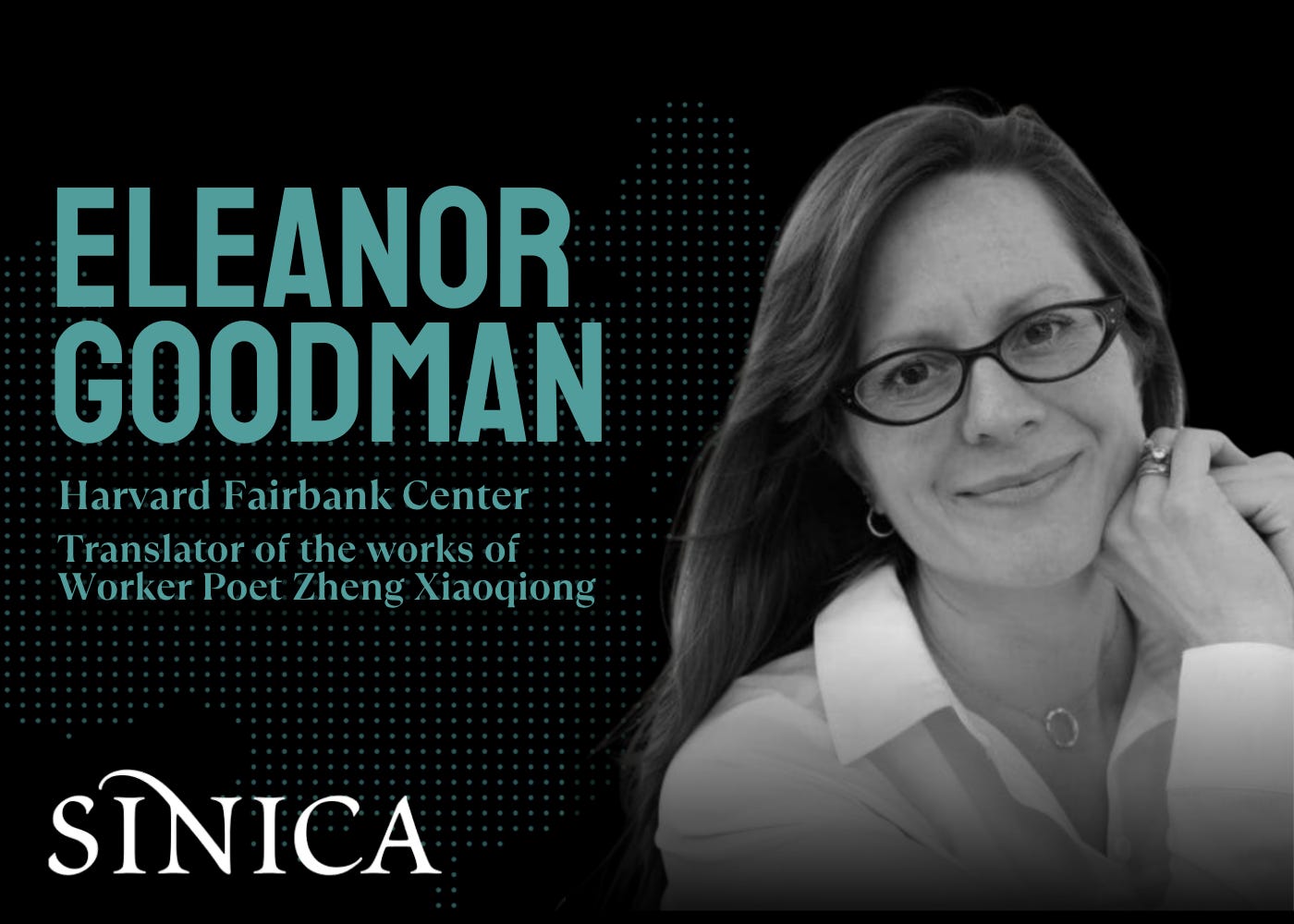
Transcript courtesy of the fantastic CadreScripts, further down the page. Image by Keya Zhou. Listen in the embedded player above!
This week on Sinica, in a special episode recorded as a live joint webcast with NYRB/Poets and Equator Magazine, I sit down with Eleanor Goodman — poet, scholar, research associate at Harvard’s Fairbank Center, and one of the most accomplished translators working between Chinese and English — to talk about the extraordinary Sichuan-born poet Zheng Xiaoqiong (郑小琼).
Born in 1980 in a mountain village, trained as a nurse, Zheng joined the great tide of internal migration in her early 20s, ending up on the assembly line of a hardware factory in Dongguan in the Pearl River Delta. She picked up a pen after a workplace injury — part of her finger taken off by a lathe — and what came out across poems, essays, and reportage has made her one of the most singular voices in contemporary Chinese literature. Her trajectory from the assembly line to the editorial desk of an official literary magazine is, as far as I know, essentially without parallel.
Eleanor has been translating Zheng since around 2013, and the partnership they’ve built has given Anglophone readers access to a body of work that defies easy categorization — at once intimate and historical, ethnographic and lyric, tender and unsparing. We talk about how they met, about Zheng’s resistance to the “migrant worker poet” label, about the bodily feminism that runs through her verse, about her unmoralizing portraits of sex workers, about lost youth and the way the body keeps the ledger of factory time. Eleanor reads Zheng’s poem “Woman Worker: Youth Pinned to a Workstation” (女工: 被固定在卡桌上的青春) in both Chinese and her English translation — and it is, every time, devastating.
Huge thanks to Abigail Dunn at NYRB Poets and Ratik Asokan at Equator for organizing this conversation and for inviting me to host it, to Eleanor for her generosity and her brilliance, and most of all to Zheng Xiaoqiong, whose voice — even when she cannot be with us in person — comes through with absolute clarity.
Eleanor’s translation of Zheng Xiaoqiong’s In the Roar of the Machine is available from NYRB Poets. The Equator selections, drawn from Zheng’s long-form prose, are available at Equator Magazine.
05:07 — How Eleanor and Zheng met in 2013, and why a book had to happen
08:14 — Navigating the awkward proposition of China for the Western left
10:50 — Zheng’s trajectory: from a Sichuan village to the assembly line to the editor’s desk
16:29 — Resisting the “migrant worker poet” (打工诗人) label
20:47 — Conventions of the genre: exhaustion, iron, lost identity, the screw in the machine
24:58 — Who gets translated into English, and why
28:34 — The translator’s ethics: how do you render a factory poem honestly?
32:42 — Eleanor reads “Woman Worker, Youth Pinned to a Workstation” (女工被固定在卡桌上的青春) in Chinese and English
37:14 — Zheng’s bodily feminism: irregular periods, a different way of caring
40:37 — Lost youth and the passage of time
44:36 — Sex work and women’s labor: portraits without moralizing
49:59 — Whose work actually counts in Chinese urban discourse?
52:45 — Why Zheng Xiaoqiong wasn’t able to join us, and how censorship really works
54:44 — Rose Courtyard and what’s next: classical allusions, ancestral homes, embroidering grandmothers
57:39 — Audience Q&A: American worker poets, the WeChat communities of migrant writers, and Zheng’s standing in Chinese letters
Transcript
Kaiser Kuo: Thank you so much, Abigail, and thank you too, Rathik. I am, as you just said, Kaiser Kuo — I’m the host of the Sinica Podcast. And this conversation, of course, is brought to you, jointly, by the NYRB Poets from the New York Review Books and Equator Magazine. I am delighted today to be speaking with Eleanor Goodman, poet, scholar, and really one of the most accomplished translators working between Chinese and English.
Eleanor is a research associate at Harvard’s prestigious Fairbank Center. She’s the author of the poetry collection Nine Dragon Island and the translator of, among many, many works, the landmark anthology Iron Moon, which really gathered the voices of Chinese worker poets, and also author of In the Roar of the Machine, the translator of In the Roar of the Machine, which we’ve just heard about, which is the first book-length English collection of poems by today’s subject, the poet Zheng Xiaoqiong.
Zheng Xiaoqiong was born in rural Sichuan in 1980. Eleanor will tell you a lot more about her. She trained as a nurse, and in her early 20s, joined the great tide of internal migration to the factories of Guangdong province in the southeast. She picked up a pen in a hardware factory in Dongguan, which is one of the biggest factory towns in the Pearl River Delta area. And what came out across poems, essays, and reportage has really made her one of the most singular voices in contemporary Chinese literature. Her trajectory from the assembly line to the editorial desk of an official literary magazine is, as far as I know, essentially without any parallel.
Eleanor has been translating Zheng since around 2013, and the two of them have built a working partnership that has given Anglophone readers a way into the body of writing of hers that is really, it defies categorization. It is at once intimate and very historical, ethnographic and lyric, quite tender and very unsparing. We’ll talk about Zheng, about the work itself. You’ll hear some of her poetry as well, read by Eleanor, and about what it means to carry these voices across a language and a world. So, Eleanor Goodman, welcome. It’s so wonderful to see you.
Eleanor Goodman: It’s great to see you, Kaiser. It’s such a thrill to be here. Thank you so much to NYRB Poets for publishing the collection, and to Equator for sort of encouraging me to unearth this long book-length work of prose by Zheng Xiaoqiong that I, despite being Zheng’s friend for many, many, many years, I didn’t know existed. So, it’s a thrill to be here. I’m so excited to be talking about Zheng Xiaoqiong and Chinese poetry, translation, and all of my favorite things. And thank you all who are here for joining us.
Kaiser: So Eleanor, let’s start at the beginning, as it were. You and Zheng, if I didn’t have that wrong, you first crossed paths around 2013, I think. Can you tell us how that happened, and what it was about her work that made you want to commit to translating her at length rather than just picking off a poem here and there?
Eleanor: So, we did meet around 2013. At the time, I was on a Fulbright Fellowship at Beida, and I sort of, as part of that, I was invited to Guangdong to participate in one of the many poetry events that were taking place around China during that time. There seemed to be like a major poetry festival every weekend. I was invited to one in Guangdong, and Zheng Xiaoqiong was sort of impressed with being my guide. I think because we were both two young women, we are almost exactly the same age.
She was sent to sort of take me around and show me the sights. She was a wonderful tour guide. She is absolutely fearless on a motor scooter. I am not. But, you know, aside from minor differences, we really had a meeting of the minds. I was so impressed with her simultaneous seriousness and her utter lack of pretension. She was incredibly warm and open. And I later discovered that she was a major literary force, even at the tender young age of 33 or 34.
And then when I did discover her work and read it, I sort of found everything that you want to find in poetry. I found a serious voice. I found an intellectual thinker. I found somebody who was passionately engaged in using art to try to make the world better. And those were things that just immediately drew me in. And I did translate her work piecemeal. I kind of played around at the edges. But then, when I worked on the Iron Moon project, which is an anthology, as you said, of migrant worker poetry, there is a major section of Zheng Xiaoqiong’s poetry, including some very long poems of hers.
And once I had done that, I knew, okay, I have to do a book. This is a voice that I think the world really needs to hear. And I really started working on a selected kind of culling from really her entire oeuvre at that point, immediately after Iron Moon. And I had no idea, you know, what would happen to it. But I think it has had just an amazing life so far in, you know, English language, literary circles.
Kaiser: Fantastic. You know, all of the qualities that you’ve just used to describe her as having, they all come very much through in her writing, in both her poetry and in her prose. But before we get deeper into Zheng herself, I want to set up something that I think hovers over any honest conversation about her work about China today. For the Western left in particular, China has become, I guess, an awkward proposition. It’s a state that styles itself as socialist.
It has lifted hundreds of millions out of poverty. I don’t deny that. But it’s a state whose factories produced those conditions that Zheng writes about, and whose party is, as Zheng puts it in one poem, embarrassed by its own proletariat. How do you find yourself navigating that as a translator who’s clearly sympathetic to her subjects, working in a Western literary world that doesn’t quite know what to do with a writer like Zheng?
Eleanor: Yeah, I try to ignore it as best I can.
Kaiser: But I’m not going to let you ignore my question.
Eleanor: Okay, well, I’ll try to answer. I mean, art, I think, is inherently political. Zheng is very conscious of writing about a topic that is politically sensitive in China. She is in a really sort of unique position in that she is not an outsider sort of investigating migrant worker migrant workers or migrant worker literature. She worked in these factories. She worked in a dime old factory. She worked in a textile factory. She worked in a warehouse. I mean, she has been all through this experience, spent many years, you know, on the assembly line.
So, she is an insider and is writing about her friends, her relatives. She has a younger brother who also works in the factories. She’s writing about herself, her own personal experience. So, I think in that sense, you know, it’s art that transcends the sort of political waves that come and go. And the relationship with China that is sometimes tenuous, sometimes warmer, sometimes very estranged, sometimes hostile, I think that these are poems that can be read in any of those circumstances and really retain their power and meaning.
Kaiser: Fantastic. I gave a really cursory biographical overview of her, but I want Eleanor, if you can, to kind of walk us through her trajectory a little bit in more detail. She comes from a mountain village in Sichuan, if I’m not mistaken. She trains, like I said, as a nurse. She ends up working in a hardware factory in Dongguan, I think, in her early 20s. And now she’s become an editor at an official literary magazine. She’s internationally translated, thanks to you. She’s been invited to all sorts of festivals — Rotterdam, Singapore.
As you note in your introduction, Xu Lizhi is really the only comparable figure, another so-called worker poet. His fame, though, came posthumously, right? What does it take to make that journey for somebody like Zheng? And how has it changed her relationship to the workers whose voices she carries?
Eleanor: Yeah, that is a great question. And I think that it is, you know, for Zheng Xiaoqiong, there’s, you know, it’s fraught to some extent.
Kaiser: Yeah.
Eleanor: So she did train as a nurse. She spent about six months working in a hospital, rural hospital, was horrified by the conditions she found there and decided – okay, this is not for me. She sort of followed like a common story, a friend of a friend or like a friend’s cousin down to Dongguan, really landed without knowing anybody, without having, you know, a job sort of just fresh in the city, which I think is a very common experience for many of these, especially younger migrant workers.
They kind of know somebody who knows somebody who knows somebody who might be able to get them a job. And they take the train, or they take the bus, and they end up in this complicated, messy, frenetic, dangerous world with very little support and a lot of vulnerability. And Zheng was in that position at the age of 21, which is actually a lot older than many of her fellow migrant workers. She had the advantage of maybe four or five years on a lot of the workers that she encountered.
So, she bounced around from factory to factory. She did a lot of different jobs. And in 2005, she suffered a workplace injury, which is more common than you would think. She had part of her finger skived off by a lathe.
Kaiser: Wow.
Eleanor: And that’s a very common theme that you see through, you know, the migrant worker genre is these workplace injuries. So, she was prevented from working for months and had this long recuperation. And during that time, she started to write poetry. And I think it began as a kind of emotional release. You know, it was just a way of dealing with this situation that she was confronted with. But it very quickly kind of picked up speed and morphed into a much, much larger project.
And my sense is that as soon as Zhen Xiaoqiong started putting words on the page, she found that form of expression just irresistible. She found her voice immediately on the page. And it was recognized very early. She started publishing in sort of smaller migrant worker publications, things that were local to Dongguan and the surrounding areas. But she was noticed almost immediately. And the sort of turning point in her career came in 2007 when she won a major award from People’s Publishing in Beijing.
She was flown to Beijing. I think she must have been 28. Young, you know, young person. Also, and this is important, a young woman. And so, a major literary award being given to a young woman was a very big deal indeed. And the first, to my knowledge, the first migrant worker writer to be kind of recognized on the national stage. And that changed her fortunes. From that time on, she got a job at a zuòpǐn, which is artworks magazine, which is in Guangzhou as, initially a sort of temporary, you know, editor — We’ll see if this works out.
She worked her way up from there. And I think her irresistible voice and the stories that she has been able to collect, both in her prose and in her poetry, have just made her a star. And she’s getting increasing attention outside of China. And she’s quite famous for her poetry in China. And she never looked back. However, having said that, she still lives in a migrant worker community. She has her roots in that community. These are her friends. These are people she talks to every day.
So, she, I think, is very conscious of not wanting to lose touch with those people, those experiences, those stories, which formed her, in large part as a person, formed her as a writer, and which are the basis of her material. So, she stays in very close contact. And as I said, her brother, last I heard, I think he was working in a factory in Indonesia. So, you know, she has family members who are still migrant workers. So, there’s a closeness that she has maintained. And I think that’s essential for, you know, the sort of natural authenticity of her work.
Kaiser: Yeah, no, she has absolutely kept it real. It’s amazing. What do you know about her, just in the early days of writing, even when she was still in school, her relation to letters, her relationship to poetry? I mean, was she a yě lù zi 野路子, as we say, somebody who’s completely an amateur in the best sense? Or was she somebody who had studied the canon, as it were, who had an idea of poetry before she put pen to paper?
Eleanor: My sense is that she was always a reader. She talks about sort of carrying around books through her life even when it is not necessarily the thing to do when you’re a young woman in the, you know, rural countryside. I think she’s learned a lot as she has gone along, as we all do. But I think she feels that her calling in life is to do this project that she’s doing, which is to write in this particular way about this particular group of people, and beyond. I hope we have a chance to talk about later. Her literary ambitions are, you know, extend quite far beyond the narrow range of, you know, writing about factory life.
Kaiser: Right, right. Well, let’s talk about that because one thing that comes through both in her writing and in your introduction is kind of her resistance to the label migrant worker poet, you know, Dàgōng Shí’ēn大功十恩 is this whole genre is known. And she obviously has this intention to transcend that. The category, though, it did give her a platform. It’s maybe also kind of a ceiling though, right? Why do you think the literary establishment, and really, this is true of both the Chinese literary establishment and the Western, why have they been so attached to that frame? And what does it occlude from, from her work.
Eleanor: That’s a great question. And I think it’s a very convenient category. And I think that, you know, if we look at that category, and we ask ourselves, okay, so what are the other sort of schools of poetry in China? You have the academic poets, you have lyric poets, you have ancient style poets, you have these schools of poets who are collected around a theme or style or some aspect of their literary output. Migrant worker poetry, in stark contrast, that’s the sociological designation, right?
That’s a group of people, not a way of writing or, you know. And so, although there are common themes that you can see, and there are commonalities, sometimes in sort of modes of expression and so on and so forth, which we can talk about later, I think that it has become this… it started out as and continues to be a very convenient shorthand for sort of what do we do with this category of writers whose really only commonality is that they are writing from the factory or from a worker background?
And Zheng Xiaoqiong certainly has chafed against that. She really resists the idea that because she started out as a migrant worker poet, that she has to write about the assembly line for the rest of her life. And that she can’t, for example, use classical allegation. And she can’t write in a highly literary or lyrical mode, which is kind of an imposition that I think especially the Chinese literary establishment has put upon this group of people. They’d really like them to just kind of do one thing because that’s easy to understand. It’s easy to write about. You can easily write a master’s thesis on this group as long as they keep doing the same thing.
Well, Zheng certainly has broken through those boundaries as she has every other… as far as I can tell, every other restriction that’s been put on her in her life, she has broken through.
Kaiser: Yeah. I’m hearing so many echoes from the world of rock and roll. It’s the same thing. No musician wants to be pigeonholed within one genre. But when you start to defy genre conventions, people look askance at you. But there are genre conventions. And let’s talk about some of those. You hinted at the idea that there are certain literary characteristics of what we’re calling worker poetry. I mean, and for listeners who haven’t encountered this body of writing, what are some of the signatures of migrant worker poetry as a genre? I mean, when you read across the Iron Moon collection, as I’ve done that fantastic anthology that you’ve put together, when you look at Zheng’s writing, her prose and her poetry book, what recurs? You know, I’m thinking Iron Moon itself is drawn from one of her poems.
Iron, both as material and as metaphor, shows up a lot. The noise, the bone-deep exhaustion, the lost youth, that stuff. You’ve spent more time with this material than anyone else I know. What are the conventions of the genre?
Eleanor: Yeah, well, you’ve named some. I mean, exhaustion is pervasive. And when you think about the lives especially, you know, you imagine literally a 17-year-old and they are standing on their feet for ten hours a day, there’s often mandatory overtime. So, you’re standing for another 2 or 3 hours. Then you wake up the next morning at 7 a.m. and you get back on the assembly line, and you do that day after day after day after day after day.
Kaiser: Modern times, yeah.
Eleanor: And that’s one form of exhaustion. I think there’s another very important kind of exhaustion, which is the mental, spiritual and emotional exhaustion of living your life with very little autonomy, very little sense of agency, losing some of your identity. I mean, Zhen Xiaoqiong talks about having her worker ID on which is printed a number. And she and her fellow workers, until they become friends, they refer to each other by those numbers. Instead of being a cog in the machine in the Chinese context, you’re a screw.
You’re a screw in the machine. You’re this tiny little piece. You don’t have a face. You don’t have a family. You don’t have a name. I mean, literally, you don’t have a face because you’re wearing protective equipment. I think that sense of a loss of agency, a loss of youth, you know, spending 12 hours a day on the assembly line, in a blink of an eye, you go from being 17 to being 27, and you don’t know where that time went. So, there’s a lot of thematic commonality. I will also say, I mean, in counter distinction to say the pejoratively termed Chūshū Guān Shìrén 出书官士人, the library poets, the migrant worker poets, many of them have an elementary school or a middle school education. They have a very, very basic education. Some went on to study further.
Zheng Xiaoqiong finished high school. She went to nursing school. Or Xu Lizhi, whom you mentioned, finished high school. That’s actually the exception to the rule. So, their writing tends to be, you know, there’s not a lot of device. There’s not a lot of fancy kind of look at me twirl sort of effect. Although, you know, that is not to say that this is not sophisticated work. I think anybody who reads the top notch Wu Xia, Chen Nianxi, you know, certainly Xu Lizhi, or Zheng Xiaoqiong, you’re not working with somebody who is writing simple stuff. This is complicated.
Kaiser: No, right. No, absolutely not. Absolutely not.
Eleanor: But I think there is a difference that you can identify in the sort of directness of the verse.
Kaiser: So Eleanor, there’s something I’ve been, this is a question I think really about, I think all about it in a lot of adjacent contexts to literature, to poetry. There’s quite a fair amount of contemporary Chinese poetry being written in all sorts of genres. Who gets translated into English and why? I mean, is there a particular kind of Chinese voice that Western publishers and readers are willing to receive? And where does this leave writers who don’t fit that? I mean, they just don’t get the translation treatment?
23:25
Eleanor: Yeah, I’m so glad you asked this question because it’s kind of a little bit of a pet peeve, I think, in the translation community that there’s this assumption that what gets translated into English is the crème de la crème of whatever poetry we’re talking about. If an Estonian poet gets translated, that means that he is the best Estonian writing today, you know. And the truth is that it’s a lot more complicated.
Kaiser: It’s who you meet at a conference. Who’s your tour guide on that? Right.
Eleanor: Who’s your tour guide? That’s how it happens. So for one, it’s these coincidental meetings. And that often is poets who are in a privileged position who get invited to conferences or who are at the universities and meet the foreign scholar. That’s a huge aspect of it. But I think also there is as a professional translator, there’s a side of you that has to be coldly calculating, which is to say, do I want to spend 18 months working on a translated poetry collection that probably will never see the light of day. Translate for the love of it.
Absolutely. But also, I think you want to get the work out there. And so there has to be a question in your own mind as a translator. Can I sell this? Like, not that there’s any poetry to be made in, you know, money to be made in translating poetry. Don’t anybody get the wrong idea here. There is none. But can I get this published? And so, for example, with Zheng Xiaoqiong, she has this absolutely irresistible voice. She has a very approachable voice. She’s extremely humane. She’s empathetic. All of this comes across so cleanly on the page.
Kaiser: But would it work if she weren’t also transgressive? Is that a requirement now? Does it need to be critical or dissident in some way in order to sell to a Western audience?
Eleanor: I think that, you know, having a dissenting voice is a plus, but no, I don’t think it’s necessary. I mean, you know…
Kaiser: I’m relieved to hear that.
Eleanor: Yeah, no, I’m thinking specifically of some poets that whom I’ve… Wan Xiaoni, who is, or Zang Di, who’s, you know, Zang Di is a professor at Beida. He’s establishment. He is not a voice of dissent at all. I do think that can be a selling point, but I think if you have a really compelling voice and you have compelling material and then you translate it well, you know, hopefully even in our incredibly lackluster publishing scene with regard to translations, there’s a chance that you’ll be able to get something out there.
Kaiser: Yeah, good, good, good. I’ll let you bring up your own background here, but I do want to ask this question seriously. How does a translator render a factory poem with all of its material specificity, the brand names, the dialect inflections, the whole bodily language, the whole knowledge of an assembly line when she hasn’t worked in a factory? I don’t think you’ve worked in it. I actually have worked on an assembly line, but not in China, not in southern China. What’s the ethical practice that makes the translation not appropriative, but honest?
Eleanor: Okay, but first, I have to ask you, what factory did you work in?
Kaiser: I worked on a PC board assembly factory in IBM in Tucson, Arizona in the summer of 1985 and summer of 1986, just feeding a machine that put little circuits on a printed circuit board. It was incredibly mind-numbing.
Eleanor: Yeah, and probably finger-numbing as well, I imagine.
Eleanor: I smoked a joint before I went in every morning and still over-fulfilled quota. I never lost a finger, so I can’t really complain.
Eleanor: You were fortunate, very fortunate. Well, I don’t have any experience like that. I was brought up in the suburbs of Buffalo, New York with two professor parents. So, I don’t have a direct experience of any of these things. And this was something that I thought about very, very carefully when I was translating Iron Moon in particular, because it’s many different voices. And it’s not just factory workers. It’s coal miners and cleaners and people who work in lots of different sort of physical labor contexts of which I have no direct experience.
And I think the key is to really read the poem. And I hope that doesn’t sound facile, but I really mean that. I mean, I think that the poem stands on its own. The poem tells you what it’s doing, right? And it tells you the names of things, and it tells you about the heat and the exhaustion and the despair and the loneliness and the homesickness. And if you really read the poem, if you are really relating to the poem, then it comes through on its own.
All you have to do is be true to that and to use the tools that you have as a translator to render that in English, which, you know, that’s a lot harder than it sounds. I mean, translators tend to want to sometimes to prettify the text that they find. They want to make it sound good because they worry that if it doesn’t sound good, they, as the translator, are going to get the flat like, “Oh, that was a terrible translation.” Like, it’s so rough, you know. But sometimes the verse is rough.
Kaiser: It couldn’t be the source material. It’s got to be rough.
Eleanor: Exactly. That was something that I learned with Iron Moon, that if it’s rough on the page, it had better be rough in the English. Like, that is a quality that needs to be captured and worked with. With respect specifically to Zheng Xiaoqiong’s work, you know, the Chinese have this concept of zhiyin, you know, to know somebody else’s music. And that was how I felt reading Zheng’s work. Her work took me into the factory. Her work told me what that was like. And I felt a connection to her voice. And I was sort of resonance in my own voice that I thought I could capture on the page.
Kaiser: Well, Eleanor, we have heard the theory. We’ll now hear the practice. We will hear what her voice sounds like channeled through your voice. I would love for you to read for us now, as we discussed earlier, the poem that you’ve chosen, which is called nǚgōng bèi gùdìng zài kǎzhuō qīngchūn 女工被固定在卡桌上的青春. That’s correct, right?
Eleanor: That’s it.
Kaiser: Woman worker, youth pinned to a workstation or pinned to a station. That really sits at the heart of so much of what I think we’ve been talking about here this evening. Could I ask you to read it for us first in Chinese and then in your English translation?
Eleanor: I would love to. I feel sad that Zhen Xiaoqiong can’t be here herself to read this poem. She has a wonderful reading voice. I can in no way replicate it.
Kaiser: Well, yours is not so shabby either.
Eleanor: You haven’t heard my Chinese yet. But she’s a wonderful reader. And perhaps in the future, you’ll be able to hear it from her own mouth. But I’ll read it in the Chinese and then I’ll read my translation.
时间张开巨大的喙 明月在机台
生锈 它疲倦 发暗 混浊 内心的凶险
汩汩流动 身体的峭壁崩溃 泥土与碎石
时间的碎片 塞满女性体内汹涌的河流
混乱的潮水不跟随季节涨落 她坐于卡座
流动的制品与时间交错 吞噬 这么快
老了 十年像水样流动……巨大的厌倦
在脑海中漂浮……多年来 她守着
螺丝 一颗 两颗 转动 向左 向右
将梦想与青春固定在某个制品 看着
苍白的青春 一路奔跑 从内陆乡村
到沿海工厂 一直到美国某个货架
疲倦与职业的疾病在肺部积蓄
卡在喉间 不再按时到来的月经
猛烈地咳嗽 工厂远处的开发区
绿色荔枝树被砍伐 身边的机器
颤抖……她揉了揉红肿的眼窝 将自己
插在某个流动的制品间
Kaiser: Wow. Beautifully done.
Eleanor: Thank you. Well, you can hear the music of her verse. You can hear the repetition. You can hear the rhythm. You can hear all of the very delicate effects that she’s having just musically in her language.
Kaiser: Yeah, yeah, yeah.
Eleanor: It’s incredible. Even if you don’t know Chinese, I think you can hear the music of that.
Kaiser: I can also hear a few things that you referred to earlier when we were talking about themes, the 10 years going by. Let’s hear the English translation now before I get too far ahead of myself.
Eleanor: Okay, great.
So, Woman Worker, Youth Pinned to a Station —
Time opens its enormous maw.
The moon on the machine, rusting, tired, darkened, turbid, its inner danger gurgles past.
The cliff of the body collapses into mud and splintered stones, the splinters of time.
Turbulent waters fill a woman’s body, wild tidal waters, no longer fluctuating with the seasons.
She sits at her station.
The flowing products and interlocking time are swallowed up so quickly, aging ten years, flowing past like water.
Enormous weariness floats through the mind.
For many years, she’s stuck by the screws, one screw, two screws, turning to the left, to the right, fixing her dreams and her youth to some product.
Look at her pale youth, running from an inland village to a factory by the sea, all the way to a shelf in America.
Fatigue and occupational diseases build up in the lungs, get caught in the throat, a lifetime of irregular periods, fierce coughing, the distant development zone of factories, the clear-cut green lychee trees, the machines by her side, shivering.
She rubs her swollen red eyes and sticks herself back into the flow of products.
Kaiser: Wow. Thank you so much. That’s devastating every time. Let’s pull a few threads out of it. The poem is, among other things, deeply feminist. And Zheng has been quite explicit that feminism really matters to her. But it’s a feminism that’s rooted very much in the body. You hear about irregular periods, about these diseases in the lungs, the swollen red eyes, rather than feminism in a Western theoretical idiom. How does her feminism work? And how does it land differently in Chinese than it might if we tried to map it onto Anglophone frameworks?
Kaiser: Yeah, I really like the way you frame that. I mean, Zheng Xiaoqiong, I think, is, at least in her writing, deliberately unconcerned with ideology. There’s no ism that she kind of attaches her emotional energy to. She cares about people. She cares about people being abused. She cares about the destruction of the natural environment. She cares about, you know, unfair labor practices. She cares about children being left behind in the countryside. Like, she cares about these things that are very, very practical. And as you said, very bodily. I mean, talking about missed periods in a poem is, frankly, revolutionary. People don’t do that. You don’t do that in China.
I mean, we have Sharon Olds, you know, here in the States and other poets who share a lot of bodily stuff. That does not happen in, you know, the contemporary Chinese poetry scene. There are feminist poets who are, you know, precedents. But I think the frankness of it really took people by surprise. And Zheng Xiaoqiong is completely unapologetic about it. This is part of her project. And in that way, I think, you know, she is extremely feminist. I also think she’s very feminist in a sort of subversive way. I mean, women are tasked, particularly in traditional Chinese society, as well as elsewhere, with being the caregivers, the caretakers, the concerned ones, the loving ones, the nurturing ones.
And Zheng, I think, with her kind of explosive verse is saying, “Look, this is my form of caring. My form of caring is to talk about the flow of products and how it is stealing the youth of hundreds of thousands of young people.” That’s my caring. And to my knowledge, she really is the only person writing like that in China. And it’s something that I admire tremendously about her work, and which I feel is extremely important and very applicable outside of China as well. She is willing to talk about things on the page that a lot of writers shy away from, and which a lot of male literary critics, especially in China, just do not know what to do with.
Kaiser: I can only imagine. There are these things that saturate the poem and this genre, I dare say more broadly, you know, we talked about the bone-deep exhaustion, occupational disease, and then lost youth more than maybe anything else. I mean, it’s in a lot of the poems in Iron Moon. Zheng often writes about workers who are too young yet to grasp that they’re losing something in the factory that is just absolutely not recoverable. And it’s not just the lungs and the spine.
It’s bodily stuff, but also the years, right? There’s something almost that does classically resonate with that. I mean, that is a theme that you do find in a lot of the great classical Chinese poetry, the way the body sort of keeps the ledger, the irresistible flow of the years. She handles that, I think, in a way that’s very much her own, whether her workers’ awareness of it shifts over the course of the writing that you’ve studied. Can you talk about how she sort of sees the passage of time in the way that people think about the passage of time.
Eleanor: Yeah. I mean, I think the piece that appeared in Equator is a perfect example, the Liangshan workers. She encounters this group of very young workers and she’s careful, you know, to say like, “I don’t know how old these kids are, but they sure seem pretty young to me. They look very, very young.” And in particular, you know, she encounters this one young man, Abu, who, he’s kind of a tough guy. He’s 16, maybe 17.
He’s, from my perspective, now that I’m in my late 40s, he’s a child. And I think, you know, the lost passage of time, he’s going to spend years probably on the assembly line, and all of those hours that are just gone and you can’t recover the physical damage to the body, which, as a 17-year-old, you really, I think, can’t grasp the long-term ramifications of. But I think also, I mean, her telling is so pointed. He’s this young kid and his dream is to be like an enforcer, like one of the people who kind of keeps the other workers in line. And he himself has suffered abuse from these people. You know, he himself has been beaten by these enforcers.
Kaiser: Oh, we all know that pattern, right?
Eleanor: Right. He becomes the abuser. And I think that is another sense in which this youth is lost. The innocence, you know, these kids are coming from often very protected, very traditional households. They grow up among the same families in small rural villages. And then they are thrown…. I mean, Leslie T. Chang makes this great point in her book, Factory Girls. You send all of these kids down, you throw them together into this big city, and they love the freedom, but they are completely without guidance at that point. When you go to college, at least there’s like supposed to be a in loco parentis kind of figure in the college itself and people looking out for you.
And that is not the case when you’re in the factory. I mean, there are lots of rules to prevent you from doing various things within the factory walls. But on the weekends, if you have five hours to go walk around in the city of Dongguan, you’re on your own as a 16, 17, 18, 19 year old. And I think that’s something that Zhen Xiaoqiong captures really beautifully in her work, is that lost innocence, the innocence of youth as well.
Kaiser: I want to make one more observation about the poem, no need to respond to it. And then I have a couple more questions to ask. We do want to get to questions from everyone participating tonight. One of the things I noticed is that last image in the poem, the workers, youth running from an inland village to a factory by the sea, all the way to a shelf in some country in America, right?
Eleanor: Yeah.
Kaiser: It telescopes this global supply chain into like a single line. I mean, Zheng is, I’ve never encountered that sort of thing before, somebody writing about the international dimensions of Chinese factory labor without it feeling polemical. It just sort of feels sort of wistful. It’s interesting that she can pull that off. But let me ask you another question. One of the things that really struck me hard is reading through In the Roar of the Machine, and also in The Equator selections, is the way that Zheng handles sex work, the Zhou Hong poem in Roar of the Machine, the middle-aged prostitutes, the young prostitutes, women who slide between sort of factory work and the dodgy hair salons, depending on the season of their lives and the season of the rhythm of the work.
She doesn’t moralize. She doesn’t aestheticize either. How would you describe her approach to it? What does it tell us about how she thinks about women’s work in China more broadly, not just sex work, but women’s work in China?
Eleanor: Yeah, I mean, you already said it. I think you summed it up brilliantly. She doesn’t moralize.
Kaiser: Right.
Eleanor: I think that is the crux of Zheng Xiaoqiong’s work, just writ large. She is observing so acutely, and she is making this amazing art out of it. She’s able to convey so much on the page, so much tactile, so much emotional, so much philosophical, all of this incredible material. You never find her moralizing. You never find a hint of her saying, “…and she should have done otherwise.”
Kaiser: Right, right, right.
Eleanor: Or she should have found a different choice. Instead, she’s just saying, “Hey, this is how I observed it. This is what this person said to me.” I think of those poems, you know, the young prostitutes, the old prostitutes, and then there are several poems in the book with the names of different people, I think of those poems as sort of portrait poems. There’s no more necessarily, you know, moralizing in a portrait of somebody. How you portray them really matters. But she’s just trying to give them full color. She wants people to actually really be able to see them.
And prostitution, again, is another like very sensitive topic. You know, it is it is illegal. It is unacceptable in China. And yet it is sort of tacitly just kind of tolerated.
Kaiser: Less so now than before, for sure. But yeah.
Eleanor: Less so now. But you can still find an amour. You know, you can still like find a massage parlor that will.... But a lot of these girls are brought south, either against their will or they’re tricked by a guy that they think is their boyfriend who turns out to be a pimp. And then they end up, you know, 16 in the middle of a city where they know nobody. And they have no skills. Maybe they’ve graduated from middle school. They have no contacts in a factory. They don’t even know how to begin to apply for a job.
What is available is sex work. And Zheng Xiaoqiong takes this very kind of like anthropological view of that. Who are these people? How are they living? Where did they come from? And then I think one way in which she is so brilliant is that she opens that up beyond, okay, these individual people in their tight jeans in the city. And she starts to think about, okay, what are the implications for their parents back in the village?
And what is the implication for this very traditional village with its, you know, sort of basically Confucian moral system, which has been passed down generation after generation after generation. And now they have a daughter who’s working in prostitution. How is that changing the fabric of the society itself? I mean, when I think about migrant workers, I often think like there is this massive social experiment going on, the ramifications of which nobody knows. I mean, we have all of these parents of young people moving south to the city to work in the factories.
You have young teenagers moving south and elsewhere to work in various manual labor jobs, leaving just older people and very young kids in the countryside to sort of get along, muddle along. And the cultural assumptions, the cultural sort of underpinning of these rural areas is really being challenged. And that’s something that I think Zheng Xiaoqiong confronts in a very frank, but as you say, not moralizing way.
Kaiser: Yeah, absolutely. There’s something else I find really striking. When work and unemployment get discussed in urban Chinese discourse today, well, I mean, look, I live in Beijing. I live in a first-tier city. I find it’s mostly, maybe not surprisingly, about white-collar workers, about college students who can’t find jobs or hiding out in grad school, about the 996 culture, which is really about white-collar labor. It’s working in the internet companies, right? about lying flat and about involution. The people doing the actual grinding labor, the ones, you know, really keep the economy running, are largely absent from that conversation.
Yeah, we’ve got books like I Deliver Packages in Beijing, but they still feel like they’re not really central to the conversation. I wonder whether Zheng’s work is helping to really change that discourse. Is it being recognized and talked about China where it really matters? Is it reaching the audiences that it should be?
Eleanor: I think Zheng’s work definitely is talked about in China, but…
Kaiser: That’s wonderful.
Eleanor: Yeah. I mean, she’s quite well known. She attends a lot of poetry events and readings and so on and so forth. So, her work is definitely getting out there. But I think that there is a feeling that these workers are sort of infinitely replaceable. I mean, you can always grow a new one in the countryside. And that’s something that Zheng talks about a lot, that there’s a total lack of respect for the kind of expertise that some of these people who’ve been working in the factories for many, many, many years have actually come to possess.
Kaiser: Yeah, yeah. They have that Fingerspitzengefühl, that fingertip-feel, process knowledge.
Eleanor: Yes, exactly. They really do. And they really know how to make machines work, for example, that are touchy or very, very dangerous. But that expertise, I think, is often overlooked. There’s this thought of like, well, anybody can do that work. And I think that one of the reasons that Zheng Xiaoqiong writes about work is that she is trying to challenge that false assumption. She’s trying to say, “No, look, you know, these people are very good at what they do. And some of them really have a lot of expertise.”
And even those, you know, young kids who are standing on the assembly line, they too are individuals. And they, too, deserve to make a living. And that’s really the fundamental point that she’s trying to make.
Kaiser: Absolutely. I need to ask you this question, and I’ll just do it directly and let you handle it however you want. Why isn’t Zheng Xiaoqiong with us tonight?
Eleanor: Yeah. Do we have another hour? I don’t know.
Kaiser: We’ll do the short version, Eleanor.
Eleanor: Yeah, the short version is we were very much hoping for her to be here. But she declined to participate, regretfully. I don’t know why. I don’t have a reason. Simply that she felt like it wasn’t appropriate for her to be here. You know, I think that that is the way that censorship works in China. There are no clear lines. There’s no like, oh, well, you can do this but you can’t do that. Or here’s the red line, we’ll clearly define it for you. It’s be careful.
Kaiser: It’s fuzzy.
Eleanor: You’ve got this. We wouldn’t want you to say the wrong thing, but you don’t know what the wrong thing is. But you shouldn’t say it. So, I think out of an abundance of caution, Zheng Xiaoqiong decided… She has a wonderfully excitable character. It is one of the really adorable things about her. And I think she was concerned that she would perhaps kind of stray into territory to a Western audience that would be problematic back home. I’m very sorry that she couldn’t be here.
Kaiser: Me too. Me too. But it’s also fully understandable for me. I completely empathize.
Eleanor: Absolutely. And ān quán dì 安全第, I mean, be safe.
Kaiser: Safety first. Yeah. Absolutely.
Eleanor: Safety first. Yeah.
Kaiser: In closing, I want to change registers here, the Rose Courtyard poems at the end of the collection are a real departure. Lots of classical allusions. You know, the five grandmother’s embroidery.
Eleanor: Yes.
Kaiser: Please read it. I mean, I hope everyone gets out and gets this collection. It’s only a year old. It’s wonderful. They feel almost like a different poet, except that the same kind of intelligence is clearly there, the same sort of feminist undercurrent, it’s unmistakably there. What does that body of work tell us about where Zheng is headed? And should we read that having placed it at the end, as sort of this is the new trajectory? What should readers be looking for her next?
Eleanor: Well, so Rose Courtyard came out in Chinese in 2016, and it was seen as a huge departure for Zheng Xiaoqiong. And I read it as Zheng’s statement of her decision not to be limited by the migrant worker poet label. She was tired of being pigeonholed.
Kaiser: Busted out of her genre, right?
Eleanor: Yeah, exactly. And I can write about whatever the heck I want to. And I can use classical allusions. And I can write about the birds and the flowers and the trees. And I can write about, you know, my ancestral home. And then, yeah, and my, you know, embroidering grandmothers. And all of that, it’s all on the table. And I don’t have to kind of stay within the lines that have been painted for me as this particular kind of poet. So she’s really breaking out of that externally imposed mold. Most recently, she sent me some poems that have continued in that vein.
They’re highly allusive. They’re much more in the sort of classical poetry range. She’s kind of feeling her more classically lyrical kind of possibilities. But she is still continuing to write about the fact… So let me put it this way, Kaiser. She is infinitely unpredictable. But whatever she comes up with is going to be well worth reading. And I certainly hope to be the one translating it.
Kaiser: Well, that is very much in evidence. And I certainly hope that you are the one to translate it because I hadn’t even imagined her being voiced by anyone else. Eleanor, what a delight to talk to you. I hope that we have still a little bit of time, if the organizers would be so good as to… Abigail, if you want to jump on and, yeah, throw some questions for Eleanor. I can sit back and listen.
Eleanor: Thank you so much, Kaiser.
Abigail: Thanks to both of you. I feel like the two of you could continue talking for hours, and I would happily be a fly on the wall. So, yes, everyone, we are going to enter the Q&A portion of the evening now. Friendly reminder to submit your questions for our hosts using the Q&A feature on zoom, which is located at the bottom of your screen. We do have a few questions from the audience, and for some reason, since I entered the room, I’ve lost my Q&A view. Okay, here we go. So, Carl, I should mention Carl has lamented that we did not ask Zheng to record herself reading, one of her poems, but I did, put a link in the chat to that Poetry International video of her reading, which I think is really lovely. Yeah, it’s too bad. I guess we could have done that, but I don’t know if she would have.
Eleanor: Next time. The next conversation. Yeah.
Abigail: Perfect. But Carl does ask an interesting question about whether or not you can make any connections between Zheng’s poetry and American worker poets. Is that something you thought about at all, either in conversation with Zheng or while you were translating her poetry?
Eleanor: Yeah, definitely. I have thought about that a lot. I mean, one of the ways that I did sort of prepare, as somebody who has never been in a factory context, I did go back and I read as much as I could find of American worker poetry. I mean, we have that genre. Philip Levine, I think, is like one of the star poets of that. Carl Sandburg, arguably Walt Whitman. You know, there’s a lot of actually part of our sort of classical canon of American poetry that talks about physical labor and talks about the body and physicality in somewhat similar ways and perhaps has some lines of correspondence.
So that is definitely something that I’ve thought about. And not just in an American context. I gave a reading actually here in Boston, and a guy during the Q&A said, “I’m from Panama, and many of the poems that you read could have been written by like a Panamanian worker poet.” I mean, I think these are really universal experiences among a certain class of people, a certain group of people. And there is worker poetry coming out of all kinds of places. I was actually approached by a guitarist of a Spanish band who wanted to set some of my Xu Lizhi translations to music because he thought it would really speak to Spanish laborers.
So, part of my hope in translating, you know, I’m privileged to speak English as my native tongue. And English is still, who knows how long this is going to last, but English is still the prestige language. It’s still the sort of universal, like most common tongue. And so, once you’re translated into English, get picked up in a lot of different places. And I do think that Zheng’s work in particular has a lot of resonance really around the world.
Abigail: Thank you. We have a question that somewhat dovetails with this sort of communal idea of the worker poet, which, as you discussed, is not a label that Zheng would like to limit herself to, obviously. But there’s a question about whether or not members of this worker poet coterie read each other. And what is communication like among, you know, in this group of people? Specifically, how tight of a community is this? And what is the appetite for poetry by these writers outside of the milieus they write about?
Eleanor: Yeah, that is such a great question, because a lot of these worker poets, migrant worker poets, do read each other’s work. And they, to a large extent, are extremely supportive of each other. There’s a lot of sort of underground magazines originally. Maghiel van Crevel, who’s widely recognized to be the leading Western authority on migrant worker literature, has an amazing collection of these underground journals, which collect a lot of this poetry and, to some extent, prose in a collection at the University of Leiden.
And he’s also studied sort of the lines of communication. And I think the most significant thing to have happened in migrant worker poetry in the last 15 years was first, Boke, the blog, the Chinese blog, and then Weixin – WeChat. There is constant activity on these WeChat groups for migrant worker poets or migrant worker writers. Earlier, the blogs were just hopping. There’s a huge desire, I think, perhaps, to some extent, out of just simple loneliness. Like, these are people who move to the factories. They don’t know anybody. You know, they’ve left their friends and family behind.
And poetry is a way of putting together a community within a community. And I think that’s been tremendously important for a lot of these writers. And Zheng Xiaoqiong, as I said, you know, originally, she published in these magazines by workers for workers. And that was a very important part of how she kind of got her chops and built her name and built her confidence. So, I think that community is tremendously important. And when that community is lacking, for example, with Xu Lizhi, who is sort of the other internationally known migrant worker poet, perhaps the only other internationally known Chinese migrant worker poet, Xu Lizhi really lacked that community and didn’t, for whatever reason, I think never found his group, his particular subgroup within the group of migrant writers, migrant worker writers.
And I personally think that that did contribute to his alienation and his eventual suicide. I mean, community, you know, we are social animals, and art is a profound way to communicate with others. And to have an audience for that, I think, can be incredibly important.
Abigail: Thank you. And as you were speaking, Eleanor, just now, one of our audience members, Catherine, sent a link in the Q&A section to an article about migrant worker poetry in Singapore. So, I’ve put that into the chat in case anyone wants to explore beyond China, this sort of specific categorization that we’ve been speaking about. I don’t want to take up too much more time, but I do want to ask one more question, which, again, sort of dovetails once more with the question you just answered, Eleanor.
So, someone has asked if more established writers such as, and this audience member uses Wang Anyi, asking if poets of that caliber appreciate Zheng and are aware of her work.
Eleanor: I think that Zheng Xiaoqiong is pretty universally known in literary circles in China. She’s I mean, she’s a member of the Guangdong Writers Association. She is working for an official literary magazine. She is very much, from that angle, part of the establishment. So, this is not sort of an unknown poet, like a hidden gem in China. No, she is very well known and I think highly respected. Her work has been widely published. She has 15 books out, some from very prominent, well-respected presses. She’s won national awards in China. So, she is a well-established literary figure.
And I think that she is taken very seriously by those who read her. There’s always pushback, I think, from a certain part of the sort of literary insiders who feel that anything that is different from the style that they are familiar with is necessarily lesser. So, there has been, especially in sort of the early sort of 2000 to 2010, where these writers were really kind of starting to come to the fore in China, there was a lot of pushback against the genre, the idea that, “Oh, you know, these migrant workers can write well.”
I mean, they’re uneducated, you know, what do they know about literature? I have a degree from Fudan University, and what do they have? You know, I mean, that definitely existed. And especially in the sort of academic discourse, there was a lot of sort of struggle to try to figure out how do we approach this? Is this a real literary genre? Like, is this a real literary group? Should this really be considered a school of poetry?
But I think we are beyond those days. I think that migrant worker poetry is now accepted as a current in the very large river of Chinese literature. And they’re taken very, very seriously. And Zhen Xiaoqiong is very much at the top echelon of that particular group.
Abigail: Well, thank you. I think I will conclude there, but I want to invite both of you, if either of you would like to say any final words, or Kaiser, if you want to get one more question in there, you’re welcome to now.
Eleanor: Can I ask a question of Kaiser?
Kaiser: Absolutely.
Eleanor: Kaiser, you talked earlier about going beyond the bounds of genre, and so on and so forth. And I saw this amazing video on YouTube of you with your band, Chunqiu, I think before you left China originally, playing acoustic. And it was phenomenal.
Kaiser: Thank you.
Eleanor: I was really wowed by the musicality and the technique.
Kaiser: Thank you.
Eleanor: And just the really amazing guitar playing and singing. And I’m just wondering, is Chunqiu, your band getting back together?
Kaiser: We are back together. We played a bunch of shows last year and culminating in a couple of unplugged sets at the famous Beijing bar Jianghu. So, we played in September. But we’ve now gone back into workshopping new material. And we’ll probably be back out playing shows at the end of the summer.
Eleanor: That is so exciting. I want recordings, please.
Kaiser: Okay. Okay. I’ll send you some. Thank you so much. Eleanor, what a fantastic pleasure. Abigail, thank you, and Rathik, so much for the honor of asking me to host this tonight.
Abigail: Absolutely. This was our pleasure, really. And I’m so glad we were able to do this together. And I just want to pass on some thanks from some audience members. Sam Osborne specifically wants me to thank both of you on his behalf. He says it was very lovely and interesting. And Carl said, our person who was disappointed in not being able to hear Zheng read, says they’re going to go and read some of your translations right away.
Eleanor: Oh, thank you so much. That’s the best thing I could possibly hear. Thank you.
Abigail: Yeah. So, thank you again to everyone in the audience for joining us this evening. To be the first to know about other events like this, we do, do these online events here at NYRB periodically. The best way to learn about them is to sign up for our newsletter by going to our website, nyrb.com. And there is a widget down at the bottom of the homepage where you can sign up for that newsletter. So, thank you again so much to Kaiser and Eleanor. Like I said, I could have listened to another hour of this conversation. So, it feels sad to end it up.
Kaiser: Thank you so much.
Eleanor: Thank you. What a pleasure. Thank you.
Kaiser: Eleanor, see you soon, I hope.
Eleanor: I hope so.
Kaiser: Okay.