


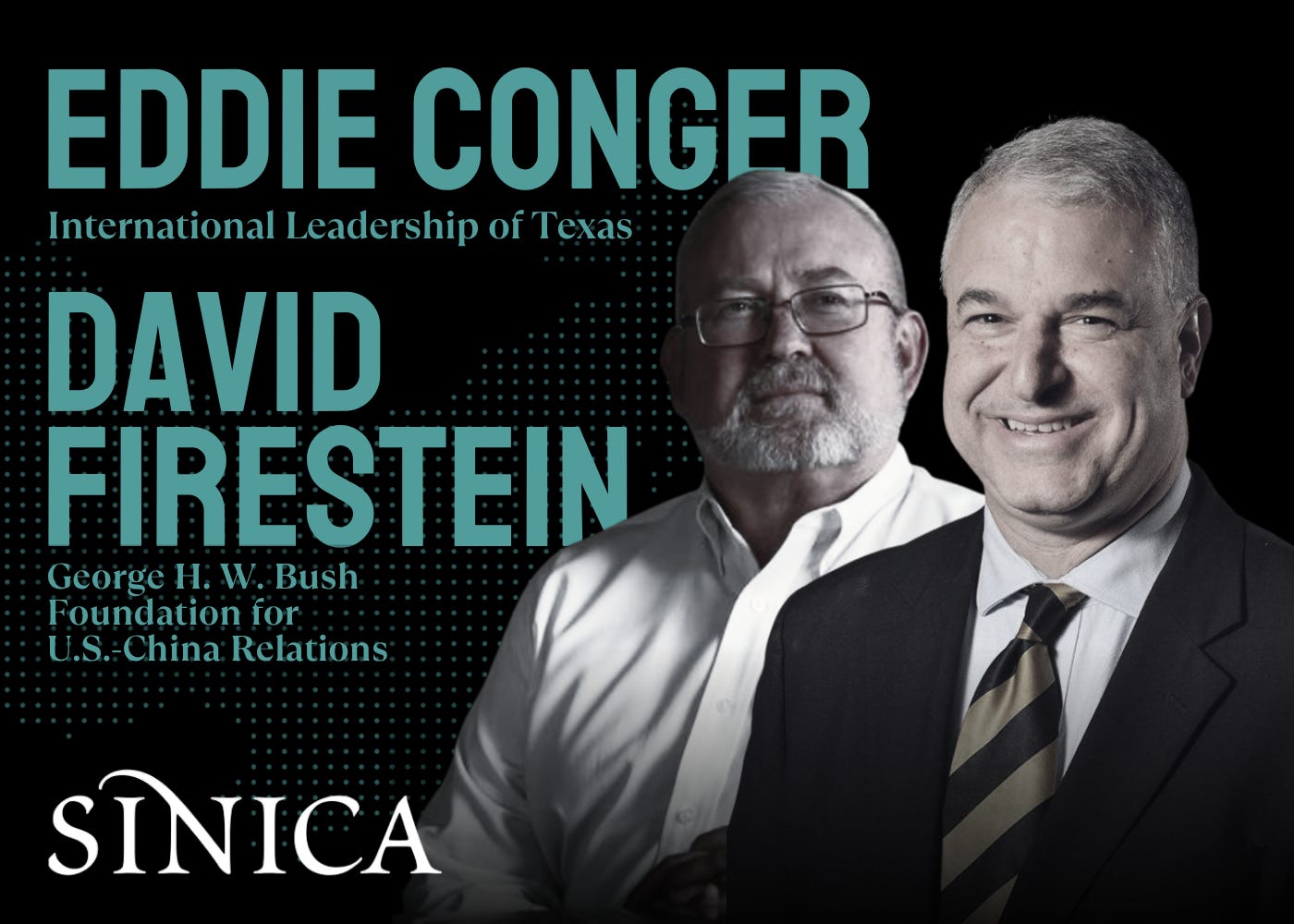
Listen in the embedded player above. Transcript courtesy of CadreScripts follows the podcast info below. Image by Keya Zhou.
The summit in Beijing produced a “constructive strategic stability” framework and a warming of tone between the two presidents. But heads of state can announce a multi-year horizon; somebody else has to operationalize it. Does the United States have the people — the linguists, the regional experts, the long-haul institution-builders — to do that work?
This week, I chatted with two Texans answering that question from very different directions. David Firestein is the inaugural president and CEO of the George H.W. Bush Foundation for U.S.-China Relations in Houston. A career State Department officer who served four administrations and spent five years in Beijing, he’s one of the few Americans concurrently affiliated with both a Republican and a Democratic presidential legacy institution. Eddie Conger is a retired Marine major and the founder and superintendent of International Leadership of Texas (IL Texas) — a public charter network of 26 campuses serving 26,000 K-12 students and now the largest K-12 Chinese language program in the country. In January, IL Texas became the first-ever K-12 recipient of the Bush China Foundation’s George H.W. Bush Award for Educational Excellence in U.S.-China Relations, joining past honorees including Jimmy Carter and Henry Kissinger.
The conversation tackles what David calls the Texas paradox: the same state that just forced its cities to dissolve their sister-city ties with China, that pioneered the closure of Confucius Institutes, and that has restricted Chinese land purchases is also where the country’s deepest K-12 Mandarin pipeline is taking root — and where the most institutionally Texan China foundation has chosen to plant its flag. David and Eddie talk through engagement honestly (no straw-man Jeffersonian-democracy fantasies), the erroneous strategic assumptions undergirding U.S. China policy, what real national-language capacity would look like operationally, what they each saw in the Trump–Xi summit, and what 5,000 IL Texas graduates are already doing in the world.
05:40 — Eddie’s path: Marine infantryman to fifth-grade math teacher to the country’s largest K-12 Mandarin program
09:12 — David on when the Nixon-through-Obama engagement consensus broke (fall 2017) and how the lexicon shifted
13:30 — Engagement honestly defined: what its architects actually believed vs. the Jeffersonian-democracy straw man
18:30 — The Texas paradox: HB 128, sister cities, Confucius Institutes — and the country’s biggest Mandarin program in the same state
31:26 — Texas business, Tim Dunn, faith, and the gap between political rhetoric and where Texans actually are
41:54 — The Defense Department safety/security story: when one Chinese word ate an entire bilateral agreement
46:16 — David’s six (or seven) erroneous strategic assumptions: China doesn’t want to be us, and it has benefited more than anyone from the current order
52:28 — What real national-language capacity would actually look like: NSLI, WALARA, and why the pipeline still runs through one Marine major in Texas
01:06:07 — Reading the Beijing summit: the warmth, the “constructive strategic stability” framing, and whether Trump’s Taiwan call could blow it all up
01:17:10 — Where 5,000 IL Texas graduates are now — White House interns, service academies, doctors, entrepreneurs, and one high-schooler who pulled a stranger out of the surf
Paying it Forward
Eddie:
Carlos Carrasco; Emily, who is heading to Taiwan this fall on a one-year high-school program; and another student bound for the University of Texas at Austin who will be sent to South Korea for a semester as a freshman — a rarity at UT. And he closes with Miles, a high-school senior and Marine scholarship recipient who, just weeks ago at a national competition in Florida, heard someone screaming for help in the ocean, called for a boogie board, and swam out to save a drowning swimmer while a crowd of adults stood on the beach. “Others before self,” as Eddie puts it — the IL Texas mission statement made flesh.
David:
Frank Zhou, who just graduated from Harvard and chaired the Harvard College China Forum; Selina Gong, a recent graduate of the Harvard Kennedy School involved in its annual China conference; and Dean Dai, a recent graduate of Columbia’s SIPA who has been deeply involved in many of the most significant student-run China conferences in the country — and who, as it turns out, was one of the organizers of the University of Chicago U.S.-China Economy and Business Summit where Kaiser spoke earlier this month.
Recommendations:
Eddie: John Pomfret, The Beautiful Country and the Middle Kingdom: America and China, 1776 to the Present (Henry Holt, 2016)
David: Stephen Roach, Accidental Conflict: America, China, and the Clash of False Narratives (Yale, 2022)
Kaiser: David Grann, The Wager: A Tale of Shipwreck, Mutiny and Murder (Doubleday, 2023)
Also mentioned: Stephen R. Platt, The Raider: The Untold Story of a Renegade Marine and the Birth of U.S. Special Forces in World War II (Knopf, 2024)
Transcript
Kaiser Kuo: Welcome to the Sinica Podcast, a weekly discussion of current affairs in China. In this program, we look at books, ideas, new research, intellectual currents, and cultural trends that can help us better understand what’s happening in China’s politics, foreign relations, economics, and society. Join me each week for in-depth conversations that shed more light and bring less heat to how we think and talk about China.
I’m Kaiser Kuo, coming to you this week from my nearly empty, soon-to-be-on-the-market home in Chapel Hill, North Carolina. I believe this is my penultimate taping here. Got one more show to tape next week, and then I’m gonzo. The house is gone.
Sinica is supported this year by the Center for East Asian Studies at the University of Wisconsin-Madison, a national resource center for the study of East Asia. Listeners, please support my work by becoming a paying subscriber at sinicapodcast.com. I do need your help to keep doing this work, so please do subscribe.
Here’s a question that doesn’t get asked nearly often enough in Washington — Whatever the United States decides it wants from its relationship with China, to compete with it, to manage or even contain it, to strike deals with China, or some shifting combination of the above, does it actually have the people to do any of that well? The institutions, the language capacity, the human infrastructure. We talk endlessly about strategy toward China, about leverage and competition, and red lines.
We talk much less about whether there is a deep enough bench of Americans who can actually read the room, who can read the documents in the original, who can understand the strategic logic of Beijing on its own terms, and do the long, unglamorous, difficult work of dealing with a country, whether you were cooperating with it or facing off against it. The summit in Beijing a couple of weeks ago, whatever you make of its constructive strategic stability framing, was a reminder of the stakes. Heads of state can announce a multi-year horizon, but somebody has to operationalize it, and that somebody is rarely the person who’s actually at the podium.
So today, I want to look at the capacity question, where America’s ability to deal with China actually comes from, who’s building it, and what it means, that the answer right now runs through, of all places, Texas. To take on that question today, I am joined by two Texans who, from very different directions, are trying to answer it with a yes, or trying to make a yes possible, at least. David Firestein is the inaugural president and CEO of the George H.W. Bush Foundation for U.S.-China Relations, based in Houston. He was a career U.S. diplomat from 1992 to 2010, serving across four administrations with a primary focus on China.
Five years at the U.S. Embassy in Beijing, four in Moscow. He has interpreted Mandarin for top-level U.S. and Chinese officials. He’s the author of three books on China, including two China-published bestsellers. And he was, in the mid-1990s, the first foreigner ever to have a regular column in a People’s Republic of China newspaper. Before the Bush China Foundation, he founded UT Austin’s China Public Policy Center and taught at the LBJ School of Public Affairs, where he still serves on the dean’s advisory council.
He’s one of the very few Americans concurrently affiliated with both a Republican and a Democratic presidential legacy institution. David, welcome to Sinica. Great to see you.
David Firestein: Thank you so much, Kaiser. It’s truly a pleasure and an honor to be with you.
Kaiser: The honor is entirely mine. Also joining us today is Eddie Conger. He is the founder, superintendent, and CEO of International Leadership of Texas, IL Texas, which serves 26,000 K-12 students across 26 campuses in the Dallas-Fort Worth, Houston, and College Station region, and is the largest K-12 Chinese language program in the United States. Eddie is a Texas A&M grad, a retired U.S. Marine Corps major with 20 years of active service, including a posting in Okinawa.
After retiring from the Corps in 2001, he started his second career as a fifth-grade math teacher in Dallas Independent School District, ISD, and went on to lead Thomas Jefferson High School, where in four years, he drove the graduation rate from 52% to 81%. He founded IL Texas in 2012. In January, the Bush China Foundation gave IL Texas its first-ever K-12 award — The George H.W. Bush Award for Educational Excellence in U.S.-China Relations, joining a list of previous recipients that includes, oh, you know, people like Henry Kissinger and Jimmy Carter. Eddie, congrats on all that and welcome to Sinica.
Eddie Conger: Thank you very much. It’s an honor and a pleasure to be here, sir.
Kaiser: Well, thank you. Thank you for making the time. And Eddie, I want to start our conversation with you because, you know, the trajectory that you’ve taken is the one that maybe is apt to surprise people most. Texas A&M, 20 years as a Marine officer, retiring as a major in 2001. You came home to Texas and became a fifth-grade math teacher. and then took on a struggling high school in Dallas and achieved really, really impressive results. And by 2012, you’d built the largest Chinese language and exchange program in Dallas ISD — 600 students before leaving to start IL Texas.
So I want to ask, when did the conviction form for you that the most patriotic thing you could do for American national security, for the country was to teach working-class Texan kids Mandarin Chinese? Was it like a single moment or was it 20 years in the making?
Eddie: I believe it’s an entire lifetime in the making. First, the concept of service — knowing early on that I wanted to serve as a Marine Corps infantry officer, the 20 years in the Marine Corps, the studying of warfare from Clausewitz, but also Sun Tzu, the ancient Chinese philosopher. All of that and the current situation, the current environment that you always pay attention to if you are a student of international relations, and especially how it impacts the military. There’s an acronym that’s taught. It’s called DIME, D-I-M-E. D is for diplomacy. I is for information intelligence. M is for the military and E is for the economy.
Well, too often, those of us who serve and have sworn oath to the Constitution, occasionally our perspective, or at least mine, and this is 100% only my thoughts, is that we dive immediately to the military and those who are willing to serve, protect, and defend. Instead of having an equal emphasis on the diplomacy, equal emphasis on the I to help us with our national power, and to be able to navigate the world that we live in. Living in Okinawa, I was able to see how fast my own children were picking up the Japanese language. And knowing here in Texas, we only require two years of a language to graduate from high school. Even at Texas A&M, when I graduated in ‘81, they had a language requirement, but you could substitute FORTRAN and COBOL for the language, and that’s what I did.
But it was that sense of service. And then in 2008, when I went to take over the principalship there in Dallas of TJ, all of the dollar value of the flights coming into DFW Airport, the highest dollar value was with China. And so, if that is the highest trading partner, second was with Mexico, Spanish-speaking, why would we not train our students to be able to speak the language, understand the culture, even from a purely economic perspective? I would want us to be forearmed, empowered, whatever the right word is, to be so comfortable in our skin of the language, but just as importantly, the culture.
And so that was the part of service that I wanted to do in the traditional school system. And then, of course, which led me to apply to the State Board of Education for this very, very unique mission of servant leadership and then mastering those three languages — English, Spanish, and Chinese.
Kaiser: You’ve got quite a bit of the world covered with those three languages. That’s for sure. David, your trajectory is in some ways the institutional inverse of Eddie’s four administrations as a State Department officer, Bush 41, Clinton, Bush 43, Obama. You didn’t watch the bipartisan consensus on China engagement dissolve from the outside. You actually lived it from the inside. When did you first sense that what we call the sort of Nixon through Obama consensus on engagement was actually over for you? Was there a specific moment for you?
David: Yes, there was. I would say 2017, toward the end of President Trump’s first year in office, after his election in 2016, was when I really saw the tide turn in terms of U.S. elite and public sentiment really turn quickly in a much more negative direction. Of course, it really started with President Trump as a candidate for president, declaring his candidacy in 2015 and running for nearly two years, a year and a half plus for the presidency.
China obviously was a very big theme in his rhetoric, and his framing of China and his tonality and word choice around China was extraordinarily harsh. It was unlike anything that we had ever seen in the modern era and decades and decades in American political life. And it started to normalize a lexicon around China that we simply hadn’t heard before, and that would have been considered irresponsible, unpresidential, and so on. And I think it culminated in the fall of 2017.
Elite public opinion, the media in this country, academics in this country really starting to coalesce around a much more negative framing of China than we had ever seen and much more harsh language, particularly from our political class, and particularly at that time from the Republican Party, which we might also refer to at that time as the MAGA Republican Party, led by the man who invented MAGA – Donald Trump. And so, I remember very well in the fall of 2017, really seeing things change, if not overnight, over a period of just a few weeks from a fairly moderate overall national tonality around China to a much more adversarial framing and a much harsher type of tonality and rhetoric.
And by 2018, we started to see that manifest itself in terms of legislation and presidential policy initiatives, including, of course, the tariffs, which were initially launched in May of 2018. And at that point, it really was a race to the most adversarial place, rhetorically, that we’ve seen in terms of American framing of China since Nixon. And I think you’re right, Kaiser, when you point out that there was a broad continuum from President Nixon through President Obama, where we had bipartisan
