


Q4 got off to a grim start. In October, industrial output slowed, consumption weakened, and investment posted its sharpest decline on record — all despite Beijing having unveiled an economic support package in late September.
But the deeper worry is how narrow China’s growth has become. One subsector — computers, AI, and electronics — is doing almost all the work.
Manufacturing output of this subsector grew 19.4% y/y in October — the strongest reading since 2012 — while manufacturing as a whole grew just 5.4%, its slowest pace since April.
Investment in this subsector surged 13%, while every other manufacturing sector saw investment decline.
On the trade side, AI-related products accounted for the bulk of export growth, with semiconductors alone accounting for more than a fifth.
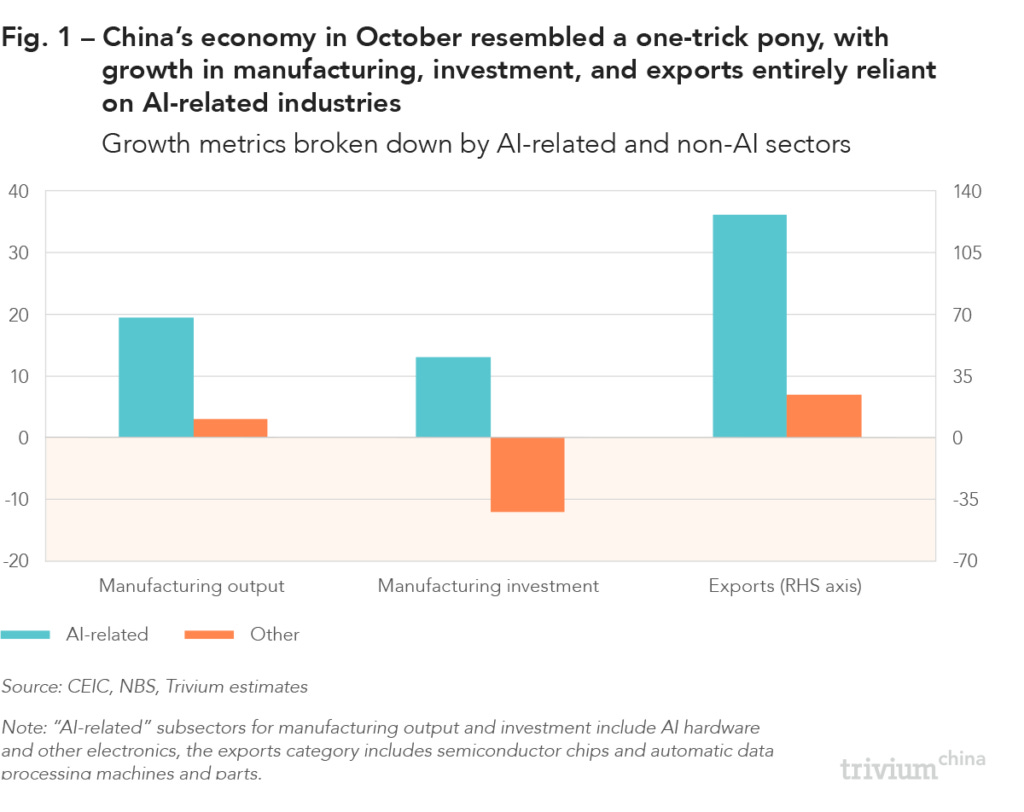
Strip out this growth driver, and almost every other corner of the economy is deteriorating.
Take consumption.
September saw a modest increase in China’s consumption metrics, but at the time we argued this was a short-lived bounce, driven by the iPhone 18 launch and the Mid-Autumn Festival holiday.
As expected, growth cooled in October, with retail sales of consumer goods up a measly 0.4%, and services consumption growth also slowing sharply.
And then there’s investment — which fell off a cliff.
Total fixed-asset investment dropped 16.9% y/y, the sharpest decline on record.
Real estate investment fell 33.2% and infrastructure investment fell 12.2%.
The infrastructure number is especially puzzling. Policy banks deployed RMB 800 billion in seed capital during September and October, and the central bank told the policy banks to ramp up lending to new “six networks” infrastructure projects. That should have driven a pickup – but instead, the opposite occurred.
Why hasn’t Beijing’s infrastructure stimulus shown up in the data yet? Dinny and I dig into that in our latest podcast.
Against this backdrop, Beijing’s nerves are starting to show. On November 6, Premier Li Qiang called for a greater “sense of responsibility and urgency” among officials to hit this year’s targets. Xi Jinping went further when, on a tour of Guangdong, he told officials to “ensure the completion of the year’s main targets and tasks” — a firmer line than a year earlier, when he effectively let the province miss its growth target.
But what neither leader offered was new money or new measures. The leadership instead wants officials to make full use of the September support package and is betting that – together with strong export growth — it will be enough to achieve the full-year growth target.
It probably will — but hitting a headline target is not the same as fixing the underlying problem.
Until Beijing is willing to tackle the structural weakness in domestic demand head-on, China’s economy will increasingly resemble a one-trick pony — relying on a single high-tech subsector to eke out growth as it limps toward its full-year GDP target.
What you missed
U.S.–China
The U.S. Commerce Department’s Bureau of Industry and Security (BIS) issued new rules restricting Chinese firms’ access to advanced chips through overseas data centers.
Suppliers of advanced chips to data centers anywhere in the world need a license if those facilities provide Chinese firms with more than 12 million Total Processing Peformance (TPP) of computing power.
Existing data centers providing computing power above the threshold to Chinese clients have 90 days to obtain licenses or risk future export restrictions.
The US Treasury and the White House Office of Science and Technology Policy are reportedly considering requiring US companies to publicly disclose their use of Chinese AI models.
Companies like Airbnb — which uses Alibaba’s Qwen to power its customer service agent — would have to post that information on their websites.
The aim is to discourage reliance on Chinese AI through “name and shame,” without imposing restrictions that could anger Beijing or US industry.
Xi Jinping pulled out all the stops to welcome Donald Trump to Shenzhen for APEC, underscoring their strong personal relationship.
When Trump arrived on Wednesday, Xi personally greeted him at the airport – a rare departure from diplomatic protocol.
The two leaders even embraced, an unusual display of affection for Xi.
Foreign affairs
Xi Jinping got US President Donald Trump and Russian President Vladimir Putin to sign a four-point declaration at their November 19 summit in Shenzhen.
The declaration largely reflects Xi’s priorities, particularly his emphasis on sovereignty, multilateral institutions, and great-power cooperation.
Getting Trump and Putin to endorse those principles represents a diplomatic win for Xi.
Xi met the leaders of Singapore, Indonesia, Malaysia, and Thailand in Shenzhen, and made progress bringing these countries into China-backed institutions.
Indonesia said it had ratified membership in the World AI Cooperation Organization and International Organization for Mediation.
Singapore agreed to join the Group of Friends for Xi’s Global Governance Initiative, while Thailand said it would consider joining the mediation body.
Econ and finance
Funding for local infrastructure projects picked up sharply in September and October, but the money appears to be sitting in bank accounts rather than reaching projects.
In October, fiscal deposits — funds held by the finance ministry (MoF) and local finance departments at banks — swelled by RMB 1.4 trillion, nearly double the increase seen in October last year.
The result: Infrastructure FAI collapsed 12.2% y/y in October, widening from the 5.6% decline in September. The categories most dependent on local fiscal funding drove the deterioration.
Tech
Tencent told investors that new U.S. rules closing China’s offshore compute loophole will slow its model training.
Per President Martin Lau: “It sets everyone back in China.”
Overseas deals are unwinding as expected: Chief Strategy Officer James Mitchell said Tencent is exiting some prepaid compute contracts because of the new rules.
Corporates
The macro planner (NDRC) and energy regulator (NEA) jointly released a five-year plan for new-type energy storage (NES).
The plan reaffirms Beijing’s commitment to increase NES capacity to 300 GW by 2030 from 167 GW at end-September — a target that, at current growth rates, could be reached as early as 2028.
The plan also backs longer-duration NES projects, which are better suited to integrating intermittent renewables and strengthening grid reliability.
As always, it was a busy week in China.
Thank goodness Trivium China is here to make sure you don’t miss any of the developments that matter.