


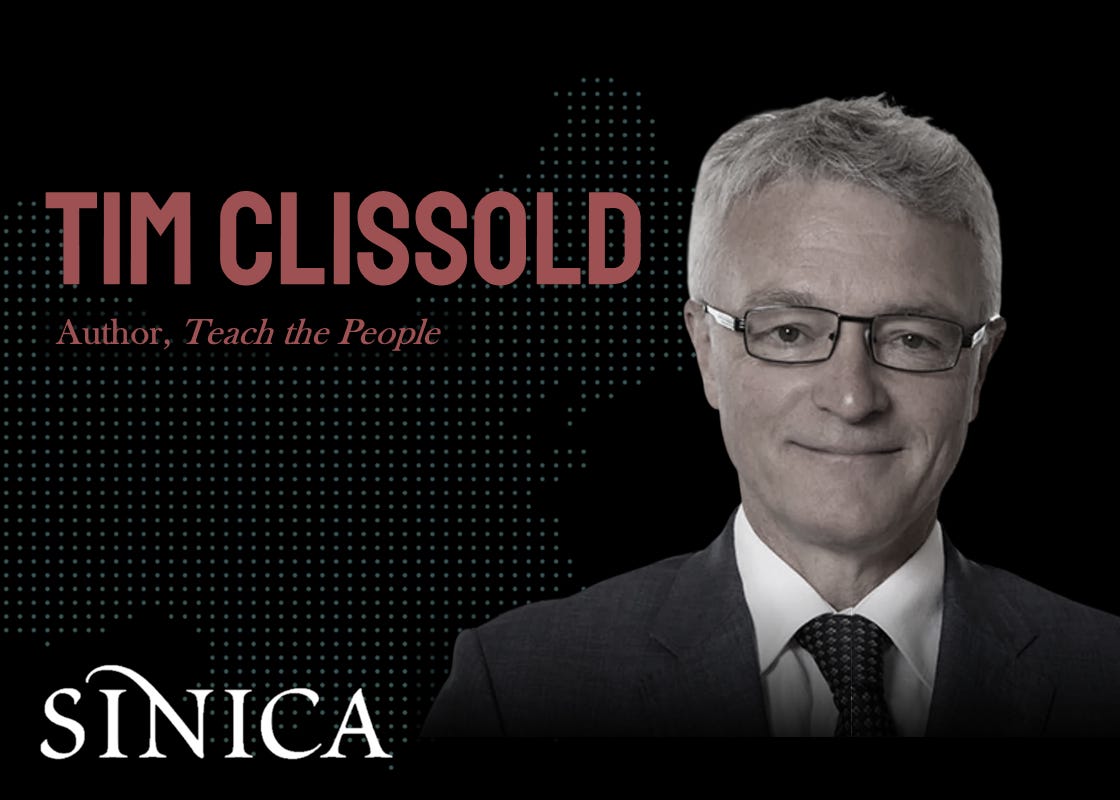
This week on Sinica, I sit down in Beijing with Tim Clissold. If you read one book about doing business in China in the 2000s, there’s a fair chance it was his Mr. China, the self-aware, admirably self-deprecating tragicomedy about standing between some $400 million of Wall Street money and twenty Chinese joint ventures that weren’t going to plan. He followed it with Chinese Rules, and for years since he’s worked mostly as a mediator between Chinese companies and the foreign investors who’ve fallen out with them. He’s a visiting fellow at Jesus College, Cambridge, and has been living, working, and thinking in and about China for nearly forty years.
But that isn’t why he’s here. For twenty years Tim has been pursuing what I’ve taken to calling his Great Enterprise — his 大业 dàyè — a new A-level in Chinese Civilisation for British schools, modeled on the existing A-level in Classical Civilisation and taught entirely in English, no Mandarin required. He’s assembled a syllabus with a dozen of Britain’s leading sinologists, lined up ten vice chancellors, the chairs of some of the country’s biggest companies, and the money to pay for it. The Department for Education’s answer has so far been no. The campaign is the subject of his forthcoming, self-published book, Teach the People: How to Narrow the Knowledge Gap between China and the West, whose premise is that the Chinese know far more about us than we know about them, and that the gap is now a matter of national security. We test that premise, and then we talk about what closing it would actually look like. Along the way Tim is generous enough to cite my essay The Great Reckoning, which he says shaped the book’s historical frame.
03:44 – Evidence of the knowledge gap
09:18 – Is this more than the ordinary incuriosity of the bigger party? Late Qing parallels, and an energy transition the West willfully ceded
14:49 – What was the West’s Second Opium War?
19:35 – Feng Guifen, the Self-Strengthening Movement, and the reciprocal questions the West should be asking itself
23:12 – The A66 and the Romans: twenty years to widen eighteen miles, a generation that can’t build wealth by working, and Hobbes as a forgotten Western strand
26:41 – Inverting tǐ-yòng: Western values as essence, Chinese methods for use, and whether you can have the electro-state without the party-state
30:40 – Mínzú: nation or race? Nine dictionaries, eight professors, a running battle with the FT, and the Stalin-to-Hitler op-ed that followed
34:42 – The Woodward Scale: a tongue-in-cheek measure of China sentiment, and why knowing China ought to unite hawks and doves
38:34 – The Great Enterprise: why Mandarin alone is pushing water uphill, collapsing language A-levels, native speakers taking all the A’s, and the Classical Civilisation model
43:34 – Nick Gibb’s no, ten merry-go-round ministers, a chairman’s letter to the prime minister, a 272-page curriculum review that never mentions China, and “that’s in the particular”
48:38 – Mind-enhancing and useful: would the A-level matter if China were no threat?
55:55 – Who can say yes? Pockets in Whitehall, a British Tóngwénguǎn, Guan Zhong’s hundred-year horizon, and what a China-literate Britain would decide differently — from Mingyang to Huawei
Paying It Forward
Morrison Cleaver, Beijing-based policy analyst at the China-Britain Business Council — Cambridge Chinese Studies, Yenching Scholar, still in his twenties, and one of the very few Brits of his generation who actually studied Chinese at university. Tim calls him a trailblazer. He’s also the man who lent me his copy of Teach the People so I could read it ahead of this conversation.
Recommendations
Tim: Bleak House by Charles Dickens — the story of an interminable lawsuit that outlives its litigants and ruins plaintiff and defendant alike; deliberately hard to follow, Tim suspects, because the joke is on us. He’s also just read Middlemarch for the first time and loved it. (I’ll always put in a word for Middlemarch — it’s the second time Bleak House has been recommended on this show, so it goes to the top of my list.)
Kaiser: Two novels by Mohsin Hamid, who’s become a friend through the Georgetown Global Dialogues. The Reluctant Fundamentalist — a short, semi-autobiographical novel told entirely as one side of a conversation in a Lahore café, by a Princeton-educated Pakistani who once understood America intimately. And Exit West, a very different and perhaps braver book about a young couple fleeing a city coming apart, in a world where doors open onto Mykonos and north London and an unrecognizable Marin County. Mohsin, I owe you a Chinese novel.
Transcript
Kaiser Kuo: Welcome to the Sinica Podcast, a weekly discussion of current affairs in China. In this program, we look at books, ideas, new research, intellectual currents, and cultural trends that can help us better understand what’s happening in China’s politics, foreign relations, economics, and society. Join me each week for in-depth conversations that shed more light and bring less heat to we think and talk about China.
I’m Kaiser Kuo, coming to you this week from Beijing.
Apologies for the long gap between episodes of late. I’ve been traveling a lot and it’s been really disruptive. Listeners, please support my work by becoming a paying subscriber at sinicapodcast.com. I get how all these Substack subscriptions can really start to add up. And so, I try to offer a lot. So, in addition to Sinica, you get the Sinica Chinese phrase of the week from Andrew Methven. You get podcasts and roundups from the terrific folks at Trivium. You get my favorite pod, the indispensable China Global South Podcast. And you get historian Jay Carter’s This Week in China’s History. So, please do subscribe so that I can continue to bring you these conversations and lots more.
My guest this week, I’m very happy to say, is Tim Clissold. If you read one book about doing business in China back in the 2000s, there’s a fair chance that it was his, Mr. China, the story of how a young Englishman who ended up as the man in the middle between 400-odd million dollars of Wall Street money and close to 20 Chinese joint ventures that were, to put it gently, not going exactly according to plan. It’s a very self-aware and admirably self-deprecating tragic comedy that’s made many lists of all-time best China books. And though it came out two decades ago, I guess now, people still routinely press it on anyone about to take a job in China, rightly, I think.
He followed it with Chinese Rules about his adventures in the carbon credit business. And in the years since, he’s worked mostly as a mediator, sorting out disputes between Chinese companies and the foreign investors who’ve fallen out with them. He is a visiting fellow at Jesus College, Cambridge, and he has been living in, working in, and thinking about China for nearly 40 years. But that’s not really why he’s here today. For the past 15 years, Tim has been pursuing what I’ve taken to calling his great enterprise, his Daye, getting a new A-level in Chinese civilization into UK schools. For American listeners, A-levels are the exams that 16 to 18-year-olds sit before university. And the idea is actually quite simple. You can study classical civilization, Western civilization, in English without a word of Latin or Greek. Why not China without the Mandarin? He’s assembled a syllabus with a dozen of Britain’s leading sinologists.
He’s lined up 10 vice chancellors, business leaders, think tanks, and even the money to pay for it all. And he’s taken it to the Department of Education. But so far, the answer has been no. The campaign is the focus of his new book, Teach the People: How to Narrow the Knowledge Gap, between China and the West. And the knowledge gap is its premise. Here’s how he puts it: “The truth is that the Chinese know more about us then we know about them, and that gives them a competitive advantage. The stakes could not be higher, nor the consequences of a mistake more dangerous. For the sake of future generations, we need to close that knowledge gap.”
We’ll test that premise, and then we’ll talk about what closing the gap would actually look like. Tim Clissold, welcome at last to Sinica.
Tim Clissold: Thank you, Kaiser.
Kaiser: Tim, you opened the book with three scenes, and I’d rather you told them than I paraphrased. There’s Jiang Zemin, then the mayor of Shanghai, later, of course, the president, facing down student protesters back in 1986, who’ve been quoting Lincoln at him from the Gettysburg Address. Then there’s Wen Jiabao, premier, of course, through the 2000s with a copy of Adam Smith, but not Wealth of Nations.
And then there’s Xi Jinping on the various philosophes of the French Enlightenment, who he’s proud of saying that he’s read. Tell those stories and then tell me why you picked those three in particular to lead the book off.
Tim: So, what I tried to do was establish the main premise, which is that there’s a huge knowledge gap. So, you can do that with all sorts of anecdotes and meetings and episodes with local government officials or business people or academics. But the one that I chose, which is quite early, because it’s absolutely verifiable, was an episode where Jiang Zemin, at the time, future president of China. He was the mayor of Shanghai and there were student protests, and it got quite ugly. There were sort of, you know, smashed shot fronts and all that kind of thing.
Kaiser: Right. By the way, the protest that ended up bringing Hu Yaobang out of power.
Tim: No, that was...
Kaiser: ‘87. In the early ’87.
Tim: No, it was ‘86. Yeah, so that was the Hu Yaobang episode, correct. And then, of course, he went back And then his death sparked the ‘89 turmoil. Yeah. So anyway, so Jiang Zemin agreed to go and meet with the students to do a gōngzuò (工作), like typical Chinese official, to pacify, listen, try and adjust policy, try and deal with their problems. It is very tetchy. And he arrived at the university quite flustered, not much time to prepare. And he saw scrawled on one of the walls a piece from the Gettysburg Address, you know, government for the people, by the people and so on.
And he went into the main auditorium, which is packed. There are about 2000 students in there, heightened atmosphere, and started discussing with the students. But the key moment when he won them over is he just recited from the top of his head, without notes, in English, the whole of the Gettysburg Address. And I think there are many politicians anywhere that would be able to do that.
And I know that that’s true because it wasn’t a propaganda stunt because he was challenged to do that later on, on an American television.
Kaiser: 60 minutes, I think it was.
Tim: Yeah, was it? Yeah. And he did the same. So that kind of got me thinking. You look at other episodes, Wen Jiabao arrives in the UK in something like 2013. And he brings with him a copy of Adam Smith’s book, but it’s not The Wealth of Nations, it’s Theory of Moral Sentiments, which talks about limits that should be placed on the market. And he quoted from it at length to his somewhat bemused toast. And the first thing he asked was to be taken to Stratford-upon-Avon for a performance of King Lear, where he talked to journalists saying Shakespeare cannot be read once, it cannot be read 10 times, you need to read it 100 times before you can fully understand it.
So, I think that there’s a lot of evidence that the Chinese know much more about Western society from leadership right down to base levels. So, then you start thinking, well, why is that? And I think the reason why it is because they had no option. Because in 1977, after Mao died, Hua Guofeng sent a delegation to Europe. And they were absolutely flabbergasted. They saw computer-controlled landings at airports and modern power generation and high-speed trains. And they just suddenly realized in an instant how far they’d fallen behind. So, when they arrived, it was a month’s trip. And when they arrived back, they drove straight from the airport to Zhongnanhai, opened a meeting in the Politburo, and they were so excited, the meeting continued right throughout the night.
So, they’d suddenly realized in a flash how far they’d fallen behind, and all these stereotypes about workers being crushed by capitalistic managers wearing top hats and tails, all of that was completely false. So, the scales fell from their eyes, and they made it their business to learn about the West. And I think my basic premise is that we now have an enormous catch-up to do because the world has changed. And China has come up with a model that is objectively successful on almost all levels, and some way or another is attractive to other developing countries.
And we don’t really understand how it works. And therefore, because we don’t understand it, we can get captured by fear. And that’s the last thing you should do. We should learn how to defend ourselves, but also cooperate as well more constructively. So, I think the only long-term solution to that is just to raise the body of people in the West to really understand China for what it actually is, warts and all.
And we just haven’t done that and we need to. So, in the UK, there are 300 graduates a year in Chinese. In veterinary science, there’s 36 times more. And I know we’re a nation of dog lovers, but I still think national security, and so on, should get a look in. It’s just as simple as that.
Kaiser: Yeah, yeah. We were talking the other day at lunch, and I warned you that I’d ask this, but there is this familiar pattern in which the smaller, weaker party always knows the bigger one, the stronger one better than the reverse. Of course, everybody in the world knows America better than America knows them. You know, Chicago knows New York better than New York knows Chicago. What’s your evidence that the China case is something more than the ordinary incuriosity of the bigger party?
Tim: Well, we have to up our game to be able to cooperate and defend ourselves in order for society with its values to survive. I mean, the idea of having large scale, wide conflict with China, I mean, that just doesn’t lead anywhere. So, we have to find a way of coexisting. And that means understanding China’s red lines, pushing where our red lines and their red lines clash, which are not in very large areas. We’ve got much more in common.
Kaiser: Yeah. But it just doesn’t feel like very long ago that the obverse was true, that China was the obtuse party here, that it had its head in the sand, it wasn’t learning about the West. And then, you know, it’s until the mid-19th century. So, what you’re essentially saying is that it’s flipped, that the whole thing has inverted now.
Tim: Yeah. So, I think there are tremendous parallels between the current situation and the late Qing.
Kaiser: I’m very fond of those-
Tim: So, yeah. And I mean, you mustn’t over egg the kind of repetition of history like Mark Twain says it doesn’t repeat itself but sometimes rhymes so that’s probably about right. But if you look at the conflict between the West and China in the mid-1800s it was basically caused by a trade deficit. So, trade deficit is about the most important issue at the moment, particularly with the EU let alone the U.S. So, you’ve got trade deficit. Layer on top of that, an opium crisis, an opium crisis in the U.S., which the U.S. claims is being facilitated by China.
And then enormous technology catch up, clash of systems, mutual misunderstandings, all sorts of different parallels. On the one side, you have a hectic,
