


Transcript (courtesy of the fantastic CadreScripts) further down the page. Image by Keya Zhou. Listen in the embedded player above!
This week on Sinica: Spanish Prime Minister Pedro Sánchez wrapped up his fourth visit to China in as many years last week, and this one may be the most consequential yet. It comes at a moment when Spain has emerged, almost improbably, as the most outspoken voice in Europe challenging the direction of American foreign policy — closing its airspace to U.S. military aircraft involved in the war in Iran, denying Washington the use of the Rota and Morón bases, recognizing Palestine, and getting expelled from the U.S.-led Gaza Coordination Center for its “anti-Israel obsession.” Against that backdrop, Sánchez delivered a remarkable speech at Tsinghua University — a speech I wrote about in detail on the Sinica Substack (PM Pedro Sánchez’s Tsinghua Speech: A Masterclass in Diplomatic Rhetoric) — defending multilateralism, calling the EU-China trade deficit unsustainable, and naming China “a country rebuilding its greatness.”
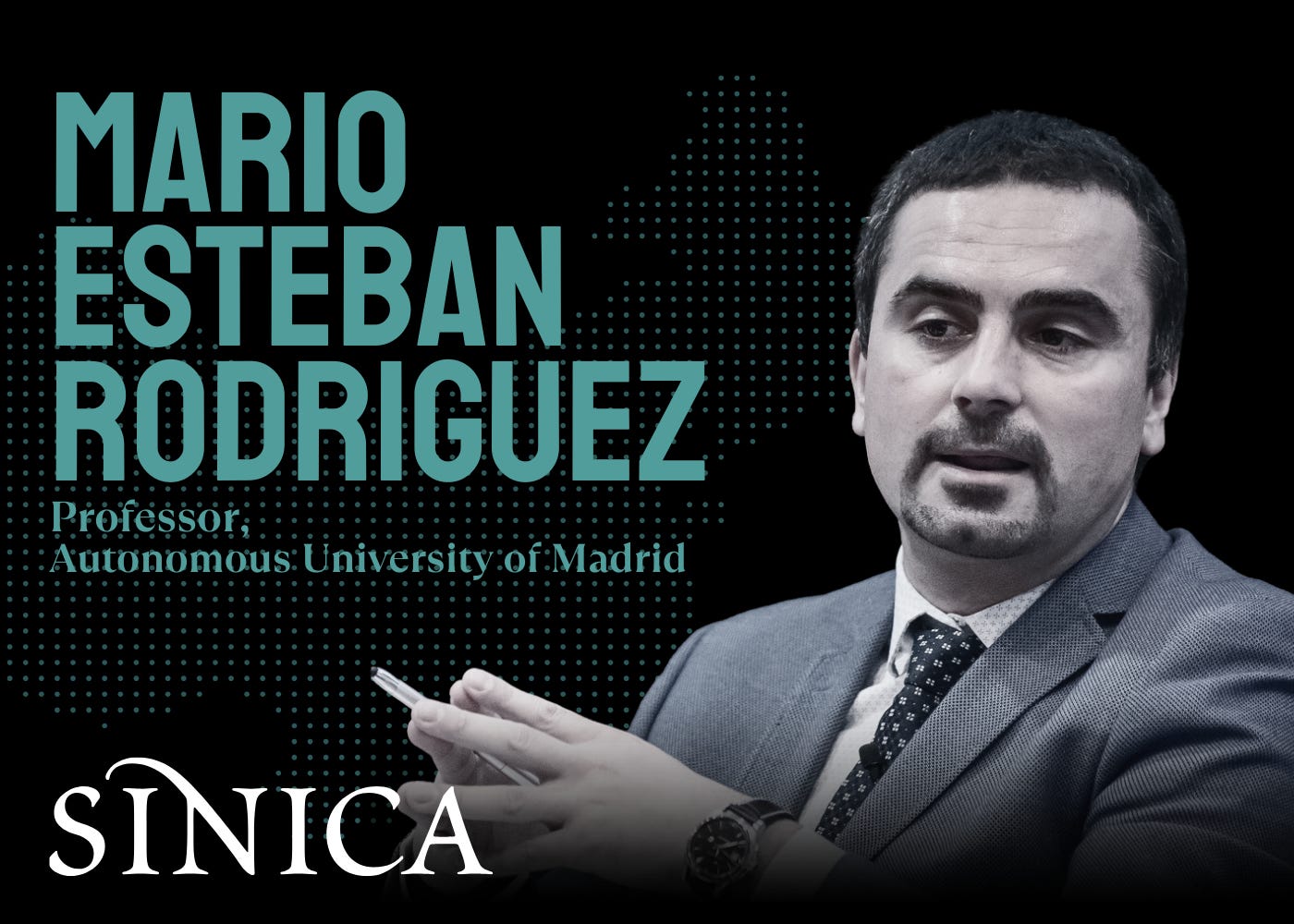
To help make sense of it, I’m joined by Mario Esteban Rodríguez, full professor at the Autonomous University of Madrid, director of its Center for East Asian Studies, and senior fellow at the Elcano Royal Institute. Mario is the scholar most frequently quoted in Spanish and European media coverage of Spain-China relations, and the author most recently of China’s Vertical Multilateralism and the Global South (Routledge, 2026). We discuss whether Sánchez is running an updated Merkel playbook or something qualitatively new, how much of the pivot is really about Trump, the sectoral politics of EVs and Iberian pork, the Chery plant in Barcelona, Spain’s role as a gateway to Latin America, and whether Madrid is now a trailblazer for a broader European — and transatlantic — reorientation toward Beijing.
06:33 — Sánchez’s China strategy: pragmatism, consistency, and political capital
08:35 — Domestic politics: the PSOE–PP consensus, Vox, and the regional contradiction
12:40 — Merkel’s playbook vs. Sánchez’s: COVID, Ukraine, and the macroeconomic imbalance
15:55 — The Tsinghua speech: Matteo Ricci, multipolarity, and the human rights omission
28:17 — The Trump factor: Iran, Gaza, and the limits of overestimating the American effect
35:48 — Trade, EV tariffs, pork, and Chinese investment in Spain (the Chery plant in Barcelona)
47:04 — Agricultural constituencies and the paradox of Vox voters who benefit from China trade
49:01 — Spain’s influence in Brussels and the conditions for other member states to follow
53:09 — Spain as gateway to Latin America, and the wider European (and Canadian) turn to Beijing
Paying it Forward: The European Think-Tank Network on China (ETNC) — a network providing country-specific insights on EU member states’ approaches to China, including the granular differences and nuances that non-European analysts often miss.
Recommendations
Mario: A trip, rather than a book — New Zealand, which he’s visiting this summer with his family to mark the 25th anniversary of the release of The Fellowship of the Ring. A nod to his love of Tolkien and tabletop role-playing games (conducted, he is careful to note, in his own basement — not his parents’).
Kaiser: CONG — a new large-format magazine published out of Hong Kong (the title is pronounced Kong, though its ambiguous Pinyin-like spelling invites a second reading), now preparing its third issue. Beautifully produced on glossy and textured paper, with broad coverage of the art, culture, and design scene across East and Southeast Asia. Check it out online here: https://www.serakai.studio/cong
Transcript
Kaiser Kuo: Welcome to the Sinica Podcast, a weekly discussion of current affairs in China. In this program, we look at books, ideas, new research, intellectual currents, and cultural trends that can help us better understand what’s happening in China’s politics, foreign relations, economics, and society. Join me each week for in-depth conversations that shed more light and bring less heat to how we think and talk about China.
I’m Kaiser Kuo, coming to you this week from my home in Beijing.
Sinica is supported this year by the Center for East Asian Studies at the University of Wisconsin-Madison, a national resource center for the study of East Asia. The Sinica Podcast is and will remain free, but listeners, if you value my work and would like to see me continue doing it, please support Sinica by becoming a paying subscriber at sinicapodcast.com. Your subscription helps me continue to bring you these conversations.
As we record this episode, Spanish Prime Minister Pedro Sánchez is wrapping up his fourth visit to China in four years, and this one may be the most consequential yet. It comes at a moment when Spain has emerged, almost improbably, as the most outspoken voice in all of Europe, challenging the direction of American foreign policy. Just weeks before this trip, Spain took the extraordinary step of closing its airspace to U.S. military aircraft involved in the war in Iran and denied Washington the use of the Rota and Moron military bases in southern Spain.
Trump threatened to cut off trade with Madrid. Secretary of State Rubio accused Spanish leaders of bragging about it. And Prime Minister Sánchez fired back with one of the great rejoinders of this young century — The government of Spain will not applaud those who set the world on fire just because they show up with a bucket. This is the backdrop against which Sánchez flew to Beijing.
On Monday at Tsinghua University, he delivered a speech defending multilateralism, calling the EU trade deficit unsustainable, and, to the astonishment of some, describing Spain as a country that recognizes China is rebuilding its greatness and is destined to play a vital role in the future. He called on Beijing to do more to push the adherence to international law and to end conflicts in Lebanon, Iran, Gaza, and Ukraine, especially now that the United States has decided to withdraw from many of these fronts, he said.
He even called on Western countries to relinquish their participation quotas at international institutions in favor of countries of the global south. On Tuesday, Sánchez met with China’s President Xi Jinping at the Great Hall of the People, where Xi greeted his guests with suitably apocalyptic language. “The international order is crumbling into disarray,” Xi said, adding that “both China and Spain are nations of principle and integrity and should cooperate closely to resist any regression toward the law of the jungle.”
Later, Sánchez met with NPC Standing Committee Chairman Zhao Leji and Premier Li Qiang, and a set of 13, I’ve also heard 15 bilateral agreements were signed on education, technology, sports, and cultural exchange. Sánchez also visited Xiaomi, the Beijing-headquartered tech company, and met with its founder, Lei Jun. He test drove one of their very nice EVs and checked out their factory automation.
This visit caps an astonishing year in Spain-China relations. King Felipe VI and Queen Letizia paid a state visit to China last November, the first by a Spanish monarch in, I think, 18 years.
Chinese investment in Spain surged from 149 million euros in 2024 to 643 million in 2025. Bilateral goods trade exceeded 55 billion last year, up nearly 10 percent. And yet the trade deficit keeps widening. China now accounts for a staggering 74 percent of Spain’s total trade gap.
So, what is Sánchez actually up to? Is this a sophisticated bid for strategic autonomy, a bid for a Spanish brand of leverage between Washington and Beijing, or is it, as one analyst put it, an increasingly one-sided and unbalanced pilgrimage? How does Spain’s China gambit sit with Brussels, which is watched uneasily as Sánchez undercut the EU’s position on EV tariffs and cozied up to Beijing while acting, as some would have it, as a self-appointed ambassador for Europe?
And what does this all tell us about the broader debate inside Europe over how to navigate between great powers? To help us make sense of all of this, I am joined by Mario Esteban Rodriguez, who is a full professor at the Autonomous University of Madrid, where he directs the Center for East Asian Studies and is a senior fellow at the Elcano Royal Institute, Spain’s preeminent international affairs think tank.
Mario has served as an expert for the European Commission, the European Parliament, and Spain’s own ministries of foreign affairs and defense. He has been a visiting professor at Beijing’s Foreign Studies University and a visiting researcher at the Chinese Academy of Social Sciences. He’s the author or editor of several important books, including most recently, China’s Vertical Multilateralism and the Global South, published by Routledge just this year, and China and International Norms: Evidence from the Belt and Road Initiative.
He also happens to be the scholar most frequently quoted in Spanish and European media coverage of Spain-China relations, and indeed was quoted in the Chinese media and in La Razón coverage of this very trip. Now, Mario comes on the strong recommendation of a dear friend of mine here in Beijing, a Spanish diplomat who had the pleasure of being present at Prime Minister Sánchez’s Tsinghua speech, and who thought Mario would be exactly the right person to help us understand what Spain is doing and what it means for Europe.
I think just from that bio I just presented, you would agree that my friend Julio was absolutely right. Mario Esteban, welcome to Sinica.
Mario Esteban: Thank you so much, Kaiser, for the invitation. It’s a real pleasure to be in your podcast.
Kaiser: Yeah, it’s wonderful to have you. So let me jump right in and start with a big picture. So, Pedro Sánchez has now visited China four times in four years. No other current European leader comes close to that level of frequency. How would you characterize his overall approach to China? What is driving that?
Mario: Well, I think that Prime Minister Sánchez, he’s being very candid himself in explaining that. I think we can characterize his strategy mainly by two things. One is pragmatism. He is being very, very pragmatic in his approach to China. He avoids this kind of idealistic or wishful thinking narratives about China, the global order. He thinks that China is a highly successful and powerful authoritarian system with a model of state capitalism.
This creates clear challenges, of course, the U.S. is always talking about that, but it also generates significant opportunities, and not only in socioeconomic terms, but also when we talk about addressing the main challenges for the international community, things like climate change, AI governance, non-proliferations, and also he has this kind of pragmatic approach. And also, this is a key issue. This is a very complex relationship, and he’s not shy in engaging in this kind of complexity.
Also, the other important thing is that he’s very consistent in his approach towards China. He has demonstrated sustained political commitment. And this is also quite new for a Spanish PM because previous Spanish governments had a similar approach but didn’t pay or didn’t invest the same level of political capital. He, as you mentioned, he has made like four visits to China. This has been also complemented by a state visit of the King and Queen of Spain in November last year.
So, the point here is that the government thinks that if a country wants to improve significantly its relationship with China, it must invest in high-level political engagement. And it needs to be consistent on that. So he thinks that diplomacy with China requires like time, attention, continuity. So I think, yeah, that’s the two things — pragmatism and consistency.
Kaiser: Just now, Mario, you talked about the former governments, the former Spanish governments under Rajoy, for example, or Zapatero. My understanding from your work at Elcano is that Spain’s China policy has historically enjoyed pretty broad consensus between the two major parties, the PSOE and the PP. It’s been largely bipartisan. Is that consensus still holding as far as you can tell? Or has Sánchez pushed things into new territory?
Mario: Well, your reading is absolutely right. In Spain, frankly speaking, you know, there are many issues that are very heated debate, many issues of the political agenda, even on foreign policy. Sometimes China policy has been a state policy, so it’s been quite consistent. But you are also quite right saying that nowadays, Sánchez’s approach toward China has been criticized domestically by the Popular Party, which is the leading opposition party, but also by Vox. At the moment, probably the third party in Spain, is a far-right party, populist far-right party.
But we need to distinguish a little bit here, because it’s true that Vox, its criticism is ideological criticism because they are like strongly anti-communist, you know, and more principled kind of criticism. And they are completely aligned with the MAGA movement in the U.S. So they will follow line whatever comes from the MAGA movement. But the popular party is more tricky. Because publicly, at the national level, they criticize Sánchez, but most of the local power in Spain, most of the regional power is in the hands of the popular party.
And those regional and local governments are actually competing to attract Chinese investment. They are receiving with open arms, you know, this kind of investment. So, I would bet that If or when the Popular Party leads a central government in Spain, they would follow a similar approach to the one that Sánchez is following. At the practical level, probably the tone or some of the narratives would be different. But in terms of favoring positive and productive engagement with China, in terms of trade and investment, they would follow line here.
Kaiser: Okay, okay. Just for listeners who aren’t familiar with Spanish politics, I’m not. I was just in Barcelona, but I’m very new to it. So, just the party in whic,h currently, Prime Minister Sánchez is a member and is in coalition is PSOE, the Partido Socialista Obrero Español, the Spanish Socialist Workers Party. It’s a center-left party, as you can imagine. Again, it’s governing in a minority coalition with the Sumar Alliance. And the other one, which you call the Popular Party or Partido Popular, the People’s Party, it’s the main opposition currently. It’s a center-right party.
And they’ve historically, as you said, shared this broad consensus on China policy, though they’ve definitely been much more critical of Prime Minister Sánchez’s critique of Washington under Trump, right? They’re a little more sympathetic to the Trans-Atlanticism and things like that. Is that correct?
