


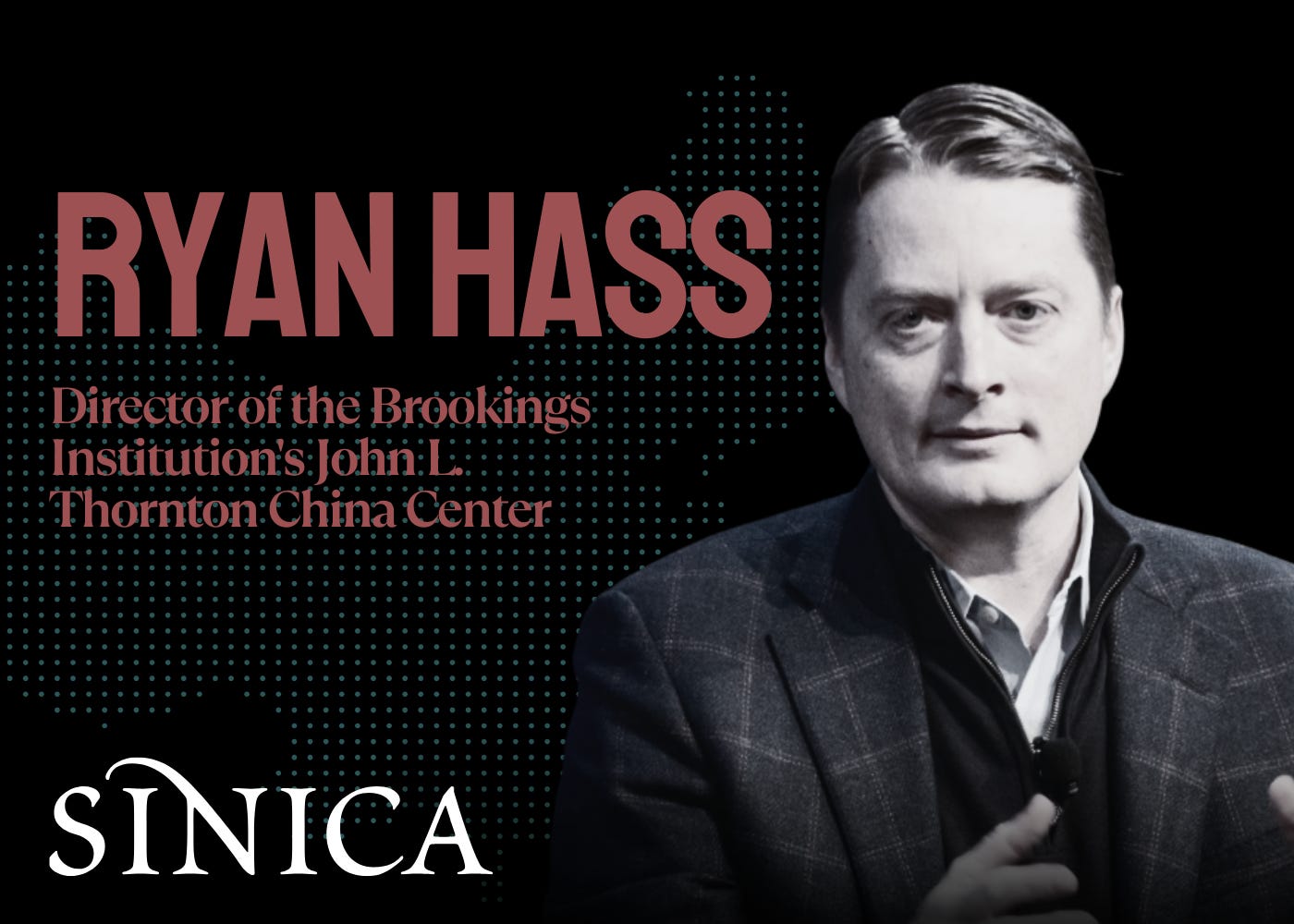
Transcript (courtesy of the fantastic CadreScripts) further down the page. Image by Keya Zhou. Listen in the embedded player above!
This week on Sinica, I speak with Ryan Hass, director of the John L. Thornton China Center at Brookings and one of the most clear-eyed analysts of the U.S.-China relationship working today. Ryan was director for China at the NSC during the Obama Administration.
As Donald Trump moves through his second year in office, the bilateral relationship has defied easy characterization. The once-dominant language of great power competition has receded, China hawks have been sidelined, and Trump’s personalistic approach—marked by praise for Xi Jinping and a willingness to bracket ideological disputes—represents a sharp departure from recent Washington orthodoxy.
Ryan has just published an essay laying out three plausible pathways for the relationship under Trump: a soft landing, a hard split, or what he considers most likely—a period of uneasy calm in which both sides seek stability not out of trust, but out of mutual constraint. We discuss Trump’s apparent strategy, the vibe shift in American attitudes, Beijing’s choice between managing Trump versus managing uncertainty, the critical importance of Xi’s planned April visit, and whether we’re headed toward genuine stabilization or just buying time before the next collision.
5:24 – Trump’s approach: respect for Xi, military deterrence, and the rare earths constraint
8:03 – The vibe shift and Trump’s “reptilian feel” for American exhaustion with confrontation
10:52 – Three scenarios: soft landing, hard split, or uneasy calm through mutual constraint
16:30 – Beijing’s bet: managing Trump versus managing whoever comes next
26:46 – Economic interdependence and why decoupling is like “separating egg whites from a scrambled egg”
37:12 – The April visit as a critical test: pageantry, protests, and what both sides are watching for
42:18 – Taiwan as the most dangerous variable and where theory meets practice
46:58 – Lack of institutional guardrails and the risks of Trump’s personalistic foreign policy
Paying it forward:
Audrye Wong (USC)
Recommendations:
Ryan: The Conscience of the Party: Hu Yaobang, China’s Communist Reformer by Robert Suettinger
Kaiser: The Last Cavalier (Le Chevalier de Sainte-Hermine) by Alexandre Dumas; Asia Society conversation with Lizzi Lee, Bert Hoffmann, and Gerard DiPippo on rebalancing China’s economy; Trivium China Podcast with Andrew Polk, Joe Peissel, Danny McMahon, and Cory Combs on capital expenditure headwinds
Transcript
Kaiser Kuo: Welcome to the Sinica Podcast, a weekly discussion of current affairs in China. In this program, we look at books, ideas, new research, intellectual currents, and cultural trends that could help us better understand what’s happening in China’s politics, foreign relations, economics, and society. Join me each week for in-depth conversations that shed more light and bring less heat to how we think and talk about China.
I’m Kaiser Kuo, coming to you this week from my home in Chapel Hill, North Carolina.
Sinica is supported this year by the Center for East Asian Studies at the University of Wisconsin-Madison, a national resource center for the study of East Asia. The Sinica Podcast is and will remain free, but if you work for an organization that believes in what I’m doing with the show and with the newsletter, please consider lending your support. I know you think of this as boilerplate by now, but seriously, I am looking for new institutional support. The lines are open. And you can reach me at sinicapod@gmail.com, or just my first-dot-last name at gmail. Listeners, please support my work by becoming a paying subscriber at sinicapodcast.com. Seriously, help me out. I know there are a lot of sub stacks out there, and they start to add up.
Yes, but I think this one delivers some serious value. You get my stuff, the China-Global South Podcast, the fantastic content from Trivium, including not only their excellent podcast, but also their super useful weekly recap. You get James Carter’s Wonderful “This Week in China’s History” column. You get Andrew Methven’s “Chinese Phrase of the week.” I am really trying to deliver value for your hard-earned dollar, so please do sign up. Things are tough — I get it. But consider helping out. Tough for me too. As we move into the second year of Donald Trump’s seemingly interminable second presidency, U.S.-China relations have once again defied easy characterization.
What began as a return to tariff escalation and hardball trade tactics has somewhat unexpectedly given way to a period of relative strategic calm marked by pauses and truces and, you know, even a noticeable softening of tone at the very top, even in the National Security Strategy and the National Defense Strategy that was just released. The once dominant language of great power competition has definitely receded, and many of the most vocal China hawks who shaped Washington’s approach over the past decade appear to have been sidelined. In their place, we’ve seen a policy posture that reflects Trump’s highly personalistic approach to foreign affairs and emphasis on leader-to-leader rapport. Xi Jinping’s my friend.
Dealmaking over doctrine and a willingness to bracket, or at least downplay ideological disputes in favor of transactional progress on trade, on technology or risk reduction. Trump’s repeated praise for Xi Jinping, his apparent sensitivity to certain of Beijing’s red lines, including on Taiwan, it seems, and his apparent comfort at treating China as a peer rather than a civilizational rival mark a sharp departure from recent bipartisan orthodoxy in Washington, if you indeed believe that it was a bipartisan consensus. Supporters argue that this shift has lowered the risk of conflict and delivered tangible gains. Critics, though, counter that the United States is conceding leverage without securing durable returns.
Either way, the result is a relationship that feels, well, less confrontational for now. In my private communications with certain among my more panda-hugging friends, there is this sort of bewilderment. It’s like we kind of agree that Trump is awful for this country, but not so bad for U.S.-China relations, right? But beneath the surface calm, lie unresolved structural tensions, deep mutual dependencies, of course, that could be weaponized, parallel efforts in both capitals to reduce those vulnerabilities. So, you know what comes next? Are we headed toward a genuine lasting stabilization or a familiar snapback to the acrimony that once dominated, once our expectations collide with reality?
Or a more ambiguous middle path, one in which both sides buy time and avoid escalation and quietly work to insulate themselves against future shocks. Well, to help us think through all these questions, I am joined by Ryan Hass, director of the John L. Thornton China Center at Brookings, and one of the most clear-eyed analysts of the U.S.-China relationship working today.
Ryan has just published an essay on the Brookings website laying out three plausible pathways for the relationship under Trump, scenarios ranging from a soft landing to a hard split, to what he sees as the most likely outcome, a period of uneasy calm in which both Washington and Beijing seek stability not out of trust, but out of mutual constraint. He joins me from D.C. And Ryan, welcome back to Sinica, man.
Ryan Hass: Thank you, Kaiser. It’s wonderful to be back with you.
Kaiser: So, Ryan, like I said, you’re joining us from Washington. So let me start there. So, one of the strengths of your piece is that it treats leaders as, you know, not free agents but constrained actors. So, from where you sit in D.C., what are the most powerful domestic forces that are shaping the U.S.-China policy right now? And which of them actually do you think matter to President Trump?
Ryan: Well, it’s a really interesting question. And I have to say, sitting in Washington, D.C., one thing that is very palpable is a hope, a wish amongst many inside the Beltway that we will soon snap back to the way that things were before. That this 1-to-2-year window is just sort of a brief pause from the long-term trajectory of intensifying competition and confrontation. I’m a little less confident of that. In fact, I’m fairly skeptical that that’s where things are headed. But that’s certainly a palpable sense of mood within the Beltway. But to your question, I actually think that President Trump is fairly unconstrained in terms of his approach to China. I think that he is pursuing the approach that he believes is going to yield the best benefit for him, personally and politically, but also for the country.
And the basic contours of it, to the extent that you can sort of assign strategy to what President Trump is doing. I think that he is trying to lower the temperature of the U.S.-China relationship through direct engagement with President Xi. I think he’s trying to show tremendous respect to President Xi, and by extension China in service of that effort. But I think that at the same time, he is also working to build deterrence in Asia militarily. I think he’s trying to reduce dependence upon China for critical inputs to the U.S. economy. And I think in his own way, he’s trying to rebalance the U.S.-China economy. So, that’s the direction that he is trying to take things. I don’t think that he surveys the landscape of the U.S. political class and finds too many threats to his vision and his approach to the relationship.
Kaiser: But he’s thinking about midterms and he is thinking about 2028, and he’s thinking about affordability and things like that. I mean, is that part of the logic that’s driving him to soften things with China right now, to hit pause?
Ryan: Yeah, I think that there are a few things that are causing him to. One, I think that he does believe that China has us over a barrel in terms of their control of rare earths and other critical inputs. And until we get out from under the sort of Damocles that the Chinese have above our head, I don’t think that he sees a lot of value in sort of taking the U.S.-China relationship toward a head on collision. I think he also recognizes that he’s managing a lot of other problems around the world simultaneously. And adding to that list with intensifying competition with China may not be wise or prudent. But I think that he also recognizes that there isn’t a ton of appetite in the United States among the body politic for head on confrontation.
This is something that Kaiser, you have written about and talked about, the vibe shift in the United States. President Trump, one of his unique strengths is his reptilian feel for the mood of the American people.
