


This article was translated from the original German and was first published on the Limen China Substack.
Exercise is strenuous. Not exercising eventually becomes strenuous too, usually a little later. Very few people who do not exercise carefully weigh the costs and benefits of that decision.
China is demanding. Failing to engage strategically with China will eventually become demanding too. It becomes expensive, perhaps at this very moment. Those costs are harder to see, because balance sheets have no line item for a neglected China strategy.
The same applies to politics. Two instruments of political strategy are routinely neglected to an inexcusable degree. One is measuring the effects of policies that have been adopted. The other is calculating the opportunity costs of measures that have not been adopted. This article examines the latter in the context of German and European policy toward China.

Doing nothing is a decision too. Every day.
The benchmark is the additional net benefit to society from a realistically achievable alternative. Failing to pursue that alternative means forgoing income, productivity, or security that it could deliver.
Every decision needs a price tag, a calculation. In business and in politics. In dealing with China, the United States, and every other region of the world.
Moritz Schularick, president of the Kiel Institute for the World Economy, known as IfW, has floated the idea of selling Volkswagen to Chinese owners “while we can still get something for it.” Opinions on that proposal may differ. But we should recognize that conspicuously ignoring it will also have costs, just as accepting it would, subject, of course, to whether a Chinese company would have any interest in buying Volkswagen at all.
A few weeks ago, Friedrich Merz and Emmanuel Macron proposed an instrument to the European Union that would allow sweeping restrictions on access to its single market in cases of severe market distortions. It has been described as a “kill switch” for trade relations between the EU and China. Who has calculated what activating that switch would cost European economies? Debating such proposals requires an economic calculation that also captures the price of continuing on the present course.
The EU’s negotiations with China on an investment agreement, the Comprehensive Agreement on Investment, or CAI, have been frozen for years and are not being pursued. What gains and losses is the EU forgoing by keeping those negotiations blocked?
For years, companies have described China as a “fitness center” for multinational corporations. How many have a real strategic plan for that training, through competition with Chinese companies and through operating in China? Does anyone in the strategy department have a figure ready for what it costs the company to have no such plan?
These costs go unrecorded, and we could extend this list of possible China strategies and options for action almost indefinitely. That does not mean the costs do not arise. Usually, it simply means that decisions are being made that could have a stronger economic foundation. Choosing not to decide is a decision too. Decisions with a stronger foundation are generally better decisions.
Let us therefore consider how these unrecorded costs can be calculated.
Research on bureaucracy, trade conflicts, and Chinese industrial support provides solid starting points. It also shows which items belong in a complete accounting of policy.
The proposed European investment agreement with China and other achievable options turn this into a concrete task for German and European policymakers.
A reform left undone has a price
An initial, very German methodological starting point comes from the ifo Institute, the Leibniz Institute for Economic Research at the University of Munich, referred to here as ifo. In their 2024 study Lost Economic Output Due to a High Bureaucratic Burden, Oliver Falck, Yuchen Mo Guo, and Christian Pfaffl examine how economic output changes after comprehensive administrative reforms or reductions in bureaucracy.
Although the subject is far removed from the China strategies of governments and companies, the methodology shows how expensive the failure to act can be for an economy.
The authors compare developments in countries with and without far reaching reductions in bureaucracy. Their preferred method identifies an average increase of 4.6 percent in real gross domestic product per capita. With the population held constant, that corresponds to an equally large difference in total economic output.
For Germany, the authors apply the estimated trajectory to an assumed start of reform in 2015. Over the period through 2022, this produces an average annual difference of around €146 billion. The summary states,
“Germany thus missed out on economic output averaging €146 billion per year. …
The results also show that a digitalization push in public administration could increase real GDP per capita by 2.7 percent with the bureaucratic burden unchanged.”
The reported forgone output is an estimated level effect that builds over several years, from 2015 to 2022 in the German scenario examined. It does not mean an equivalent additional annual growth rate. Yet placing these figures alongside Germany’s annual potential growth rate of 0.3 percent makes clear how much economic potential Germany leaves unused by doing nothing, or too little, to reduce bureaucracy. This is potential over which the country is currently struggling intensely in other policy areas.
For policy toward China, the value of this approach lies in the comparison it makes possible. What additional value added would arise under a different, achievable policy?
The proposals advanced by Schularick, Merz, and Macron identify different alternatives whose economic consequences must be assessed against this benchmark.
Calculating the kill switch and the cost of separating from China
The 2022 ifo study Geopolitical Challenges and Their Consequences for the German Economic Model simulates higher trade barriers between the EU and China. Its model captures connections between countries and industries as companies and customers adjust their sourcing and export markets.
The researchers first model a scenario in which the EU unilaterally decouples from China. This would presumably correspond roughly to the kill switch proposed by Merz and Macron.
“Germany’s real GDP would fall by 0.52 percent in the long run, and China’s real GDP by 0.42 percent.”
China would, however, be unlikely to watch such a development with a shrug. Extending the scenario to include China’s response seems realistic.
“If China were to impose comparable retaliatory measures against the EU, its losses in real GDP over the long run would be almost twice as large as in the unilateral scenario. Germany and the rest of the EU would also suffer greater real economic losses in the bilateral scenario, amounting to 0.81 percent and 0.53 percent, respectively. […]
For the German economy, the negative effects of a trade war between the EU and China, measured against the level of GDP, would be almost six times as large as the estimated costs of Brexit.”
For every €100 of German economic output, this means 81 cents in forgone value added over the long run. The gap persists in the resulting equilibrium. The calculation captures higher trade costs while leaving out short term adjustment losses and additional effects on direct investment or the diffusion of technology, which would have to be added. The authors also point out that their calculation provides a lower bound for the expected losses.
The reported loss of at least 0.81 percent means that, once economic adjustment is complete, Germany’s real GDP would remain that much below the reference scenario under the assumed trade barriers. That value added would then be missing year after year for as long as those conditions persisted.
If this were to escalate into a trade war between China and the West, with further trade restrictions imposed on both sides, the consequences would be even more substantial.
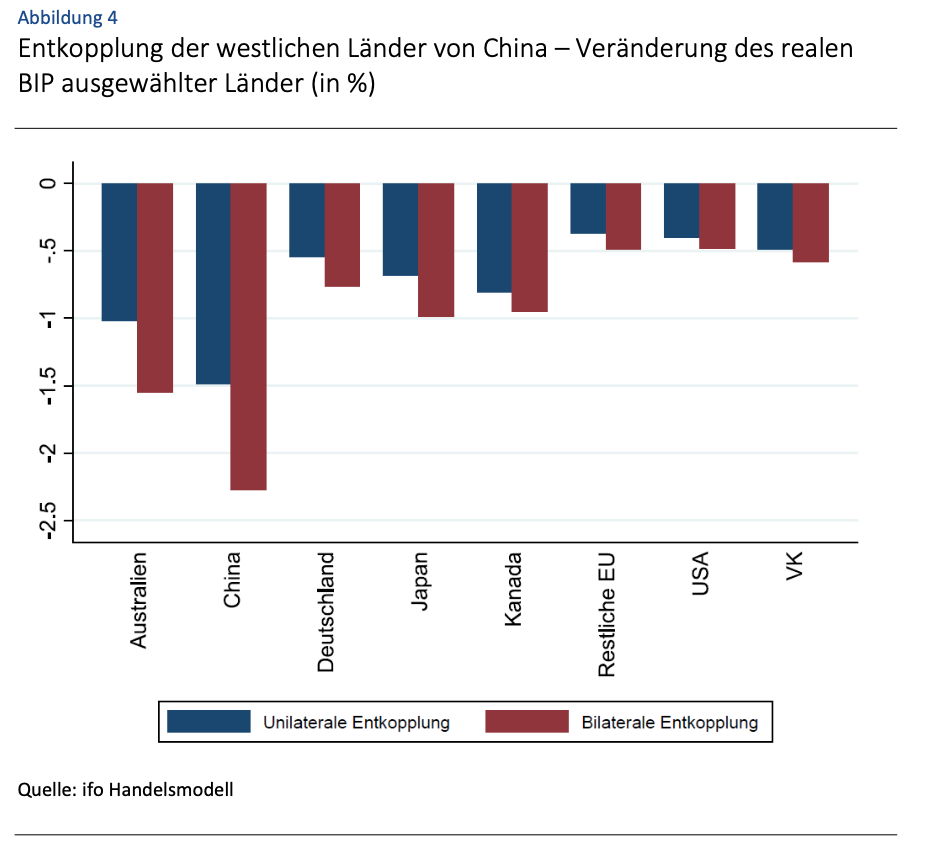
The chart above shows that, in this scenario, China itself would suffer most among the countries examined. That would offer little consolation to the German economy. It illustrates the study’s central conclusion,
“Every form of deglobalization leads to losses in value added.”
In the 2024 IfW paper What If, David Baqaee, Moritz Schularick, and their coauthors examine the abrupt formation of blocs with a complete interruption of trade between rival groups of countries. Their model accounts for the difficulty of replacing important intermediate inputs in the short run. For Germany, the immediate loss amounts to around 5 percent of real domestic consumption and investment opportunities, measured as gross national expenditure, or GNE. After adjustment over the long run, a loss of around 1 to 1.5 percent remains. Using the nominal ratio between these aggregates in 2025, an amount equal to 5 percent of GNE corresponds to approximately 4.9 percent of GDP.
“Our results provide grounds for arguing that Western countries should pursue a gradual course of de risking rather than wait for a much more costly ‘hard decoupling’ dictated by geopolitical events.”
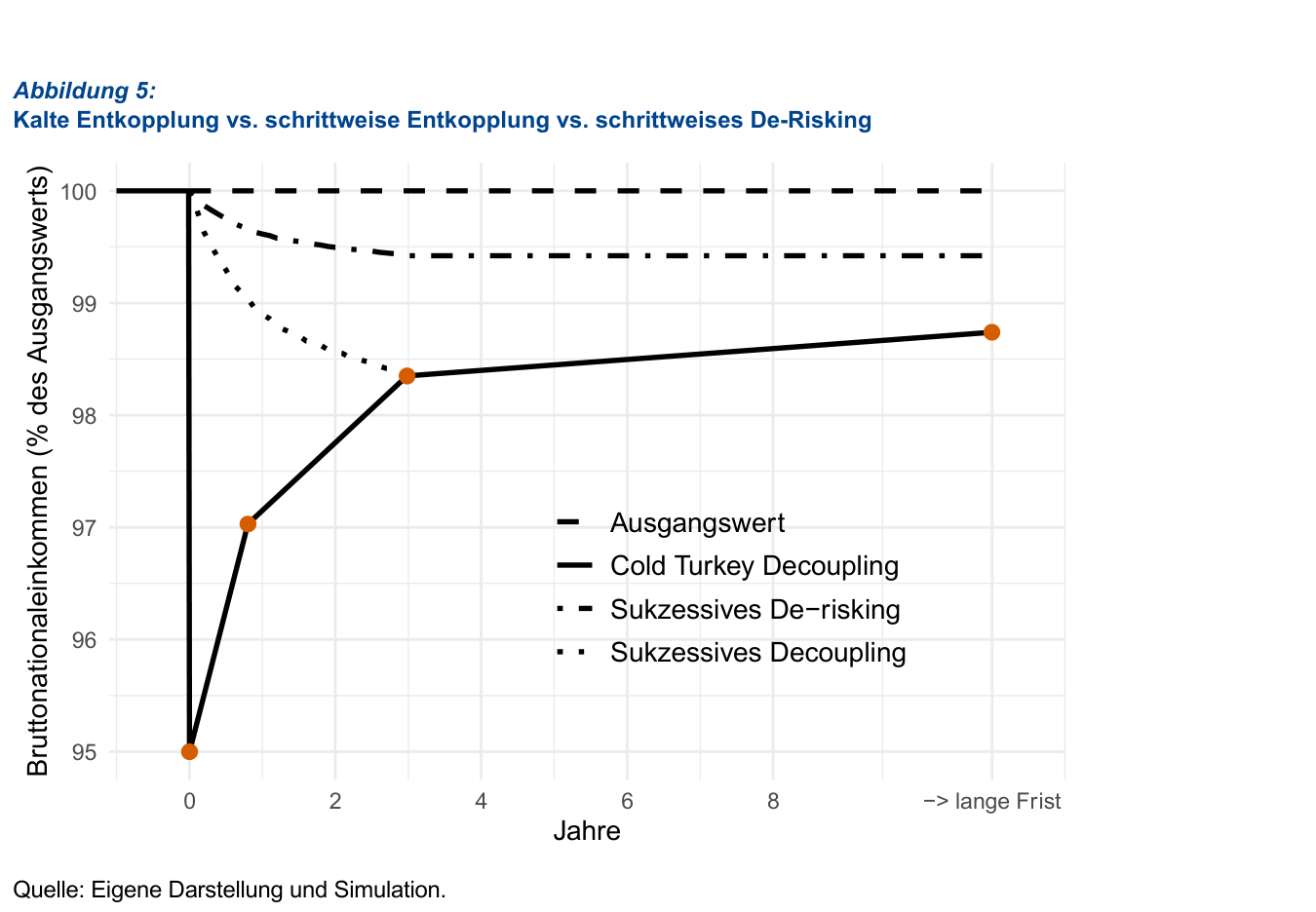
Figure 2. Different adjustment paths change the economic losses. Original Figure 5 from the IfW study, page 13. On the different labeling of the measure, see footnote 5.
The study describes the effects of a hard decoupling of Germany from China, the latest variant of the kill switch scenario, as “severe but not devastating.” Whether anyone in Germany should find that reassuring is open to serious doubt.
“The short term economic effects are comparable to the global financial crisis and the COVID pandemic, but these costs, though severe, are manageable.”
Here too, the figures in the study provide only a lower bound for the costs. The authors add that amplification through the business cycle could drive costs up to 6.5 percent of GNE. Chinese foreign direct investment in Germany and German foreign direct investment in China would also disappear. Further, unquantified losses would arise from the loss of strategic raw materials for which no substitutes are available.
We consider these dramatic figures. Where the authors draw the line at effects that finally qualify as “devastating” remains their secret. The reference to the global financial crisis and COVID hardly seems reassuring either.
Given Germany’s economic situation and growth prospects, we would certainly be prepared to use that adjective for a welfare loss of up to 6.5 percent, plus further negative effects from shortages of raw materials and disappearing foreign direct investment, resulting from a single policy measure.
In our article on the European kill switch, we examined the economic credibility of such a threat. This research makes the economic costs of policy decisions transparent. A welfare loss of up to 6.5 percent according to IfW, and a lasting loss of 0.81 percent in the level of GDP according to ifo, are costs of such magnitude that political credibility requires mentioning them alongside the corresponding proposed measure.
Before a conflict, Europe needs suitable alternative suppliers, materials qualified for use, and time to make the transition. Postponing those preparations allows an avoidable share of the eventual damage to develop. This form of inaction must also enter the calculation.
China’s industrial support also needs a complete accounting of returns
As we urge Germany and Europe to think more strategically about economic policy, we must also recognize that China’s economic policies come with costs of their own.
In their 2025 International Monetary Fund study Industrial Policy in China, Daniel Garcia-Macia, Siddharth Kothari, and Yifan Tao examine government support for Chinese companies and the resulting misallocation of capital and labor. The IMF researchers combine company data with a structural model. Their abstract identifies the central finding.
“Overall, factor misallocation from industrial policies is estimated to reduce domestic aggregate TFP by about 1.2 percent.”
This means a level of productivity across the economy that is approximately 1.2 percent lower. When adjustment in the capital stock is included, the authors put the possible gap in Chinese GDP at up to 2 percent. Here, the model measures the cost of the misallocation examined. Returns from knowledge spillovers or the correction of market failures fall outside this calculation. GDP that is 2 percent lower is substantial alongside a politically targeted growth range of 4.5 to 5 percent.
In his statement on the 2026 country report, China’s representative at the IMF primarily criticizes the extrapolation from publicly listed companies to the economy as a whole and the classification of certain tax, credit, and land benefits as industrial policy. His objections concern assumptions that are indeed decisive for the magnitude of the estimates.
Jiandong Ju, Hong Ma, Zi Wang, and Xiaodong Zhu model an additional channel of returns in Trade wars and industrial policy competitions, published in the Journal of Monetary Economics in 2024. Their calculation accounts for the way larger production volumes raise productivity in certain technology industries. Cheaper intermediate inputs also benefit customers abroad. With optimally designed Chinese support, their baseline calibration produces positive net effects for China and the United States.
“Given the strong external economies of scale in the ‘MIC 2025’ [Made in China 2025] sectors, China’s optimal uniform subsidy rate for these sectors is 7.96% (of sales). This policy results in a 2.47% increase in China’s welfare, and, surprisingly, a 0.44% increase in the US welfare as well.
… industrial subsidies, if properly implemented, may generate less distortion than import tariffs as a means of international competition.”
While the IMF calculates a loss from misallocation of up to 2 percent of China’s GDP, Ju and his colleagues estimate a welfare gain of almost 2.5 percent from subsidizing just one sector, high technology. They also demonstrate that the United States experiences a welfare gain from the Chinese policy. The same would presumably apply to the EU and Germany.
The size of these returns depends heavily on the assumed economies of scale. Under observed direct subsidies, the estimated effects are considerably smaller. A further IMF paper by Lorenzo Rotunno, Michele Ruta, and Priyam Verma, Industrial Policy and Trade Tensions in Strategic Sectors, brings together productivity gains, the costs of support, and international repercussions in 2026. For the combination of recent subsidies and tariffs examined, it finds a global welfare loss.
“As a result, global real income decreases by 0.3 percent under this subsidies-and-tariff scenario. These findings underscore the global efficiency costs of an uncoordinated subsidy-tariff spiral.”
This makes the policy accounting more concrete. Accessible Chinese machinery, materials, and technologies provide an economic benefit to Europe when their use raises its own productivity. At the same time, the loss of European capabilities can undermine future development and supply.
A complete assessment must examine both effects and identify the conditions under which the additional return remains positive.
American tariffs show the way toward calculating net effects
Europe is considering what it should do. A kill switch would be extremely expensive if it abruptly ended trade relations between the EU and China. China subsidizes high technology, benefiting at least its own economy considerably, and possibly those of other countries as well. Let us also look at the United States, which has lately specialized in tariffs as its principal instrument of trade conflict.
In The Return to Protectionism, Pablo Fajgelbaum and his coauthors analyze the American tariffs of 2018 and the retaliatory measures of trading partners. For American buyers of imported goods, they initially identify a burden of around $51 billion, equivalent to 0.27 percent of the GDP used as the reference measure. The summary then moves to the net effect.
“After accounting for tariff revenue and gains to domestic producers, the aggregate real income loss was $7.2 billion, or 0.04% of GDP.”
The calculation accounts for additional tariff revenues of $34.3 billion and income gains on the producer side of $9.4 billion. The remaining estimated net loss corresponds to 0.04 percent of GDP and is not statistically significant at conventional levels. After offsetting tariff revenues and producer gains, an estimated net loss of $7.2 billion remains. Its statistical uncertainty also allows for an aggregate effect of zero. For individual buyers, companies, and regions, the consequences were substantial.
Security also has an economic price
A complete accounting must capture how much security a given expenditure purchases. In Export Controls and the Economics of National Security, an October 2026 working paper from the National Bureau of Economic Research in the United States, referred to as NBER, Jingting Fan, Kyle Handley, and Nuno Limão combine export control data with a model of civilian and military production.
They compare unilateral American measures with coordinated controls by several supplier countries against a group of states that includes China and Russia. Their security indicator measures the relative purchasing power of American military spending against that of the affected states. The summary reports an increase of
“1 log point under multilateral controls but only 0.14 log points under unilateral controls, with both imposing a similar civilian real cost.”
At similar civilian welfare costs, coordinated controls have an effect on this indicator that is approximately seven times as large. The chart combines the security gain on the horizontal axis with civilian economic consequences on the vertical axis. It thus shows what a given expenditure delivers in the model.
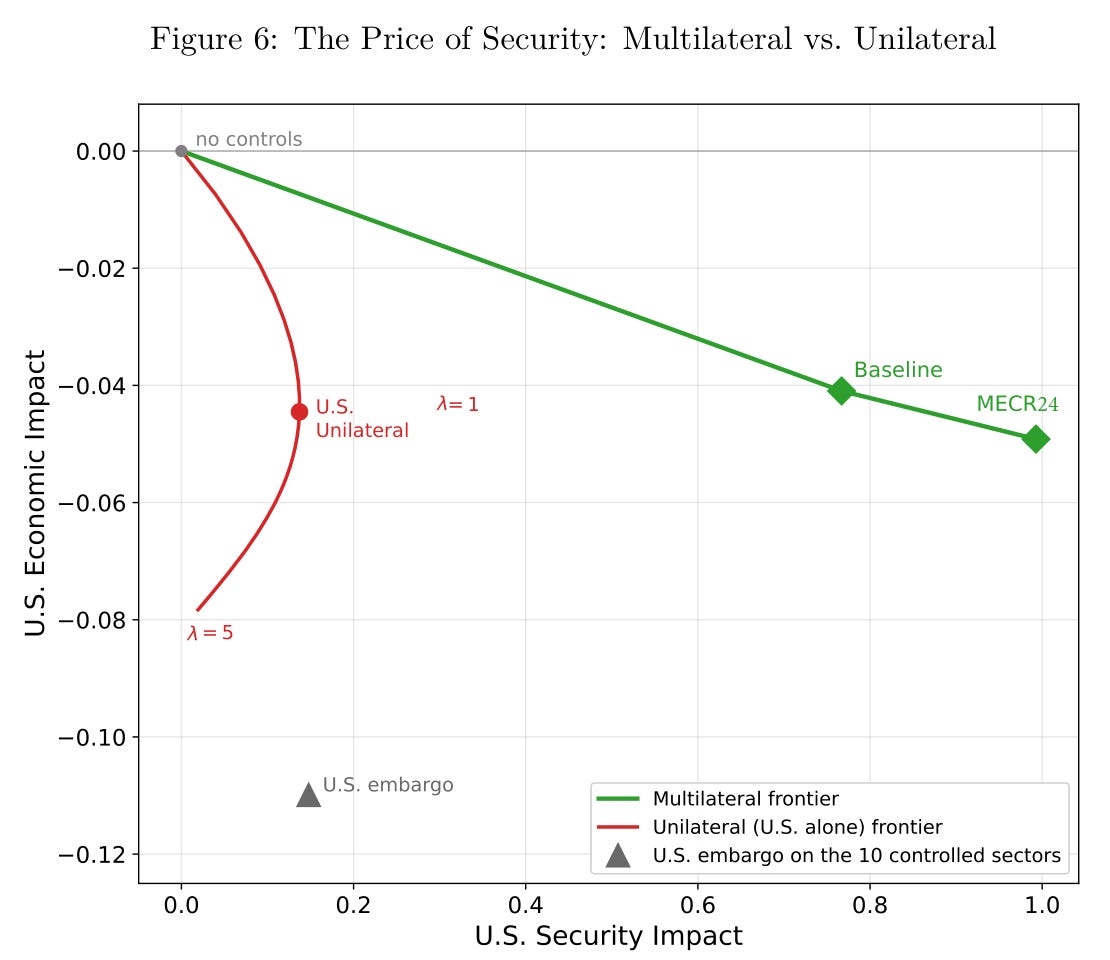
Figure 3. The economic price of different security effects. Original Figure 6 by Fan, Handley, and Limão, page 53. Both axes show logarithmic changes, not percentages of GDP.
The indicator measures an economic prerequisite for military capabilities. The importance society attaches to this gain remains a political judgment.
For European technology controls, this implies a concrete requirement. Their economic cost needs a demonstrable security gain, whose magnitude also depends on coordination with other supplier countries.
In The Fragmentation Paradox from 2026, Thierry Mayer, Isabelle Méjean, and Mathias Thoenig extend the calculation to include bargaining and the risk of military escalation. Their abstract describes the additional relationship their model captures.
“decoupling may reduce the diplomatic concessions needed to maintain peace but can paradoxically raise the risk of escalation”
In the model, trade ties between states influence the economic damage a war would cause. Asymmetric dependencies also change bargaining power and the price of diplomatic concessions. The economically sensible degree of integration therefore also depends on the underlying risk of conflict.
Reducing dependencies is expensive because it interferes with optimal market allocations. The more dependent states are on one another, the greater their incentive to avoid escalation. And escalation is expensive, as we have already seen.
Allowing dependencies to persist can therefore pay off twice for states. They save the costs of independence and also reduce the risk of escalation and the costs it would entail.
The investment agreement makes forgone opportunities concrete
This brings us back to our starting point, the question of whether engaging with China might be economically more beneficial than repeatedly raising the prospect of escalation.
In our latest article on cooperation and competition with China, we proposed a renewed European investment framework. The text of the Comprehensive Agreement on Investment, politically agreed at the end of 2020, has yet to enter into force. That agreement and today’s economic conditions therefore provide different starting points for a new assessment.
In their 2021 Bruegel analysis Is the European Union’s investment agreement with China underrated, Uri Dadush and André Sapir explained the benefits of the agreement.
“From an economic viewpoint therefore, the CAI is an important agreement, …
The CAI is far from a perfect deal, but from an economic viewpoint, it is an important agreement, and one worth having. …
The CAI opens new avenues for improving WTO rules on SOEs and subsidies, and for negotiating bilateral investment agreements that include market access.”
They identify limited additional market opening and emphasize the binding commitment under international law to openings that have already taken place. There are also obligations concerning state owned enterprises, technology transfer, and transparency. Reliable market access strengthens the basis on which a company finances development, training, and production for a market. Greater control over its own business changes the opportunities to protect knowledge and use returns.
Bruegel does not, however, quantify an aggregate economic gain. The authors also identify limitations, particularly transparency and consultation obligations for certain subsidies, which create no automatic obligation to reduce support. The economic value of a renewed agreement therefore depends on the additional, enforceable rights it creates.
In their 2024 paper Economic impacts of the EU China comprehensive investment agreement, Fan Zhai and Juzhong Zhuang present a quantitative model calculation. The publicly available summary describes an illustrative scenario in which the agreement increases openness to mutual foreign direct investment by 10 percent. The authors identify the income effect over the long run.
“These would generate a gain in the steady‐state gross national product (GNP) of 0.23% for China and 0.73% for the EU.”
The modeled opening scenario raises the EU’s gross national income over the long run by 0.73 percent. The study thus provides a concrete order of magnitude for the income that greater openness to investment could deliver.
The price of currently forgoing the CAI is thus given a concrete figure.
We therefore stand by our proposal to negotiate a renewed investment framework with China. The task for policymakers includes a concrete offer, the economic value of the commitments sought, and a credible route to enforcing them.
The status quo has a price too
The research provides ample approaches for beginning a program of work whose results can be tested. A range of policies toward China are conceivable as realistically implementable measures. We will explore options of this kind in future articles.
As soon as such trade measures and strategies appear realistic, they must be assessed quantitatively. In their costs and in their returns. They are also alternatives to the status quo. Delaying or failing to implement them, in turn, produces costs and revenues of its own.
The status quo has a price.
Not exercising is exhausting too. In the end, people are reluctant to accept that wheezing on the stairs comes from a lack of training, rather than the stairs themselves.
A missing China strategy costs money, for companies and for the economy as a whole. Once it is too late, it becomes all too easy to say that the jobs disappeared because of China’s pursuit of great power status and its industrial policy, and that they will not return.
Every measure left unadopted, every missing strategy, needs a price tag. In business and in politics.
Because doing nothing is a decision too. Every day.
