



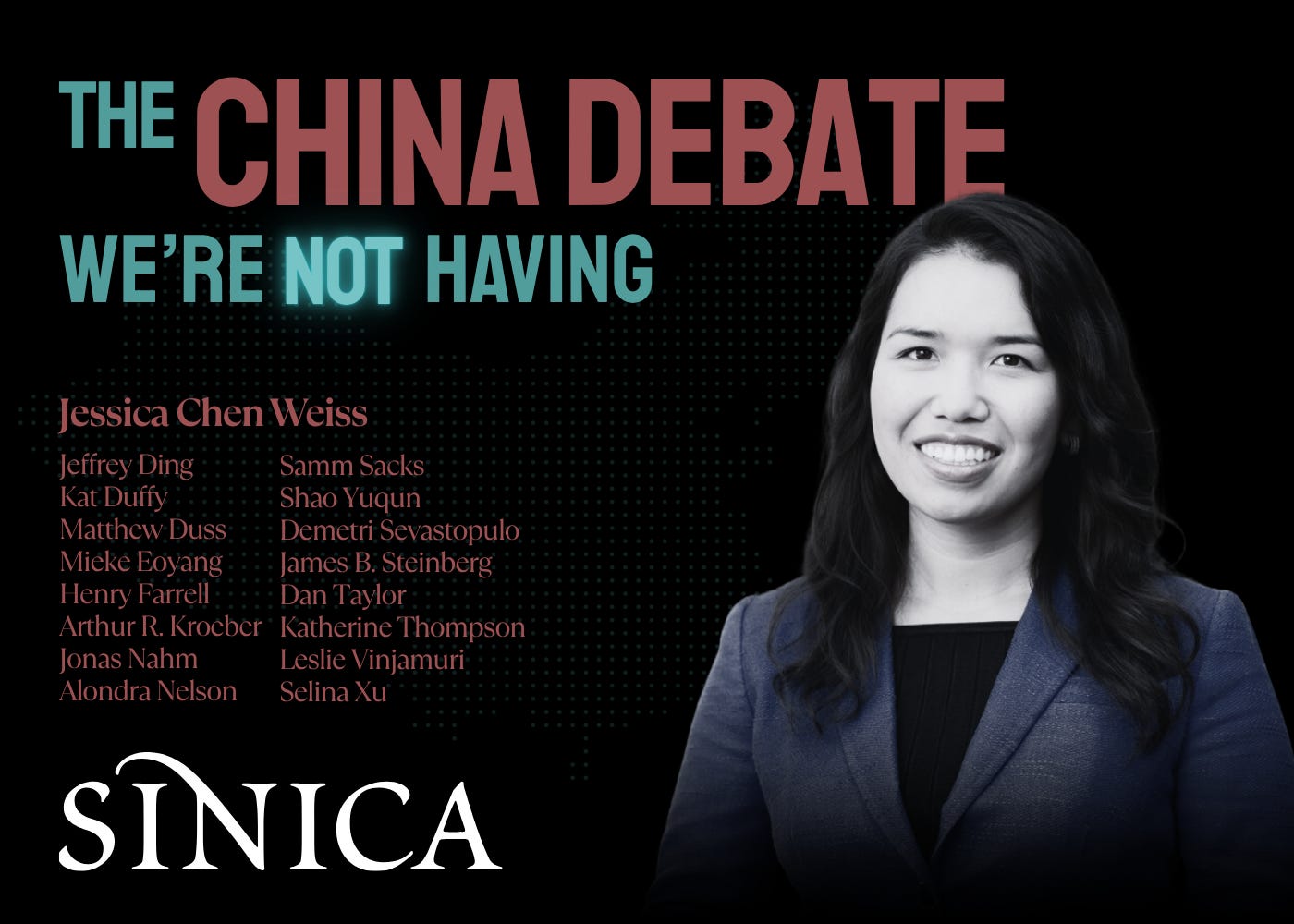
This week’s episode features audio from a day-long conference hosted by the Institute for America, China, and the Future of Global Affairs (ACF) at Johns Hopkins SAIS, held on April 3rd in Washington, DC. The conference, titled “The China Debate We’re Not Having: Politics, Technology, and the Road Ahead,” brought together a wide range of scholars, former officials, and analysts to interrogate some of the foundational assumptions underlying US policy toward China — a conversation I found compelling enough to share directly with Sinica listeners, with the full blessing of the organizers.
You’ll hear two segments in this episode.
Opening Remarks — Jessica Chen Weiss
ACF’s inaugural faculty director Jessica Chen Weiss opens the conference by framing its central provocation: that much of the prevailing US policy discourse assumes an intrinsically zero-sum competition with China, and that this assumption has not been adequately examined. She argues for a more rigorous, evidence-based conversation — one that takes seriously the possibility that American and Chinese interests are competitive but not necessarily adversarial, and that may even leave room for complementarity in some domains. She previews the day’s three thematic sessions — on what China wants, what the United States wants, and the stakes of technological and AI rivalry — and situates the whole enterprise in what she describes as a hinge moment in world history.
Session 1: What China Wants
Moderated by Demetri Sevastopulo of the Financial Times, the first panel takes up the deceptively simple question of what China is actually trying to achieve on the world stage — and whether its ambitions are as expansive as much US policy discourse assumes.
Jessica Chen Weiss argues that China’s core objectives remain relatively modest and sovereignty-focused: security, development, and legitimacy within an order long dominated by the United States. She pushes back on the idea that China is eager to assume the burdens of global leadership, noting that Chinese interlocutors are acutely aware of the domestic overextension that has constrained American power. Sevastopulo coins — with Weiss’s amusement — the term “China-first” to describe Beijing’s orientation.
Dan Taylor, drawing on his decades in the Defense Intelligence Agency, urges the audience to take Chinese leadership statements seriously rather than projecting worst-case intentions onto them. He notes that Beijing still sees itself as a developing nation with enormous domestic work ahead, and that its articulated goals leave considerable room for interpretation before one arrives at the conclusion that China seeks to displace the United States as global hegemon.
Arthur Kroeber adds an economic dimension, tracing how China’s export-driven model has generated massive global surpluses — and why the resulting tensions with trading partners are, in his view, a structural problem rather than evidence of strategic malice. He argues that much of what looks like geopolitical aggression is better understood as the consequence of an economic model operating at enormous scale with insufficient domestic demand to absorb its own output.
Shao Yuqun, speaking from her perch at the Shanghai Institutes for International Studies, offers the most pointed challenge to the panel’s relatively sanguine framing. She argues that the United States’ own behavior — erratic policy, withdrawal from multilateral commitments, and the disruptions of the Trump era — has itself destabilized the order that American strategists claim to be defending. She is measured but direct, and her presence gives the conversation a texture that too many Washington panels lack.
The discussion ranges across China’s Iran diplomacy, the prospects for a US-China summit, the question of whether Beijing is exploiting Trump-era tensions to deepen ties with traditional US allies, and — in a lively closing exchange — who the next generation of Chinese leadership looks like (with Kroeber’s deadpan answer, “Xi Jinping,” getting the biggest laugh of the session).
Guests:
Jessica Chen Weiss, David M. Lampton Professor of China Studies, Johns Hopkins SAIS; Inaugural Faculty Director, ACF
Dan Taylor, Adjunct Researcher, Institute for Defense Analyses; Senior Fellow, Johns Hopkins SAIS ACF
Arthur Kroeber, Founding Partner, Gavekal Dragonomics
Shao Yuqun, Director, Institute for Taiwan, Hong Kong & Macao Studies, Shanghai Institutes for International Studies
Moderator: Demetri Sevastopulo, US-China Correspondent, Financial Times
Remaining sessions from the conference — on what the United States wants, tech rivalry and competing visions of the future, and a fireside chat between Henry Farrell and Alondra Nelson on the AI race reconsidered — will be released over the coming weeks.


