


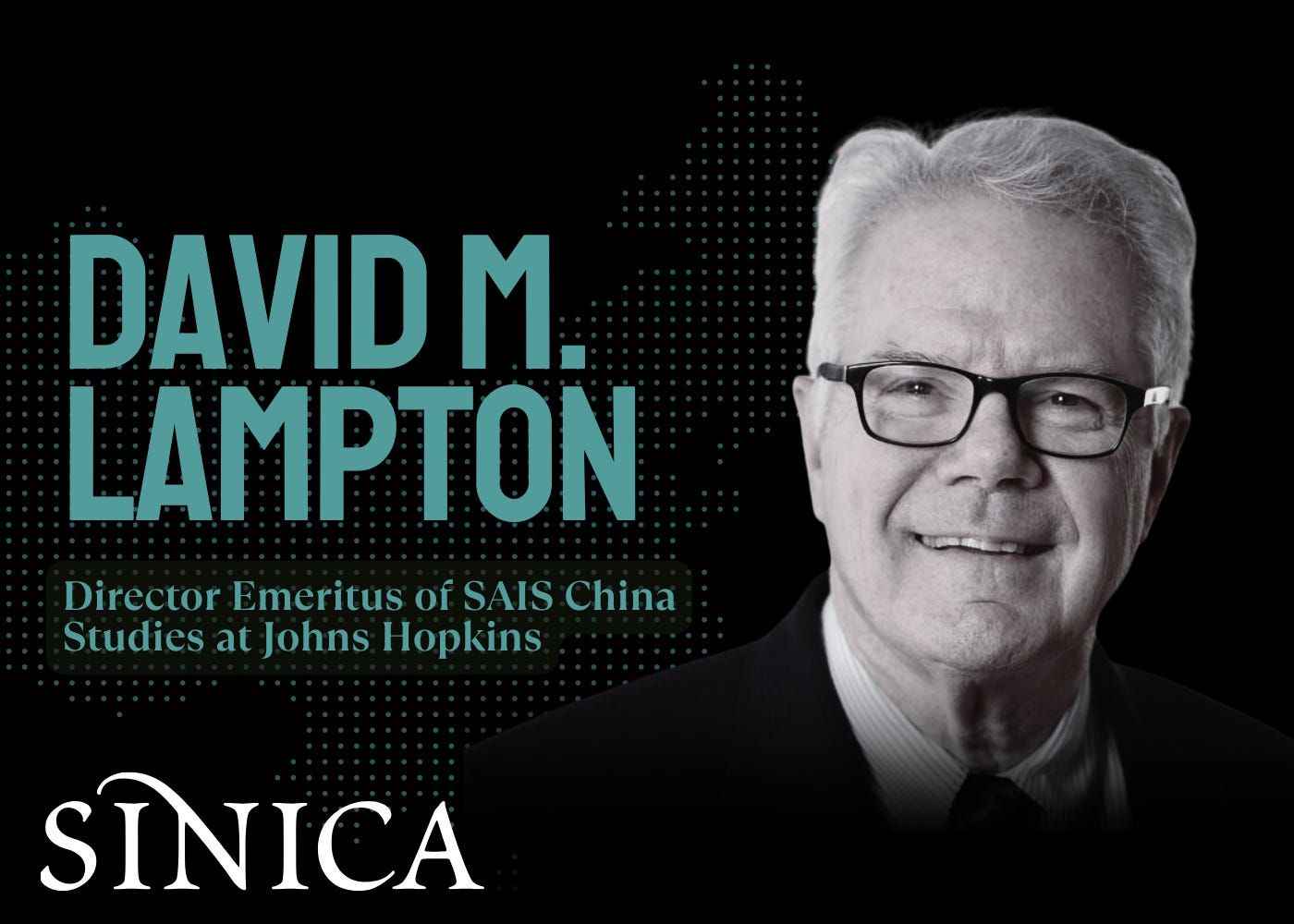
David M. Lampton—“Mike”—is one of America’s most distinguished scholars of U.S.–China relations, director of China Studies Emeritus at Johns Hopkins SAIS, and the author of landmark works on Chinese politics and foreign policy. He joins me this week to discuss a striking new Foreign Affairs essay he co-authored with the eminent Chinese international relations scholar Wang Jisi of Peking University: “America and China at the Edge of Ruin: A Last Chance to Step Back from the Brink.”
Written against the backdrop of President Trump’s planned visit to China (and before the outbreak of the U.S.–Israeli war on Iran), the essay is less a routine policy paper than an urgent intervention — two veteran scholars, one American and one Chinese, throwing a rope across a widening chasm. They argue that strategic rivalry has become self-reinforcing, that the greatest danger is no longer deliberate conflict but accidental war driven by miscalculation and escalation dynamics neither side fully controls, and that a rare, narrow window for “a new normalization” may now be opening.
We range across the essay’s boldest claims — on Taiwan as the unlikely starting point for stabilization, the corrosive logic of securitization, the ghost of the first Cold War, and the looming talent crisis in serious China studies — in a meaty, substantive conversation.
3:39 How the Lampton–Wang Jisi collaboration came together
6:31 The division of labor and the essay’s unified voice
9:15 Wang Jisi’s cognitive empathy and his unusual depth of American understanding
13:57 The essay’s emotional register: veteran scholars and the specter of another Cold War
16:32 From reassurance to deterrence—and why deterrence keeps getting harder to maintain
25:02 Mirror-image threat narratives as self-fulfilling operating systems
32:08 Securitization, the “one-way ratchet,” and whether economic interdependence can be rebuilt
39:23 Accidental war: what has changed since Hainan 2001 and Belgrade 1999
44:16 Where the most damaging choices were made—China’s Ukraine pivot, U.S. arms-control withdrawals
51:29 The window of opportunity: Trump’s China visit, the 4th Plenum, and post-Iran recalculation
1:01:30 Taiwan as the counterintuitive starting point for stabilization
1:10:03 Collapse fantasies, hubris, and the Pearl Harbor danger of “act now or lose the window”
1:13:14 The looming China-talent crisis and the future of the field
Paying It Forward
Mike highlights Rosie Levine, executive director of the U.S.–China Education Trust, where she is leading a major new initiative to expand serious American scholarship in China and encourage Chinese institutions to open their doors wider to foreign researchers and students.
Recommendations
Mike: The Raider by Stephen R. Platt (Knopf, 2025) — a biography of Major Evans Carlson, the swashbuckling Marine officer who trained with Chinese Communist forces in the 1930s, befriended Zhu De, brought the word “gung-ho” into English, and died in 1947 just in time to miss both the PRC’s turn away from liberty and McCarthyism’s persecution at home.
Kaiser: “How China Learned to Love the Classics,” a New Yorker piece by Chang Che on the remarkable renaissance of interest in Greco-Roman philosophy and literature in contemporary China — and what it says about the world we now inhabit.


