


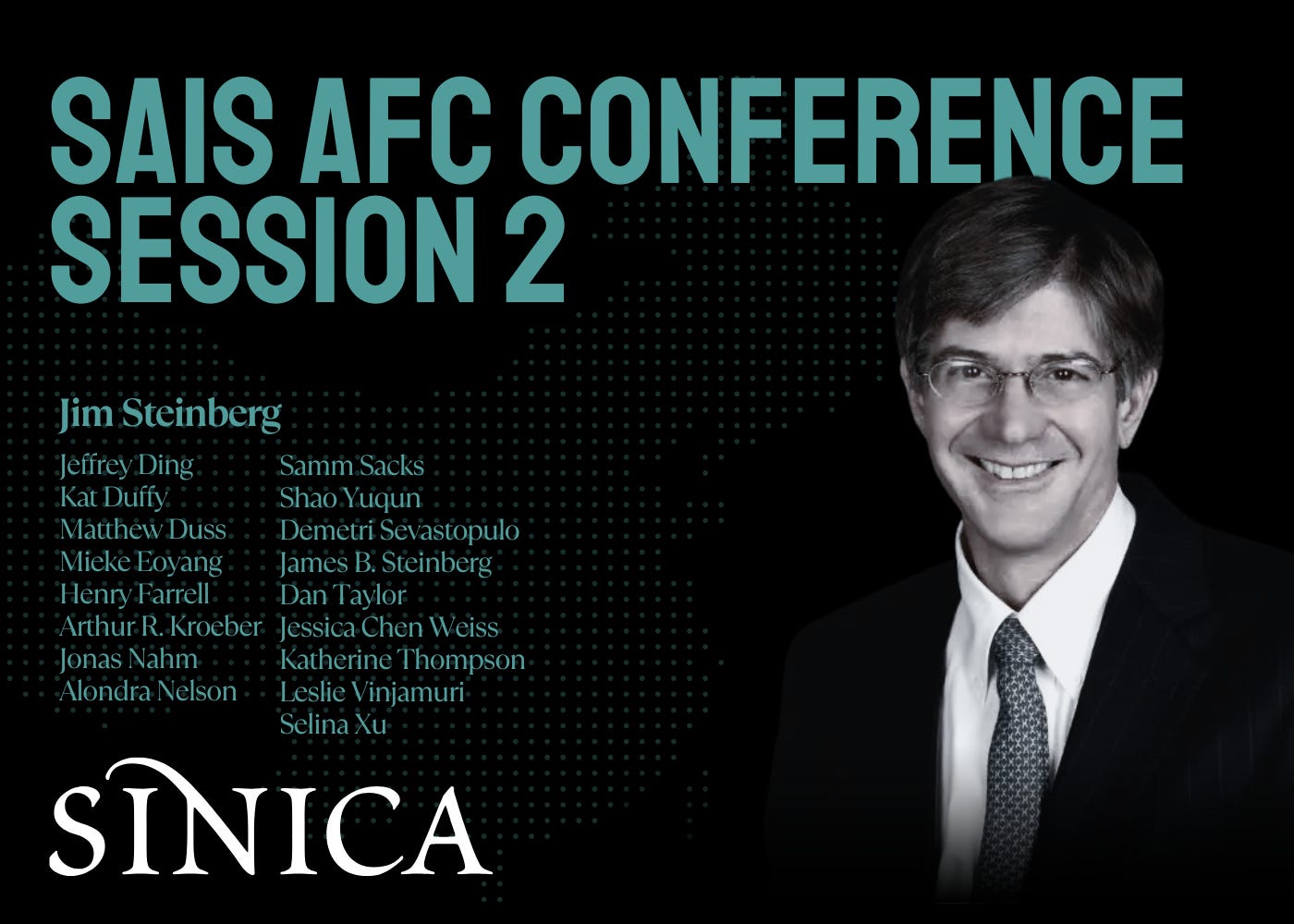
This week I’m sharing the next installment from the terrific day-long conference convened by the Institute for America, China, and the Future of Global Affairs (ACF) at Johns Hopkins SAIS on April 3rd in Washington — “The China Debate We’re Not Having: Politics, Technology, and the Road Ahead.” Last week’s episode featured Jessica Chen Weiss’s opening remarks and the first panel, “What China Wants.” This week, I’ve got the companion panel — “What Does the United States Want?” — which I think pairs beautifully with that first session, and which takes up a question that’s arguably harder and more uncomfortable to answer.
The panel is moderated by SAIS Dean James Steinberg, who served as Deputy National Security Advisor in the Clinton administration and Deputy Secretary of State under Obama — and who keeps this moving with real sharpness. He’s joined by Matt Duss, Executive Vice President at the Center for International Policy, who starts things off with a bracing observation: the United States does not know what it wants. The old foreign policy consensus has shattered, he argues, and neither the Trump administration nor the Democratic establishment has produced a coherent replacement. He locates the most interesting thinking in the progressive wing of the Democratic Party, where he hopes the 2028 primary will force some of these hard questions into the open.
Katherine Thompson, a Senior Fellow at the Cato Institute who previously served in the Pentagon and on Capitol Hill, brings a military-strategic lens. She makes a sharp case that the new National Defense Strategy, for all its imperfections, at least opens the door to an honest conversation about trade-offs — something Washington has been allergic to. If you’re going to prioritize deterrence in the Indo-Pacific, she argues, you have to actually give things up elsewhere, and the Iran situation is making that tension impossible to ignore.
Jonas Nahm, the Andrew W. Mellon Associate Professor at SAIS who served in the Biden administration, reframes economic competition with China in refreshingly concrete terms. Rather than abstract great-power framing, he identifies three specific buckets — affordability and energy, technological catch-up, and manufacturing competitiveness — where Chinese capacity could actually help solve American problems, if we had the political imagination to let it.
And Leslie Vinjamuri, president and CEO of the Chicago Council on Global Affairs, brings striking new polling data showing a 40-percentage-point swing in American favorability toward China since 2024 — now at 53 percent — driven largely by Democrats but with movement among Republicans too. She situates this in the fading of pandemic-era hostility and the absence of sustained anti-China rhetoric from the current administration, and adds an invaluable perspective on how utterly confused America’s allies are about what Washington actually expects of them.
The conversation ranges across Taiwan and strategic ambiguity, whether allies arming up in the Indo-Pacific helps or hurts, the collapse of U.S. credibility on human rights, the future of dollar dominance, and whether the 2028 election will finally force a reckoning with these questions. It’s a rich, candid discussion — and a reminder that the hardest debates in U.S.-China policy may not be about China at all.
Panelists:
— Matt Duss, Executive Vice President, Center for International Policy
— Katherine Thompson, Senior Fellow, Cato Institute
— Jonas Nahm, Andrew W. Mellon Associate Professor, Johns Hopkins SAIS
— Leslie Vinjamuri, President and CEO, Chicago Council on Global Affairs
Moderator: James Steinberg, Dean, Johns Hopkins School of Advanced International Studies


