


This week on Sinica: Spanish Prime Minister Pedro Sánchez wrapped up his fourth visit to China in as many years last week, and this one may be the most consequential yet. It comes at a moment when Spain has emerged, almost improbably, as the most outspoken voice in Europe challenging the direction of American foreign policy — closing its airspace to U.S. military aircraft involved in the war in Iran, denying Washington the use of the Rota and Morón bases, recognizing Palestine, and getting expelled from the U.S.-led Gaza Coordination Center for its “anti-Israel obsession.” Against that backdrop, Sánchez delivered a remarkable speech at Tsinghua University — a speech I wrote about in detail on the Sinica Substack (PM Pedro Sánchez’s Tsinghua Speech: A Masterclass in Diplomatic Rhetoric) — defending multilateralism, calling the EU-China trade deficit unsustainable, and naming China “a country rebuilding its greatness.”
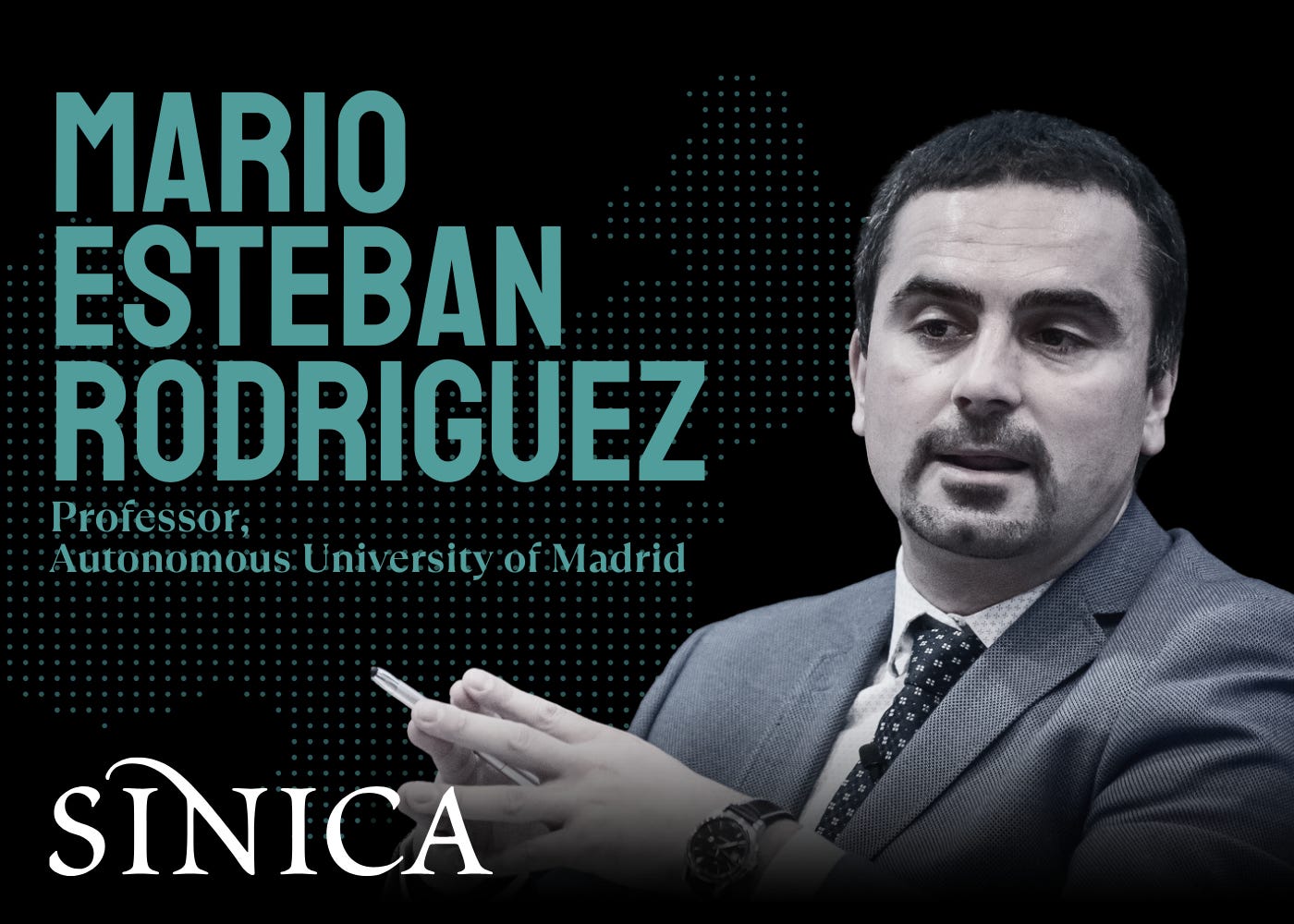
To help make sense of it, I’m joined by Mario Esteban Rodríguez, full professor at the Autonomous University of Madrid, director of its Center for East Asian Studies, and senior fellow at the Elcano Royal Institute. Mario is the scholar most frequently quoted in Spanish and European media coverage of Spain-China relations, and the author most recently of China’s Vertical Multilateralism and the Global South (Routledge, 2026). We discuss whether Sánchez is running an updated Merkel playbook or something qualitatively new, how much of the pivot is really about Trump, the sectoral politics of EVs and Iberian pork, the Chery plant in Barcelona, Spain’s role as a gateway to Latin America, and whether Madrid is now a trailblazer for a broader European — and transatlantic — reorientation toward Beijing.
06:33 — Sánchez’s China strategy: pragmatism, consistency, and political capital
08:35 — Domestic politics: the PSOE–PP consensus, Vox, and the regional contradiction
12:40 — Merkel’s playbook vs. Sánchez’s: COVID, Ukraine, and the macroeconomic imbalance
15:55 — The Tsinghua speech: Matteo Ricci, multipolarity, and the human rights omission
28:17 — The Trump factor: Iran, Gaza, and the limits of overestimating the American effect
35:48 — Trade, EV tariffs, pork, and Chinese investment in Spain (the Chery plant in Barcelona)
47:04 — Agricultural constituencies and the paradox of Vox voters who benefit from China trade
49:01 — Spain’s influence in Brussels and the conditions for other member states to follow
53:09 — Spain as gateway to Latin America, and the wider European (and Canadian) turn to Beijing
Paying it Forward: The European Think-Tank Network on China (ETNC) — a network providing country-specific insights on EU member states’ approaches to China, including the granular differences and nuances that non-European analysts often miss.
Recommendations
Mario: A trip, rather than a book — New Zealand, which he’s visiting this summer with his family to mark the 25th anniversary of the release of The Fellowship of the Ring. A nod to his love of Tolkien and tabletop role-playing games (conducted, he is careful to note, in his own basement — not his parents’).
Kaiser: CONG — a new large-format magazine published out of Hong Kong (the title is pronounced Kong, though its ambiguous Pinyin-like spelling invites a second reading), now preparing its third issue. Beautifully produced on glossy and textured paper, with broad coverage of the art, culture, and design scene across East and Southeast Asia. Check it out online here: https://www.serakai.studio/cong


