



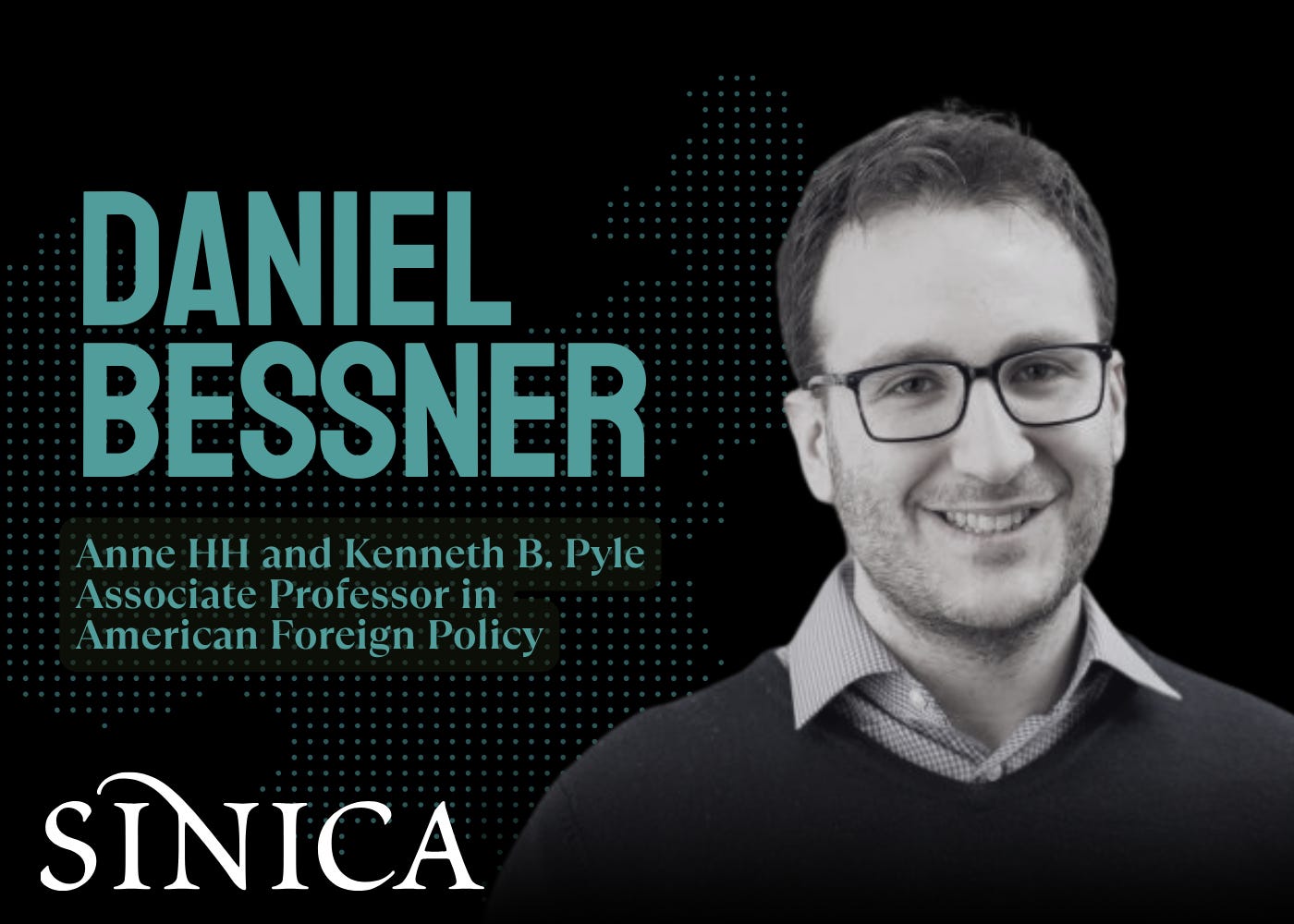
This week on Sinica, I speak with Daniel Bessner, the Anne H.H. and Kenneth B. Pyle Assistant Professor in American Foreign Policy at the Henry M. Jackson School of International Studies at the University of Washington and co-host of the American Prestige Podcast. If you follow U.S.-China relations even casually, you can’t avoid hearing that we’re in a new Cold War — it’s become a rhetorical reflex in D.C., shaping budgets, foreign policy debates, media narratives, and how ordinary Americans think about China.
But what does it actually mean to call something a Cold War? To think clearly about the present, I find it helps to go to the past, not for simple analogies but to understand the intellectual and ideological machinery that produced and now sustains a Cold War mentality. Danny has written widely about the architecture of American power, the rise of the national security state, and the constellation of thinkers he calls Cold War liberals who helped define the ideological landscape of U.S. foreign policy. We explore how Cold War liberalism reshaped American political life, how the U.S. came to see its global dominance as natural and morally necessary, why the question of whose fault the Cold War was remains urgent in an age of renewed great power rivalry, the rise of China and anxiety of American decline, and what it would take to imagine a U.S.-China relationship that doesn’t fall back into old patterns of moral binaries, ideological panic, and militarized competition.
6:20 – Danny’s background: from Iraq War politicization to studying defense intellectuals
11:00 – Cold War liberalism: the constellation of ideas that shaped U.S. foreign policy
16:14 – How these ideas became structurally embedded in security institutions
22:02 – The Democratic Party’s destruction of the genuine left in the late 1940s
27:53 – Whose fault was the Cold War? Stalin’s sphere of influence logic vs. American universalism
31:07 – Are we facing a similar decision with China today?
34:23 – The anxiety of loss: how decline anxiety distorts interpretation of China’s rise
37:54 – The new Cold War narrative: material realities vs. psychological legacies
41:21 – Clearest parallels between the first Cold War and emerging U.S.-China confrontation
44:33 – What would a pluralistic order in Asia actually look like?
47:42 – Coexistence rather than zero-sum rivalry: what does it mean in practice?
50:57 – What genuine restraint requires: accepting limits of American power
54:14 – The moral imperative pushback: you can’t have good empire without bad empire
56:35 – Imperialist realism: Americans don’t think we’re good, but can’t imagine another world
Paying it forward: The Quincy Institute for Responsible Statecraft and Responsible Statecraft publication; The Trillion Dollar War Machine by William Hartung and Ben Freeman
Recommendations:
Danny: Nirvana and the history of Seattle punk/indie music (forthcoming podcast project)
Kaiser: Hello China Tech Substack by Poe Zhao (hellochinatech.com)


