


The summit in Beijing produced a “constructive strategic stability” framework and a warming of tone between the two presidents. But heads of state can announce a multi-year horizon; somebody else has to operationalize it. Does the United States have the people — the linguists, the regional experts, the long-haul institution-builders — to do that work?
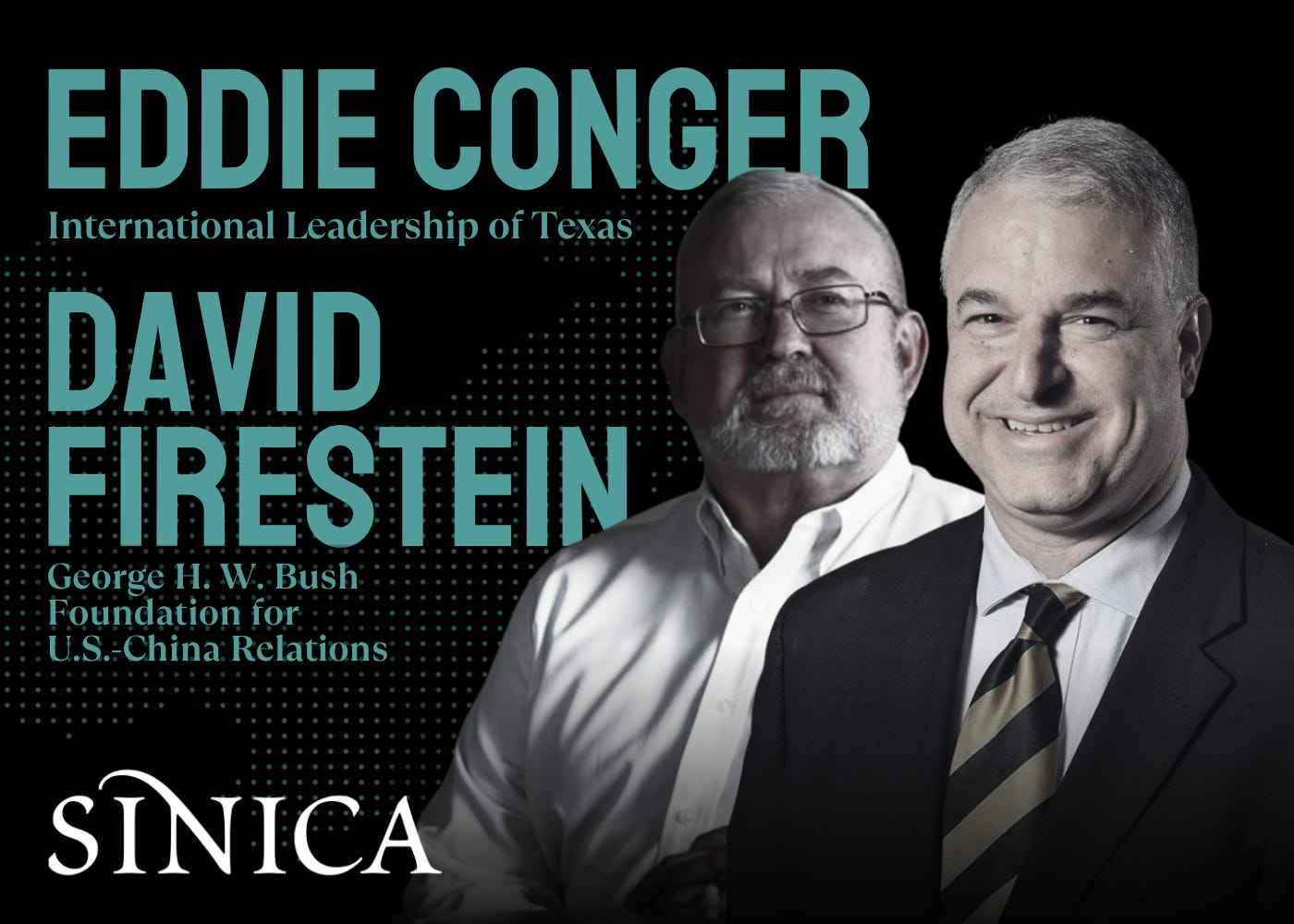
This week, I chatted with two Texans answering that question from very different directions. David Firestein is the inaugural president and CEO of the George H.W. Bush Foundation for U.S.-China Relations in Houston. A career State Department officer who served four administrations and spent five years in Beijing, he’s one of the few Americans concurrently affiliated with both a Republican and a Democratic presidential legacy institution. Eddie Conger is a retired Marine major and the founder and superintendent of International Leadership of Texas (IL Texas) — a public charter network of 26 campuses serving 26,000 K-12 students and now the largest K-12 Chinese language program in the country. In January, IL Texas became the first-ever K-12 recipient of the Bush China Foundation’s George H.W. Bush Award for Educational Excellence in U.S.-China Relations, joining past honorees including Jimmy Carter and Henry Kissinger.
The conversation tackles what David calls the Texas paradox: the same state that just forced its cities to dissolve their sister-city ties with China, that pioneered the closure of Confucius Institutes, and that has restricted Chinese land purchases is also where the country’s deepest K-12 Mandarin pipeline is taking root — and where the most institutionally Texan China foundation has chosen to plant its flag. David and Eddie talk through engagement honestly (no straw-man Jeffersonian-democracy fantasies), the erroneous strategic assumptions undergirding U.S. China policy, what real national-language capacity would look like operationally, what they each saw in the Trump–Xi summit, and what 5,000 IL Texas graduates are already doing in the world.
05:40 — Eddie’s path: Marine infantryman to fifth-grade math teacher to the country’s largest K-12 Mandarin program
09:12 — David on when the Nixon-through-Obama engagement consensus broke (fall 2017) and how the lexicon shifted
13:30 — Engagement honestly defined: what its architects actually believed vs. the Jeffersonian-democracy straw man
18:30 — The Texas paradox: HB 128, sister cities, Confucius Institutes — and the country’s biggest Mandarin program in the same state
31:26 — Texas business, Tim Dunn, faith, and the gap between political rhetoric and where Texans actually are
41:54 — The Defense Department safety/security story: when one Chinese word ate an entire bilateral agreement
46:16 — David’s six (or seven) erroneous strategic assumptions: China doesn’t want to be us, and it has benefited more than anyone from the current order
52:28 — What real national-language capacity would actually look like: NSLI, WALARA, and why the pipeline still runs through one Marine major in Texas
01:06:07 — Reading the Beijing summit: the warmth, the “constructive strategic stability” framing, and whether Trump’s Taiwan call could blow it all up
01:17:10 — Where 5,000 IL Texas graduates are now — White House interns, service academies, doctors, entrepreneurs, and one high-schooler who pulled a stranger out of the surf
Paying it Forward
Eddie:
Carlos Carrasco; Emily, who is heading to Taiwan this fall on a one-year high-school program; and another student bound for the University of Texas at Austin who will be sent to South Korea for a semester as a freshman — a rarity at UT. And he closes with Miles, a high-school senior and Marine scholarship recipient who, just weeks ago at a national competition in Florida, heard someone screaming for help in the ocean, called for a boogie board, and swam out to save a drowning swimmer while a crowd of adults stood on the beach. “Others before self,” as Eddie puts it — the IL Texas mission statement made flesh.
David:
Frank Zhou, who just graduated from Harvard and chaired the Harvard College China Forum; Selina Gong, a recent graduate of the Harvard Kennedy School involved in its annual China conference; and Dean Dai, a recent graduate of Columbia’s SIPA who has been deeply involved in many of the most significant student-run China conferences in the country — and who, as it turns out, was one of the organizers of the University of Chicago U.S.-China Economy and Business Summit where Kaiser spoke earlier this month.
Recommendations:
Eddie: John Pomfret, The Beautiful Country and the Middle Kingdom: America and China, 1776 to the Present (Henry Holt, 2016)
David: Stephen Roach, Accidental Conflict: America, China, and the Clash of False Narratives (Yale, 2022)
Kaiser: David Grann, The Wager: A Tale of Shipwreck, Mutiny and Murder (Doubleday, 2023)
Also mentioned: Stephen R. Platt, The Raider: The Untold Story of a Renegade Marine and the Birth of U.S. Special Forces in World War II (Knopf, 2024)


