


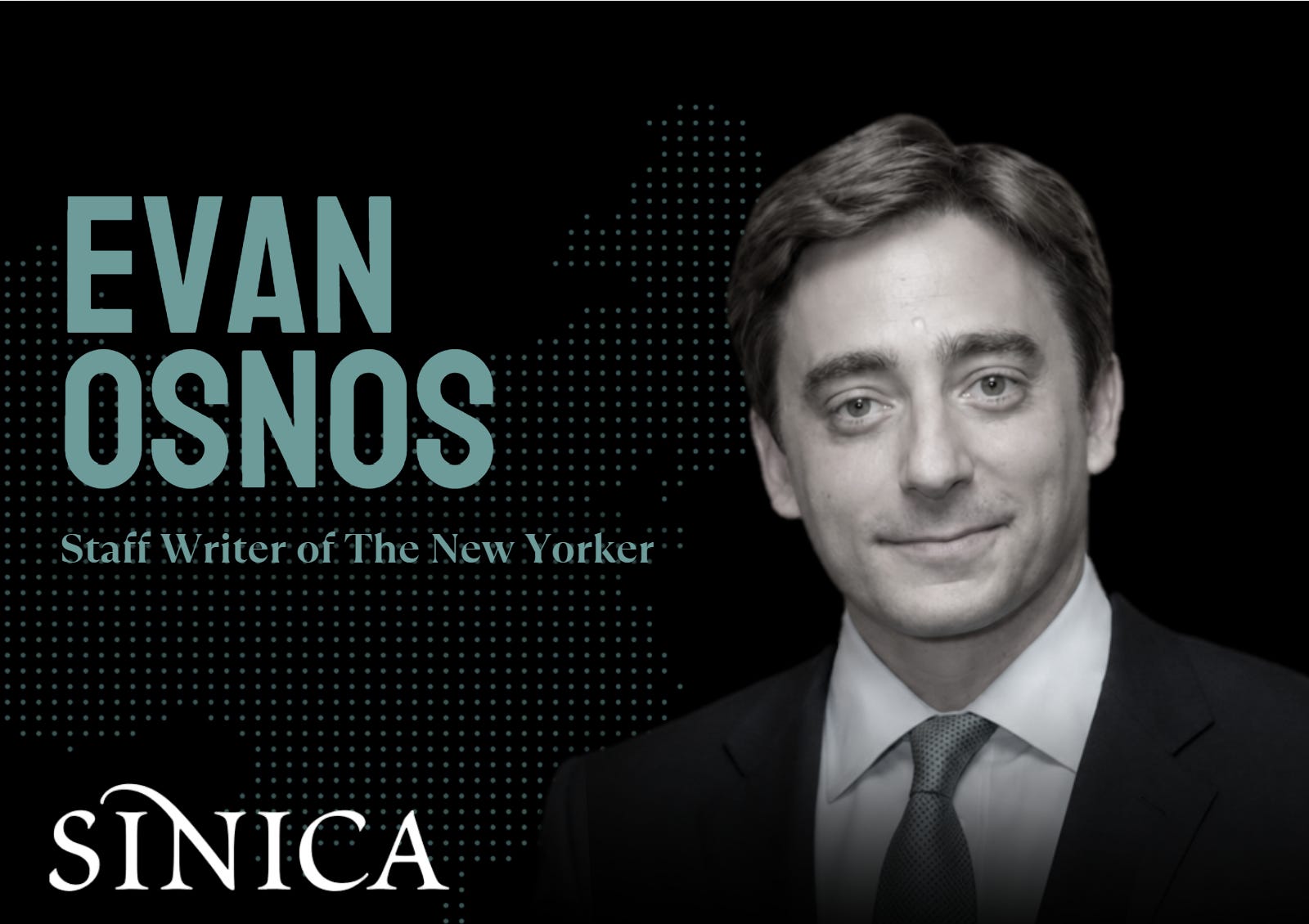
This week on Sinica, I welcome back Evan Osnos of The New Yorker, whose marvelous new essay, “The Future, Made in China,” chronicles a tech-focused return trip to Beijing, where he lived from 2005 to 2013 — first for the Chicago Tribune, then as The New Yorker’s China correspondent. Evan is the author of Age of Ambition: Chasing Fortune, Truth, and Faith in the New China, which won the National Book Award, as well as Wildland: The Making of America’s Fury and The Haves and Have-Yachts.
His essay is far more than another breathless account of China’s advances in robotics and electric vehicles. It’s a meditation on what China’s technological ascent means for the United States, for how both societies are organized, and for the rest of us, whose futures increasingly seem to be wagered by two small circles of powerful men in Beijing and Washington. We talk about the Xiaomi Hyperfactory, “Chinamaxxing,” the export control debate, and the deeper contest Evan identifies: not democracy versus authoritarianism, but humanism versus scientism.
3:04 – Walking Beijing’s streets again: quieter, richer, more surveilled
11:26 – The Xiaomi Hyperfactory: choreography, awe, and what’s actually real
18:10 – Doomed to coexist: Evan’s message for the American reader
24:15 – Schrödinger’s China: joke or juggernaut?
27:16 – The limits of knowability in an increasingly opaque system
31:56 – Threat narratives vs. “Chinamaxxing”: America’s two China conversations
43:20 – “Thank Trump”: America’s self-inflicted wounds
47:29 – Revisiting the Sullivan doctrine and export controls
53:10 – Mankind 2000: humanism, scientism, and rival oligarchies
1:02:48 – Convergence: arriving at dystopia from opposite directions
1:07:21 – Self-strengthening redux: Levenson and America’s meum-verum gap
1:17:53 – The other Sputnik moment: the backlash against tech oligarchy
Paying It Forward
Yi-Ling Liu, author of The Wall Dancers: Searching for Freedom and Connection on the Chinese Internet — Evan admires how her work grapples with the competition between scientism and humanism across national borders.
Chang Che, who writes for The New Yorker and The Guardian — watching China’s technological developments up close, “creating history in real time.”
Recommendations
Evan: How to Rule the World: An Education in Power at Stanford University by Theo Baker — the youngest-ever Polk Award winner on how a rising generation at Silicon Valley’s feeder school perceives its opportunities and obligations. Also True Grit by Charles Portis — splendid, sentence-savoring dialogue.
Kaiser: Butcher’s Crossing by John Williams, author of Stoner — a Western with the same sentence-level craft; for fans of Melville and Cormac McCarthy.


