


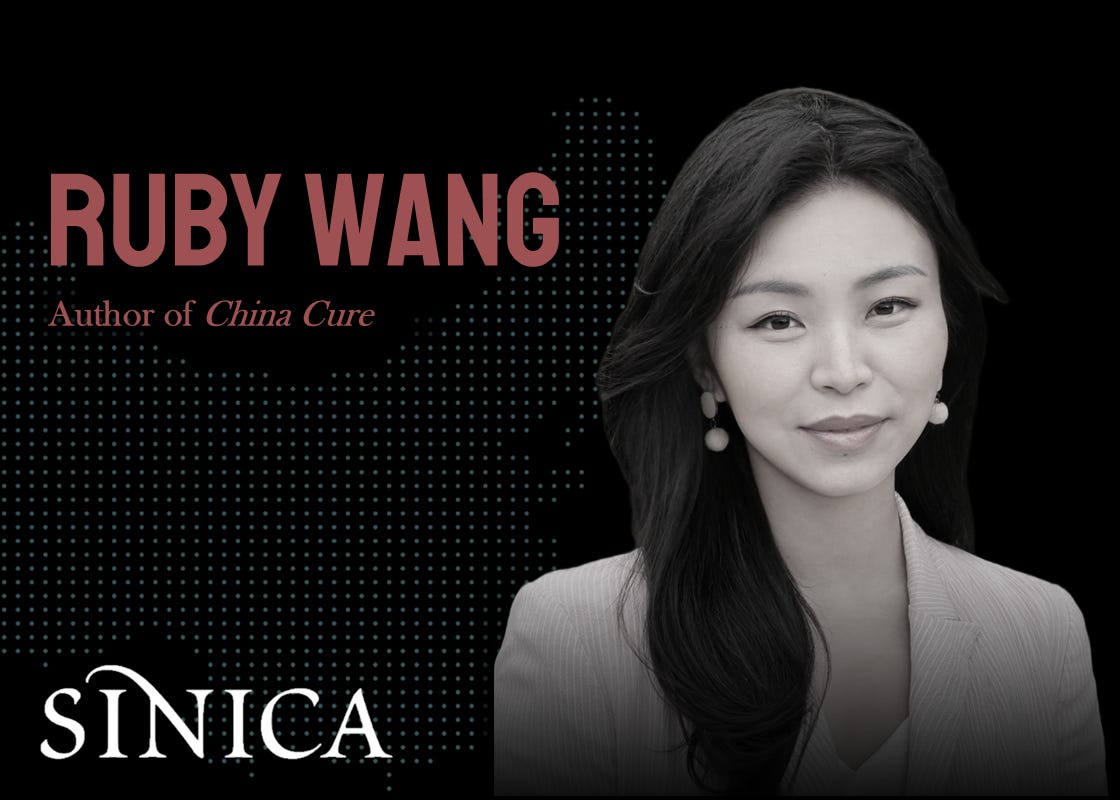
This week on Sinica, I sit down with Dr. Ruby Wang, whose new book, China Cure: The Rise of a Biotech, AI Medicine and Global Health Superpower (Agenda Publishing, out October 31, with a foreword by Kerry Brown), is the explanation general readers have been missing for one of the most consequential and least understood transformations in China today. Ruby is a rare creature in this space: a practicing physician in Britain’s NHS, trained in surgery, who worked London’s hospital wards through the first wave of COVID; the former head of the UK government’s health engagement in China at the British Embassy in Beijing; a former health adviser within the UN system; a onetime medical adviser at AliHealth in Hangzhou; and a Schwarzman Scholar. She now runs the strategy consultancy Lintris Health and writes the excellent China Health Pulse newsletter and podcast, both of which I recommend to anyone trying to follow this space.
Anyone who spent time in a Chinese hospital in the late ‘80s or ‘90s — the pre-dawn queues, the ticket scalpers, the cashier’s window at every step, the IV drips for a head cold — will find the arc of this book hard to believe. Within living memory, China sent barefoot doctors into the countryside with herbal remedies and antibiotics in army-green satchels; last year, Chinese companies signed something like 186 out-licensing deals worth a disclosed $137 billion, roughly half the global total and close to ten times the 2021 figure, with Pfizer, Bristol-Myers Squibb, AstraZeneca, GSK, and Eli Lilly all buying. Since Ruby gave a terrific interview to my friend Kyle Chan on his High Capacity podcast this spring on the apps, data flows, and clinical AI, I deliberately steered elsewhere: to her family — a deckhand grandfather, a father’s crooked splint, a grandmother’s transnational hunt for Gleevec — to the four reinforcing conditions she argues made the transformation possible, to the “China is fast because China is loose” shortcut and what’s actually behind the speed, to BIOSECURE and its successors, to the AI doctor avatars now fielding millions of inquiries a year, and to the burnout and violence that still bedevil the lives of Chinese clinicians.
10:31 – Two family stories from 1970s Zhejiang: a deckhand grandfather and a barefoot doctor’s crooked splint
15:57 – Four reinforcing conditions, part one: demographic pressure and crisis as catalyst (SARS, melamine, fake vaccines)
23:42 – The long view: Healthy China 2030 and why China’s health ministers are technocrats
27:54 – The cultural inheritance: who signs the consent form, and China’s health codes vs. Britain’s billion-pound app
35:26 – Grandma and Gleevec: a family’s transnational hunt for a drug in 2003
40:17 – The reversal: hǎiguī, copycats to first-in-class, and the tenfold surge in out-licensing
42:35 – Is China fast because China is loose? Where China leads (oncology, GLP-1s) and where it lags
50:22 – BIOSECURE, COINS, and BINSA: who loses when politics meets pharma
55:37 – Digital health in three systems, Ant Afu’s AI doctor avatars, and whether the silver generation can keep up
1:08:44 – “A lifetime of eating bitterness”: Dr. Wang of Guangzhou, burnout, and yī nào
Paying It Forward
Yanzhong Huang, senior fellow for global health at the Council on Foreign Relations and professor at Seton Hall — the go-to voice on the geopolitics of China and health, and Ruby’s first port of call.
Afra Wang, writer of the Concurrent newsletter — Ruby admires how she reads the cultural currents beneath technology, and finds it endlessly useful to take those insights to the health-tech angle.
Olivia Plotnick, Shanghai-based founder of Wai Social — on-the-ground work on branding and consumer behavior across some 30 lower-tier Chinese cities, including health and wellness.
Recommendations
Ruby: Deep China: The Moral Life of the Person, edited by Arthur Kleinman with Yunxiang Yan, Jing Jun, Sing Lee, and others — what being sick reveals about society and culture in China: psychiatry, caregiving, and how patients and families have changed as the country has. Kleinman’s The Soul of Care is also worth your time.
Kaiser: Augustus by John Williams — the third of his novels I’ve recommended on the show, and the National Book Award winner: an epistolary novel of imperial Rome told through a crazy quilt of letters and fragments from family, friends like Agrippa, and poets like Virgil and Horace, each given a completely distinct voice. Quiet campus novel, anti-Western, imperial Rome — the range, and the restraint, are astonishing.
Also: Ezra Klein’s conversation with Carnegie’s Matt Sheehan — a masterclass in clarity on AI safety and the U.S.-China relationship, and the best thing to listen to in the wake of Dario Amodei’s “Pacing the Frontier” essay.


