


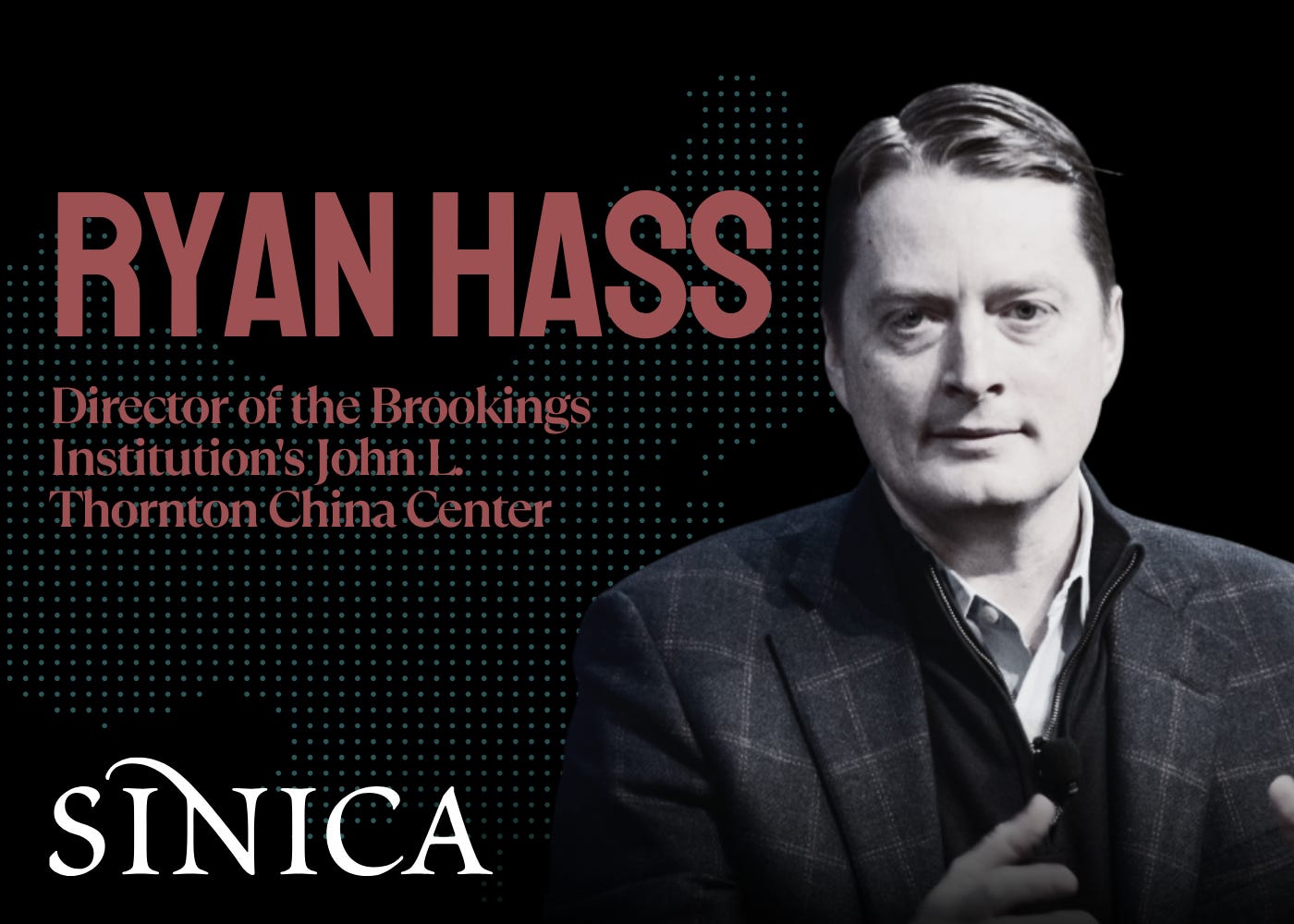
This week on Sinica, I’m joined once again by Ryan Hass, Director of the John L. Thornton China Center at Brookings, former NSC director for China, Taiwan, and Mongolia, and co-host of the Beijing Brief podcast. Ryan has just published two pieces that couldn’t be better timed: a long essay in China Leadership Monitor, “China’s Great Power Vision Comes into Focus,” which argues that the 2020s may be remembered as the decade Beijing finally laid its cards on the table — and a shorter Brookings piece, “Why Beijing Isn’t Taking the Bait with Trump,” on why Xi Jinping has answered an unusually accommodating American president with a poker face, and what that means for Xi’s state visit to Washington later this month.
We start with the perennial question — what does China want? — and Ryan’s own two-decade journey with it, from chasing a supposed secret strategy in Zhongnanhai as a junior political officer to concluding that Beijing’s vision is now legible and consistent: an international political order stripped of its liberal core and rebuilt around sovereign equality and the “global majority.” We talk about “American decline” and “strategic stalemate” in Chinese discourse, the tension between China’s pitch to the developing world and its export juggernaut, the Middle East and Northeast Asia as test cases, and the central riddle of Ryan’s essay: why a country so willing to articulate its ambitions has been so unwilling to pay for them. Then we turn to the summit — constructive strategic stability, escalation dominance, and what will and won’t be on the table when Xi comes to Washington.
03:11 – The “What does China want?” genre — and why Ryan concluded there is no secret plan locked in a Zhongnanhai vault
06:10 – From participant to architect: what actually changed, and whether Beijing is revisionist or, as I cheekily put it, restorationist
09:12 – “American decline” (美国衰落) and “strategic stalemate” (战略相持): reading Beijing’s rhetorical restraint and the Maoist echo
14:34 – Champion of the global majority, or the world’s factory? The $6 toaster problem and the credibility gap on Ukraine and Japan
19:36 – The Middle East as a test case: economic enabler, not security patron — and the good-faith maximalist rebuttal
24:38 – Northeast Asia: why Beijing keeps generating the very encirclement it fears
26:59 – Rhetoric without resources: flat foreign aid, shrinking BRI lending, and the SCO as China’s proving ground
32:28 – The Pew swing that hasn’t materialized, and why Biden may have been America’s last restorationist president
36:01 – Why Beijing isn’t taking the bait: Xi’s poker face, “constructive strategic stability,” and the G2 refusal
41:55 – Confident abroad, anxious at home: the purges, the memory of 2020, economic escalation dominance, and a viewer’s guide to the September summit
Paying It Forward
Ryan flags two women doing important work in China studies, both with books out this fall: Emily Matson of Georgetown, whose China’s Date Debate: How Manchurian Scholars Rewrote World War II examines how the start date of China’s war with Japan was moved from 1937 back to 1931; and Shuxian Luo of the University of Hawaiʻi at Mānoa, whose Simmering Seas: Escalation and De-escalation in China’s Maritime Disputes is forthcoming from Oxford University Press in October. He also gives a shout-out to the engines of the Brookings China Center, research assistants Allie Matthias and Joyce Yang.
Recommendations
Ryan: Barbara Tuchman’s The Guns of August, which he’s late to but found poignant for its eerie echoes of today’s battlefields — and Maggie Haberman and Jonathan Swan’s Regime Change, an inside account of the second Trump administration that he calls harrowing but essential for anyone trying to anticipate the president’s behavior. (He also finally read The Three-Body Problem, and now knows his sophons from his Trisolarans.)
Kaiser: Robert Harris’s Agrippa, published September 1 — the memoir of Marcus Agrippa, the general who won Octavian’s battles and built half of Augustan Rome, and a story about the pivot from republic to empire that feels uncomfortably relevant. And if you’ve read Tuchman, do read Christopher Clark’s The Sleepwalkers: How Europe Went to War in 1914. Not my official recommendation, but astonishing.


