



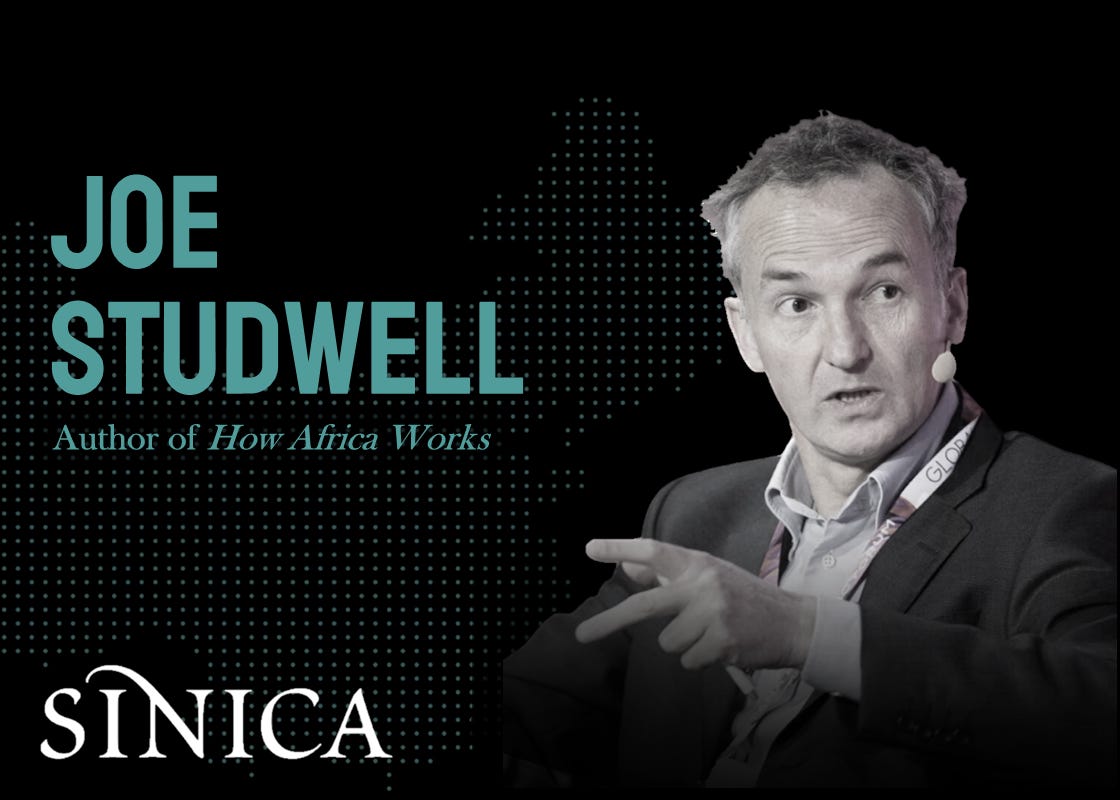
This week on Sinica, I speak with Joe Studwell, whose 2013 book How Asia Works gave a generation of readers a usable account of how East Asia got rich. His new book, How Africa Works: Success and Failure on the World’s Last Developmental Frontier, is one of the most educational things I’ve read in years. We talk about why low population density, more than corruption or ethnic conflict, held the continent back; about Ethiopia, which under Meles Zenawi studied Taiwan and South Korea harder than anyone; about what is and isn’t distinctively Chinese in China’s own development; and about what Chinese firms and lenders are actually after in Africa.
08:02 – From Asia to Africa
11:44 – The population density constraint
20:32 – Disease, elephants, and absent land reform
28:12 – The education catch-up
37:10 – Meles Zenawi’s developmental state
49:17 – Ethiopia’s missteps: METEC, federalism, war
01:05:08 – China on the ground in Ethiopia
01:14:12 – Is China sui generis?
01:17:26 – Which African states come closest
01:22:12 – What Chinese firms want in Africa
01:27:29 – America’s retreat, China’s opening
Paying It Forward: Joe names Kurtis Lockhart, founder and director of the Africa Urban Lab at the African School of Economics in Zanzibar, for his work on urbanization; and Eric Pohlman, co-founder and CEO of One Acre Fund, which supports smallholder farmers across Africa.
Recommendations:
Joe: Anthony Burgess’s 1980 novel Earthly Powers.
Kaiser: Made in Ethiopia (2024), the documentary by Xinyan Yu and Max Duncan, and the directors’ interview with Eric Olander and Cobus van Staden on the China in Africa Podcast; and a visit to Mexico City.
Also mentioned:
Maria Repnikova, Competing for Soft Power: China’s Image-Making in Africa (Cambridge University Press, 2026), the subject of an upcoming episode
Feyi Fawehinmi’s conversation with Joe at the Africa in the World festival, and his read-along of the book at 1914 Reader
Wale Lawal, founder of The Republic


